
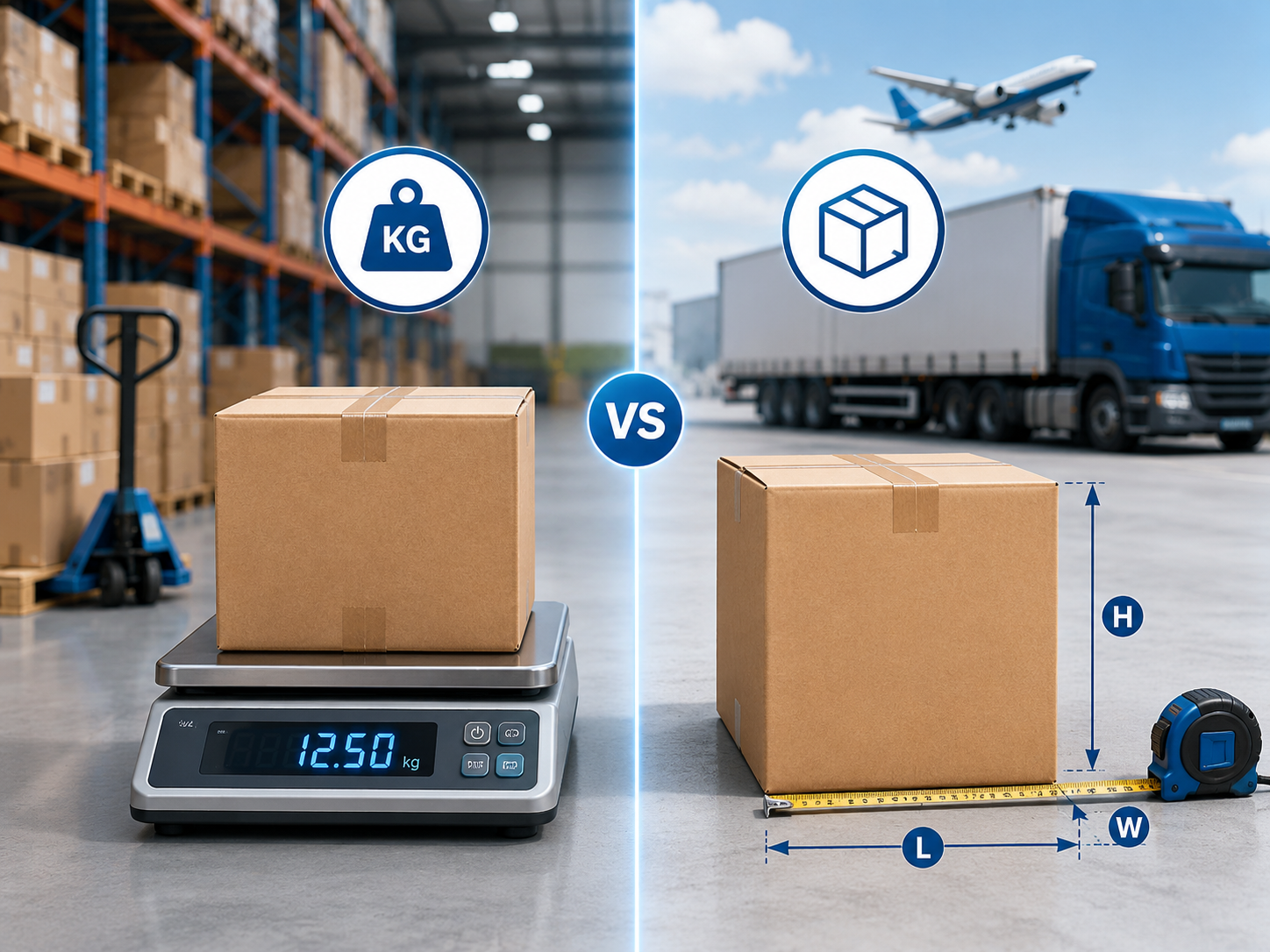
A lightweight package can sometimes cost more to ship than a heavier package. Carriers consider both actual weight and package size. Knowing the difference between actual weight and dimensional weight can help you estimate shipping costs more accurately.
What Is Dimensional Weight?
Dimensional weight, also called volumetric weight, is calculated from a package’s length, width, and height. It reflects the space a shipment takes up rather than how much it weighs on a scale.
- Dimensional Weight = (Length × Width × Height) ÷ DIM Divisor
The divisor depends on your units and carrier. For domestic U.S. parcels measured in inches and pounds, UPS and FedEx use 139, and USPS uses 166. For international air freight measured in centimeters and kilograms, the IATA standard divisor is 6000 (some couriers use 5000). Always confirm the divisor for your specific carrier, service, and route before calculating.
What Is Actual Weight?
Actual Weight (also called Gross Weight) is the true weight of the goods including their packaging, measured directly on a scale, expressed in pounds (lb) for domestic U.S. shipping or kilograms (kg) internationally.
This is simply what the package weighs when you put it on the scale. It doesn’t account for how much space the package occupies. That’s what dimensional weight captures, and the two are compared to decide your final charge (covered next).
What is Chargeable Weight
Chargeable Weight is the weight a carrier actually uses to calculate your freight charges. The rule is simple: it’s the greater of the Actual Weight and the Dimensional Weight.
This exists because transport vehicles are limited by both weight and space. If charges were based on actual weight alone, lightweight cargo that fills up a truck or aircraft would generate too little revenue, leaving the carrier at a loss. By always taking the larger of the two figures, chargeable weight ensures every shipment is priced fairly, whether it’s heavy on the scale or simply space-consuming.
The calculation follows three steps: first, weigh the shipment for its actual weight; next, calculate the dimensional weight from its size; finally, compare the two and take whichever is greater. That’s your chargeable weight. Air carriers run the same calculation, and this guide covers calculating chargeable weight for air freight step by step.
For example: a box of throw pillows with an actual weight of 11 lb but a dimensional weight of 26 lb has a chargeable weight of 26 lb (low-density cargo is billed by volume); a box of screws with an actual weight of 66 lb but a dimensional weight of 18 lb has a chargeable weight of 66 lb (dense cargo is billed by actual weight).
In short, Chargeable Weight = max (Actual Weight, Dimensional Weight), and that’s the number that truly drives your freight bill.
Actual vs. Dimensional vs. Chargeable Weight: 5 Real-World Examples
The five examples below offer a clear side-by-side comparison of how actual weight, dimensional weight, and final chargeable weight relate to one another. Dimensional weight is calculated with the U.S. domestic formula throughout: Length × Width × Height (in) ÷ 139 (the UPS and FedEx divisor).
|
Package Type |
Dimensions (in) |
Actual Weight |
Dimensional Weight |
Chargeable Weight |
Billed By |
|---|---|---|---|---|---|
|
Screws / Hardware |
12×8×6 |
66 lb |
4 lb |
66 lb |
Actual weight (classic dense cargo) |
|
Throw Pillows / Soft Goods |
24×20×16 |
11 lb |
56 lb |
56 lb |
Dimensional weight (classic low-density cargo) |
|
Books |
16×12×10 |
26 lb |
14 lb |
26 lb |
Actual weight (on the heavier side) |
|
Standard Box (balanced density) |
16×16×16 |
24 lb |
30 lb |
30 lb |
Dimensional weight (nearly balanced) |
|
Plastic / Foam Goods |
32×24×20 |
18 lb |
111 lb |
111 lb |
Dimensional weight (extreme low-density cargo) |
How Can You Avoid Unnecessary Chargeable Weight?
Now that you understand the rule (chargeable weight is the greater of the actual weight and the dimensional weight), the real key to saving money lies in proactively managing your shipment’s volume. In other words, whenever the dimensional weight exceeds the actual weight, that extra cost can often be trimmed by optimizing how you pack and ship. Here are a few practical approaches.
- Right-size your packaging. This is the most direct lever. Use boxes sized to your product and cut out the empty space. Since volume is length × width × height, shaving even a few centimeters off each side can noticeably lower the dimensional weight.
- Reduce filler and void fill. Without compromising protection, swap bulky foam blocks for thinner, form-fitting materials like bubble wrap or air pillows, keeping goods safe without inflating the box.
- Consolidate and stack smartly. When shipping multiple items together, tuck smaller pieces into the gaps around larger ones and pack as a single unit to shrink total volume. Mixing dense and lightweight goods also helps balance the density of the whole shipment.
- Choose the right shipping mode. Low-density cargo is usually cheaper by ocean freight (billed by cubic volume) than by air, while dense cargo shipped by air is billed by actual weight with no penalty. Match your shipping channel to your cargo’s density.
- Design products with shipping in mind. Reduce volume at the source through vacuum compression, flat-pack designs, or knock-down (disassemblable) structures.
- Confirm the carrier’s billing rules upfront. Different couriers and forwarders use different divisors (÷5000 or ÷6000), and their first-weight, additional-weight, and minimum chargeable weight rules vary too. Nail down the rules first, then tailor your packaging accordingly.
Bottom line: push your density up. Fit the same weight into a smaller volume, and the dimensional weight drops, the chargeable weight falls back to the actual weight, and what you save goes straight to your margin.
Conclusion
Carriers generally compare actual weight with dimensional weight and use the higher value as the chargeable weight.
To avoid unnecessary charges, choose packaging that fits the product, load pallets carefully, and measure the final shipment before booking. For bulky, irregular, or multi-carton cargo, ask a global freight forwarder to review the details and recommend a suitable shipping option.
FAQ
Does the U.S Charge by Dimension or Weight
Both. U.S. carriers bill by whichever is greater: your package’s actual weight or its dimensional (DIM) weight. Whichever is higher, DIM weight or actual weight, is the billed weight.
How Much Does the U.S Charge for a 50 Pound Box?
There’s no flat price; it depends on the carrier, zone, and whether it’s residential. For a 50 lb box shipped coast-to-coast via ground, base rates run roughly $40 to $90. Once you add the Additional Handling Surcharge that kicks in at 50 pounds, plus residential and fuel fees, the realistic total lands in the $70 to $130+ range for most shippers (volume discounts, staying just under 50 lbs, and other ways to reduce shipping costs can cut that meaningfully).
Can the DIM Divisor Vary by Carrier or Shipping Method?
Yes. The DIM divisor can vary by carrier, shipping method, and route. Confirm the applicable formula before calculating dimensional weight.
Can Carriers Recheck Package Dimensions After Pickup?
Yes. Carriers may measure and weigh a package again after pickup. If the carrier’s measurements differ from the submitted details, the shipping charge may be adjusted.
How Are Irregularly Shaped Packages Measured?
Measure the outermost length, width, and height of the package. Include handles, bulges, and any parts that extend outward.
Do Carriers Round Up Package Dimensions?
Sometimes. Rounding rules vary by carrier and service. Check the carrier’s rules before booking.
Is Dimensional Weight Calculated Per Package or Per Shipment?
Dimensional weight is usually calculated for each package. For multi-package or pallet shipments, the method can vary by service. Confirm the carrier’s rules before requesting a quote.
Both. U.S. carriers bill by whichever is greater: your package’s actual weight or its dimensional (DIM) weight. Whichever is higher, DIM weight or actual weight, is the billed weight.
There’s no flat price; it depends on the carrier, zone, and whether it’s residential. For a 50 lb box shipped coast-to-coast via ground, base rates run roughly $40 to $90. Once you add the Additional Handling Surcharge that kicks in at 50 pounds, plus residential and fuel fees, the realistic total lands in the $70 to $130+ range for most shippers (volume discounts, staying just under 50 lbs, and other ways to reduce shipping costs can cut that meaningfully).
Yes. The DIM divisor can vary by carrier, shipping method, and route. Confirm the applicable formula before calculating dimensional weight.
Yes. Carriers may measure and weigh a package again after pickup. If the carrier’s measurements differ from the submitted details, the shipping charge may be adjusted.
Measure the outermost length, width, and height of the package. Include handles, bulges, and any parts that extend outward.
Sometimes. Rounding rules vary by carrier and service. Check the carrier’s rules before booking.
Dimensional weight is usually calculated for each package. For multi-package or pallet shipments, the method can vary by service. Confirm the carrier’s rules before requesting a quote.