
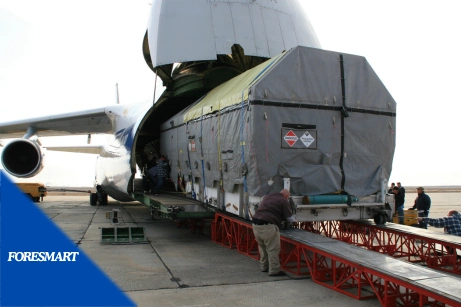
Most air freight cargo is loaded and transported by specialized cargo planes. When it comes to the biggest cargo plane in the world, the Antonov An-225 tops the list. This aircraft was built in the 1980s by the Antonov Design Bureau to transport the Soviet Buran space shuttle. At more than 84 meters long, 88.4 meters in wingspan, and a maximum takeoff weight of about 640 to 663 tons, it is the largest freight plane in the world.
Launched into the skies by six Ivchenko Progress (Lotarev) D-18T turbofan engines producing a minimum thrust of over 51,600 lbs each, the An-225 was built for power and performance. With a maximum internal carry capacity of 250 tons, it is a true monster of the air cargo world. Its legacy today as the largest freight plane has continued to captivate engineers and aviation enthusiasts all over the world.
Largest Air Cargo Capacity
What marks the An-225 as something unique is its large cargo capacity, firmly establishing it as the largest cargo aircraft in the world. Its internal cargo hold measured roughly 44.3 meters long, 6.4 meters wide, and 4.4 meters high. Such immense proportions allowed it to carry large loads, ranging from cars and trucks to components for huge wind turbines.
Other sources claim that the total volume of cargo could be as big as 1,200 cubic meters. This enormous capacity meant that the An-22 was not only an engineering marvel; it was also an essential tool for transporting critical infrastructure across continents quickly.
The An-225’s World Records
As the largest transport airplane, the An-225 set more than 240 world records during its time in service. These records feature things such as hauling the heaviest single payload at 253.82 tons and carrying an oversized item such as a 42.1-meter-long wind turbine blade. The achievements further solidify its position as both the world’s largest freight plane and the market leader for heavy air cargo capacity.
Significant record-setting events include:
August 2009: Transport of a 189.98-ton power-plant generator, a new record for commercial cargo.
June 2004: A flight from Prague to Tashkent loaded with 247 tons of pipeline equipment, demonstrating once again its huge lift potential.
The An-225 has shown that real capability in air transport is not simply a question of size; it’s the fusion of new, state-of-the-art engineering design principles and sound operational performance that achieves industry records.
Range & Performance: The World’s Largest Freight Aircraft Takes to the Skies
The An-225 had a cruising speed of around 497 mph (800 km/h) and its max speeds were up to 528 mph (850 km/h). This allowed it to quickly cover large distances. It had different operating ranges depending on the payload, about 2,500 km on its full load, up to 4,500 km on less weight.
The fact that it can fly so far, with such a payload, is a true showcase of incredible engineering. The An-225 could easily take on all commercial and humanitarian demands on every continent.
Largest Freight Plane in Humanitarian & Commercial Service
Aside from blazing across the record books, the Antonov An-225 made a tangible contribution to the real world. It was tasked several times to deliver important logistics, either in crisis or in daily commercial transportation of large cargo.
An example of this is the 2010 Haiti earthquake, for which the An-225 transported supplies to the afflicted region. In commercial roles, it has carried everything from oil and gas equipment to compressors, and even COVID-19 test kits in the midst of global shortages. It is these missions that show the unparalleled versatility of the aircraft and once again underline its credentials as the world’s largest freight plane.
Technological Innovations and Engineering Marvels
The Antonov An-225 Mriya is celebrated not only for its physical size but also for the technological innovations it brought in. Its airframe structure, navigation, and cargo-handling systems were all representative of cutting-edge technology at the time.
Innovations included a number of firsts:
The plane’s vast cargo bay could be quickly reconfigured into an entirely different form to transport virtually any kind of load.
Despite its vast size, it had to fly in even the most difficult of circumstances.
The layered features of safety assured a better record for an airplane in long-distance operations, even under deep clouds.
This kind of engineering expertise has influenced the design of newer aircraft. Today’s aerospace engineers are still studying the An-225’s systems through ground simulations, showing how important it is for pushing the limits of air transport.
Operational Challenges Faced by the Heaviest Plane Ever Built
Operating an aircraft as big as the Antonov An-225 posed difficult problems. Regular maintenance requires specialized facilities capable of handling its enormous dimensions and complex systems. Ground crews had to use custom-built equipment, and maintenance cycles were far more extensive compared to standard cargo aircraft.
In addition, the problems involved in maintaining such a megascale asset have bred a culture of excellence among technicians and engineers. Ongoing upgrades and refurbishments have kept the world’s largest freight plane in top shape, to make it fly with unmatched reliability and efficiency every time it takes off.
The Antonov An-225 Mriya’s Cultural Impact
The An-225 has far outgrown its records and its technical description; now it is a symbol of global aviation. As the largest freight plane to date, it has generated a following of aviation enthusiasts and historians, along with the general public. Museums and aviation exhibitions around the world have offered model planes and interactive exhibits dedicated to the An-225, singing extended praises not just about the aircraft, but also about the engineering expertise that went into it.
Extraordinary flights and record-setting cargo missions are often recounted on social media platforms by enthusiasts all over the world, which raises the international conversation about the future of air cargo and aerospace design. This lingering curiosity further cements Antonov’s place in history as the greatest freight plane ever made.
Other Giant Aircraft: An-124 & Boeing Dreamlifter
While the world’s largest freight plane is the An-225, other types of aircraft have also added to the history of heavy air transport. These include:
Antonov An124 Ruslan
This cargo airplane has a payload of about 150 tonnes and a cargo volume of approximately 1,028 m³. Even though its experience is not as vast as that of the An-225, it is still impressive. For instance, it once carried a fully assembled Boeing 737. Moreover, it is also widely used in military and commercial sectors.
Boeing 747-400 Large Cargo Freighter (Dreamlifter)
A conversion from the 747-400, this aircraft carries a cargo volume of 65,000 ft³ (about 1,839 m³). It is a critical part of the assembly of Boeing’s 787 Dreamliner, as the large cargo freighter is used to transport larger sections of the aircraft across continents.
Legacy of the Largest Freight Plane & Outlook for the Future
Although the Antonov An-225 was destroyed during the Russo-Ukrainian War in 2022, it is still recognized as a symbol of technological ambition. The standards it sets are now shaping the way new-generation cargo machines are designed and built.
The decision on whether or not to rebuild the An-225 has been a subject of debate within the aviation industry. Ukrainian president, Volodymyr Zelenskyy, announced that he plans to rebuild the An-225 as a tribute to the Ukrainian soldiers killed during the war. This has kicked off a debate in the aviation world. Experts say the project is a rare chance to bring back an incredibly powerful aircraft. It’s also a chance to learn countless lessons from its design. On top of that, it’s an opportunity to rebuild it with cutting-edge technology and better safety features.
Conclusion
Despite its operational problems and its destruction amidst war, the An-225’s legacy has left a permanent mark on the aviation world as the former largest freight plane.
As the talks about its potential rebuild continue, we must hold on to the hope that we might get to see this marvel back in the sky once again. Its story is a testament to how the power of innovation, perseverance, and international cooperation can turn the most fantastic engineering dreams into a reality.
Frequently Asked Questions (FAQs)
What made the Antonov An-225 the largest freight plane in the world?
The An-225 was the longest and the heaviest aircraft ever built, and it had a wingspan of around 88.4 meters with a weight of around 650 tons.
What kind of cargo would this aircraft carry?
The An-225 could hold up to 250 tons of cargo, including things like urban equipment, trucks, space equipment, and humanitarian supplies.