
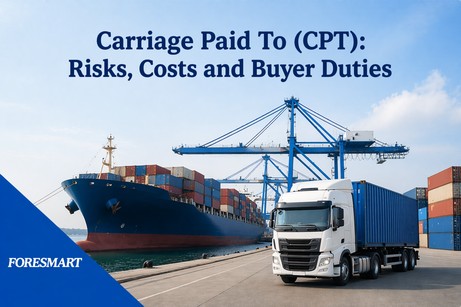
Carriage Paid To (CPT) means the seller pays freight to the named destination. Risk transfers to the buyer the moment goods are handed to the seller’s carrier, with no mandatory insurance required. According to Allianz Global Corporate & Specialty, cargo damage is the single most frequent cause of marine insurance claims. CPT gives buyers no coverage for it by default.
This guide covers when that risk transfer happens and what costs each party owns. The last section breaks down how CPT compares to FOB and CIP.
What Is Carriage Paid To (CPT)
Carriage Paid To (CPT) is a global trade rule separating freight costs from cargo risk. The seller pays to transport the goods to a named destination. However, the buyer assumes all liability the moment the first carrier takes possession.
This cost-risk split creates a direct financial trap for importers. If a crane drops the container at origin, the buyer absorbs the total loss. The importer pays the price despite never managing the freight contract.
- Freight and Export Costs: The seller pays 100% of the transport fees to the destination and clears origin export customs.
- Immediate Risk Transfer: Cargo liability shifts to the buyer at the first pickup point. Importers face full exposure long before goods reach the final terminal.
The Insurance Gap: The ICC mandates zero insurance obligations for the seller. Buyers must buy independent coverage or pay out of pocket for ruined freight.
When Does Risk Transfer in CPT
Under Carriage Paid To (CPT), physical risk transfers to the buyer the exact moment the first carrier takes possession. This handover immediately shifts all cargo liability.
- Origin Facility (0% Transit): The seller loads the goods onto the first truck. The buyer assumes 100% of the cargo risk the second loading finishes.
- Main Transit (50% Transit): The seller pays the main carrier invoice. The buyer holds full liability for vessel sinkings or cargo drops.
- Named Destination (100% Transit): The goods arrive at the agreed terminal. The seller’s contracted freight route concludes, though the buyer has carried the physical risk since day one.
Delivering to the First Carrier
Cargo liability shifts to the importer the exact second the first carrier assumes control of the freight. This initial carrier is typically a local truck arriving at the export warehouse.
The driver simply signs the pickup receipt to transfer physical risk. If the truck backs into a wall ten seconds after leaving the loading dock, the buyer pays the damage bill.
Navigating Multi-Carrier Routes
Default CPT rules assign all multi-leg transit risk to the buyer starting from the first origin vehicle. Importers assume liability long before the cargo reaches the main ocean port.
A standard international shipment fuses local trucks, rail lines, and cargo ships. The buyer absorbs physical risk across every single transfer point.
If an origin railcar derails 500 miles before the export terminal, the importer eats the total financial loss.
Decoupling Risk from Freight Payment
CPT structures a strict split between the freight invoice and physical cargo liability. The seller pays the transport bill while the buyer carries the physical transit risk.
Exporters sign the legal contract with the freight forwarder. Importers hold the risk for the goods inside the container.
This structural gap leaves buyers highly exposed. Importers must rely on a transport carrier they never selected to protect their freight.
What Are the CPT Duties and Costs for Sellers and Buyers?
CPT dictates a strict financial split between export logistics and destination liabilities. Sellers fund the outbound freight journey, while buyers absorb import taxes and physical transit risks.
CPT Cost and Duty Allocation Matrix
Clear boundaries define who pays the freight bill and who carries the physical risk. This table shows the shift in liability and expense.
|
Obligation / Cost Area |
Seller (Exporter) Duty |
Buyer (Importer) Duty |
|
Main Freight Costs |
Pays 100% of the transport fees to the named destination. |
Pays $0 for the main transit invoice. |
|
Physical Cargo Risk |
Ends the exact moment the first carrier takes possession at origin. |
Assumes 100% liability from the first pickup to the final yard. |
|
Customs Clearance |
Clears origin export customs and pays outbound port fees. |
Clears destination import customs and pays local duties. |
|
Cargo Insurance |
Holds zero legal obligation to insure the goods. |
Carries the sole burden to purchase independent coverage. |
|
Terminal Handling (THC) |
Pays origin handling fees. |
Pays destination unloading (THC) unless the contract states otherwise. |
This matrix reveals the CPT risk-cost disconnect. Sellers fund the transit. Buyers own the danger. Importers must insure their cargo to avoid unrecoverable transit claims.
The Hidden Terminal Handling Trap
Destination Terminal Handling Charges (THC) typically fall to the importer as a hidden expense. This billing gap creates immediate surprise costs. Sellers only pay the main transport invoice. Destination terminals charge separate fees to lift the container off the vessel.
Buyers must clarify unloading duties in the initial sales agreement. If the seller’s freight contract excludes unloading, the carrier bills the importer at the port. These invoices reach hundreds of dollars per container. To avoid these extra fees, many importers switch to door to door shipping.
What Are the Pros and Cons of CPT?
CPT offers speed for exporters but creates a liability gap for importers. The rule simplifies shipping logistics while leaving cargo vulnerable to uninsured damage.
Benefits and Risks for the Buyer (Importer)
Importers trade cargo safety for logistical convenience. This arrangement removes administrative burdens while creating high financial exposure.
- Reduced Overhead: Importers skip the stress of negotiating international freight contracts.
- Simplified Management: The seller handles all carrier relations. This delegation lowers the buyer’s internal staff costs.
- Liability Gaps: Physical risk shifts to the buyer at the first origin loading point.
- Zero Oversight: Importers assume 100% of the risk without controlling the carrier selection.
- Uninsured Losses: The seller has no insurance obligations. Unprotected buyers pay for transit damages out of pocket.
Benefits and Risks for the Seller (Exporter)
Exporters gain supply chain control but face financial uncertainty. Managing the freight journey protects the production schedule but exposes the budget.
- Booking Power: Sellers select the carrier and define the transit timeline.
- Operational Flow: Direct transport management prevents cargo pileups at the origin facility. Foresmart secures guaranteed vessel space. Stable booking prevents the origin bottlenecks common in unmanaged transit.
- Cost Volatility: Sudden rate spikes before booking cut into the exporter’s profit.
- Payment Liability: The seller remains responsible for the freight invoice despite transit delays.
- Fixed Revenue Risk: Sellers often struggle to pass unexpected shipping surcharges onto the buyer.
How Does CPT Compare to Other Key Incoterms?
Selecting the right Incoterms in shipping balances logistical control against physical liability. A firm grasp of these global trade rules is essential before comparing the critical shifts in cost and risk management.
Comparing CPT and CIP
Risk transfer points remain identical for both CPT and CIP. Liability shifts to the buyer the moment the first carrier takes the goods. Insurance requirements serve as the only major differentiator.
|
Feature |
CPT (Carriage Paid To) |
CIP (Carriage and Insurance Paid) |
|
Risk Transfer Point |
First carrier at origin. |
First carrier at origin. |
|
Insurance Obligation |
Buyer carries the sole burden. |
Seller must buy coverage for the buyer. |
|
Financial Protection |
Zero mandatory protection. |
Guaranteed via mandatory seller policy. |
Switching from FOB to CPT
Moving to CPT grants the exporter total logistics authority. Standard FOB Incoterms end the seller’s responsibility once the goods are on board the vessel. CPT extends this management reach to the final destination.
|
Control Area |
FOB (Free On Board) |
CPT (Carriage Paid To) |
|
Management Reach |
Ends on board the vessel. |
Extends to the final destination. |
|
Carrier Selection |
Buyer nominates the shipping agent. |
Seller selects the transport carrier. |
|
Operational Flow |
High risk of origin vessel delays. |
Prevents cargo pileups via direct booking. |
Conclusion
CPT operates as an efficiency tool rather than a safety net for cargo protection. This rule requires both parties to recognize the sharp divide between freight payment and physical liability.
Sellers gain control over the transport timeline and carrier selection. Buyers receive administrative relief but assume financial exposure at the first origin pickup. Successful CPT transactions require a detailed sales agreement to address insurance gaps and terminal handling fees.
At Foresmart, we provide the strategic oversight required for CPT management. Foresmart services link freight payment and physical risk. Direct coordination ensures a controlled logistics outcome. Professional traders use CPT to centralize supply chain management through a single point of control.
Frequently Asked Questions (FAQs)
Does CPT Include Unloading Charges at the Final Destination?
No, CPT typically excludes unloading charges at the final destination terminal. The buyer pays these fees directly to the terminal operator or carrier. Sellers only fund the main freight journey to the named arrival point. Clarifying unloading duties in the sales agreement prevents unexpected terminal invoices.
Who Is Responsible for Import Customs Clearance and Duties Under CPT?
The buyer holds sole responsibility for import customs clearance and all destination taxes. Importers must manage local entry paperwork and pay necessary duties. The seller only executes the export clearance formalities at the origin. Effective import management depends on the purchasing party navigating local regulations.
Is CPT a Suitable Incoterm for Letter of Credit (L/C) Transactions?
Yes, CPT is a highly suitable Incoterm for Letter of Credit transactions. Carriers issue a bill of lading or transport receipt immediately after origin pickup. This shipping documentation proves the seller dispatched the cargo according to the credit terms. Secure fund releases depend on these verified transport documents.
No, CPT typically excludes unloading charges at the final destination terminal. The buyer pays these fees directly to the terminal operator or carrier. Sellers only fund the main freight journey to the named arrival point. Clarifying unloading duties in the sales agreement prevents unexpected terminal invoices.
The buyer holds sole responsibility for import customs clearance and all destination taxes. Importers must manage local entry paperwork and pay necessary duties. The seller only executes the export clearance formalities at the origin. Effective import management depends on the purchasing party navigating local regulations.
Yes, CPT is a highly suitable Incoterm for Letter of Credit transactions. Carriers issue a bill of lading or transport receipt immediately after origin pickup. This shipping documentation proves the seller dispatched the cargo according to the credit terms. Secure fund releases depend on these verified transport documents.