
Incoterms provide clear guidelines and frameworks for buyers and sellers alike, serving as a crucial component of global trading. Among these terms, FAS Incoterms (Free Alongside Ship) holds particular significance in ocean freight.
This article is a comprehensive guide explaining FAS terms, their role in deciding the responsibilities of buyers and sellers, and the circumstances under which they apply. We’ll also compare FAS shipping terms with other Incoterms like FOB (Free on Board) and FCA (Free Carrier), providing a detailed FAQ section for common queries.
What Does FAS (Free Alongside Ship) Stand For?
FAS stands for “Free Alongside Ship,” which specifies the sellers’ and buyers’ obligations in international trade. It is one of the 11 Incoterms (International Commercial Terms) given by the International Chamber of Commerce (ICC).
As per FAS shipping terms, the seller takes responsibility for goods until they are delivered to the port of shipment and placed alongside the ship. The buyer already specifies the port of shipment, and upon reaching there, the obligation will shift to the buyer. These obligations comprise all the costs, legal procedures, and risk factors associated with the shipping process.
FAS Incoterms Obligations
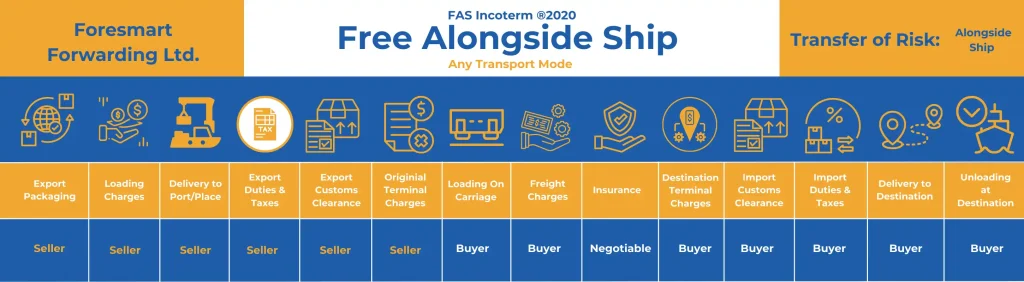
FAS Incoterms breaks down the cost structure and obligations of the buyer and seller at various stages of shipment. This helps reduce misunderstandings and disputes in international transactions.
Obligations of FAS Sellers
Under FAS Incoterms, the seller has several key responsibilities:
- Packaging and Documentation: The seller must properly pack the goods and prepare the clearance documents, such as the commercial invoice and export documentation, as proof.
- Picking-Up: It is mandatory for the seller to deliver the consignment from the factory to the port of shipment, which the buyer already specifies.
- Export Clearance: It is the seller’s responsibility to complete any legal procedures for exporting goods, including obtaining any necessary export licenses and filling in the export declaration form.
- Original Terminal Charges: Terminal fees that occur when the goods arrive at the origin port are taken by the seller.
The seller is responsible for all expenses or dangers encountered during the picking-up process. This obligation ends when the goods reach the port of shipment and are placed alongside the ship.
Obligations of FAS Buyers
The buyer also has significant responsibilities under FAS terms:
- Main Carriage: It is obligatory for the buyer to arrange and bear all shipment expenses, including loading goods on the carriage after the cargo is placed alongside the ship.
- Import Clearance: The buyer needs to handle the import clearance of goods and pay for duties and taxes.
- Insurance: While not obligatory, the buyer typically arranges for shipping insurance after the cargo reaches the port of shipment.
- Delivery: After reaching the destination port, FAS buyers should arrange for local delivery and bear all the expenses associated with the consignment.
This division of responsibilities allows buyers to control the logistics and costs of the main carriage and import process.
When to Use FAS Incoterms?
FAS Incoterms are most suitable for bulk cargo, non-containerized freight, and goods that are shipped directly from the port. This term is particularly useful when the buyer has better access to shipping contracts or can arrange for ocean freight more economically than the seller.
What to Consider If You Use FAS Shipping Terms?
When using FAS delivery terms, consider the following:
- Port Capabilities – Ensure that the designated port of shipment can accommodate and fulfill all the operational demands for loading your cargo alongside the ship.
- Insurance and Risk – Remember you will bear the risk as soon as cargo is placed alongside the ship. It is crucial for both parties to explore and discuss insurance options as insurance adds an extra layer of protection to avoid any damage or loss during shipment.
- Shipping Agents – Considering all freight charges are covered by the buyer, which is you, working with the right shipping agent means a lot to your business. A reliable shipping agent can help to transport the goods to your specified location safe and sound.
- Logistical Coordination – Effective communication and coordination between the seller and the buyer are necessary to ensure timely delivery and smooth loading operations at the designated port.
FAQs about FAS Incoterms
What Is the Difference Between FOB and FAS?
While FOB (Free On Board) and FAS (Free Alongside Ship) terms involve the seller’s responsibility for delivering goods to a specific point at the port, the key distinction lies in the risk transfer.
Under FOB terms, the risk falls to the buyer as soon as the consignment is loaded on the ship, whereas under FAS terms, the risk transfers after the goods are placed alongside the ship at the shipment port.
What Is the Difference Between FAS and FCA?
FAS (Free Alongside Ship) means the seller is responsible for getting the goods to the port and placing them next to the ship. Once the goods are there, the buyer takes on all responsibility and risk for the shipment.
In FCA (Free Carrier), the seller is responsible for delivering the goods to a specified location, like a terminal or warehouse. Once the goods are handed over to the carrier at this location, the buyer takes on all the responsibility and risk.
Who Pays the Freight on FAS Incoterms?
Under FAS Incoterms, the seller must make arrangements and payments to transport goods to the origin port of shipment. However, the buyer bears the entire expense and risk factors that may be encountered on the next journey, i.e., from the origin port to the final destination.
Wrap Up!
Understanding the obligations of both sellers and buyers under FAS or Free Alongside Ships terms makes for successful trade operations and risk management.
By delineating responsibilities and clarifying the point of risk transfer, FAS Incoterms contribute to the efficiency and transparency of global commerce. With careful consideration of logistical factors and effective communication between involved parties, you can leverage FAS shipping terms to facilitate transactions and mitigate potential risks in the international supply chain.