
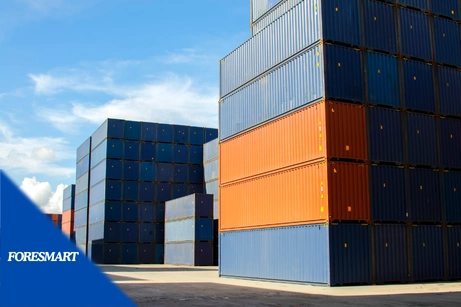
Containerization has significantly increased international trade. Before shipping containers, items were transported in irregular containers that wasted a lot of space and made stacking challenging. By addressing these issues, standard shipping containers transformed freight systems.
International intermodal containers are called ISO containers. These are made according to the standards of the International Organization for Standardization (ISO). The ISO container is suitable for trucks, ships, and rail, and their capacity is measured in twenty-foot equivalent units (TEUs).
Twenty million freight ISO containers move 80% of the world’s trade through road, rail, and air. This blog explains every detail related to the ISO container, its standards, and its types.
About an ISO Container
According to international standards, ISO-certified containers are trade-compliant. The ISO container has certain specifications set by the International Standardization Organization. These standardized intermodal containers are made from steel, which meets the intermodal cargo transport durability requirements through ships, trucks, and railways.
These ISO-certified containers can withstand extreme conditions as they have high structural integrity. Transporters can stack these containers safely on ships, trains, and container yards. Uniform stacking of these containers saves space which helps in cutting down the shipping cost.
ISO Container Dimensions
ISO-certified containers come in certain standard dimensions. A slight variation may be acceptable but they have to remain within the limit set by ISO shipping container standards. The standards set by ISO are followed worldwide, and this smooths the international shipping process.
There are several types of ISO containers; the 20-foot and 40-foot standard height containers and the 40-foot and 45-foot high-cube containers. For example, a 20-foot standard container is 19 ft 10 ½ in length, 8 ft in width, and 8 ft 6 in height. Moreover, standardized door apertures and minimal internal dimensions provide uniformity against containers.
Related Reading: More About Container Dimensions
Benefits of the ISO Containers
ISO-certified containers offer many benefits to everyone involved in the whole shipping process. Here are some of the important benefits of the ISO container listed below.
Durable
The ISO container is made from the same steel that is used to build bridges and buildings and is best suited to survive harsh environments. The outer surface of these containers must be waterproof, uneven, and wind-resistant, so the goods remain safe. Their strong build makes it easier to stack those on top of each other and saves space. These containers can be used in a variety of climates without compromising the quality of goods inside.
Inexpensive
ISO-certified containers aid in reducing the high cost of international transportation as they offer a standardized shipping method. More amount of cargo can be moved safely and efficiently as trucks, ships, and trains can carry more intermodal freight containers of the same size in one go.
Versatile
The design of the ISO container makes it easy to carry nearly every type of goods, for instance, liquids and refrigerated products can also be shipped in these containers without any damage. These containers can be used for different purposes apart from just shipping goods. You may notice some of these containers turn into:
-
Food trucks
-
Medical clinics
-
Temporary housing
-
Tiny shops
-
Schools
-
Mobile washrooms
-
Mobile ATMs
ISO Container Types and Sizes
ISO-certified containers have relatively consistent material and dimensions and these can be great for a vast range of applications. Nowadays the ISO container is used for various purposes. We have listed below the different types of ISO containers available in the market:
Dry Storage Containers
These are the most common types of containers employed in international shipping. These ISO containers are used for dry items and those that don’t require storing at a certain temperature. Examples of these items could be clothes, boxes, and bedding. The dry storage ISO container is waterproof and usually 20 to 40 feet tall. They aren’t suitable for shipping liquid items.
Dry storage containers have some other creative applications too, for instance, these can be used as mobile clinics, washrooms, warehouses, and more.
Refrigerated Containers
Refrigerated containers are also known as “refers” and are suitable for shipping goods that require temperatures between -65 °C and 40 °C. These containers are usually 20 to 40 feet long. Reefers are suitable for goods and food items that cannot be stored at warm temperatures. Using high-quality reefers is suitable for all including the manufacturer, transporter, and consumer as some essential goods need to be transported safely at a certain temperature including medicines and life-saving drugs.
-
Refers are widely used in the following industries:
-
Food and beverages
-
Supermarkets
-
Florists and nurseries
-
Military
-
Pharmaceutical
-
Chemical
-
Disaster relief
-
Cosmetics
Top-Loading/Open-Top Containers
The top-loading ISO container is best for dry storage but comes without a roof. The container has no top or a removable canvas top is attached to it which makes it easy to load and unload heavy cargo. Once the cargo is loaded, it can be covered to protect it from rain and dust.
Flat Rack Containers
The flat rack ISO container has two sidewalls and an open top. These also come with walls that can be attached or detached as per the requirements. They can be used for loading and unloading cargo from the top and sides. These containers are the best solution for businesses that need to ship irregular and bulky types of machinery.
Open Side Containers
Open side containers are equipped with doors that open along the side of the container, rather than just at the end. This feature allows more room for the loading and unloading of goods. The dimensions and sizes of these containers are the same as dry storage containers.
Ventilated containers
The ventilated ISO container is used to transport goods that require air to pass through them. For instance, coffee and cocoa beans require enough air supply to remain fresh.
Tank Containers
The ISO tank container is used for the transportation of liquids, usually toxic, highly inflammable, and corrosive liquids. These liquids include chemicals, beer, oil, wine, milk, or mineral water. Tank containers are different from dry storage containers as they contain a polyethylene tank, which allows liquid transportation safely. To save these containers from rust, they have an anti-corrosive coating on their walls.
Tunnels Containers
Tunnel containers have openings on both sides, which makes them look like a tunnel, hence the name. They can best accommodate long and heavy goods that can’t be turned around or bent. The two openings of tunnel containers make it easy, as one can be used as an entrance and the other one can be used as an exit for goods.
Customized Containers
These ISO-certified containers are manufactured for special purposes. The customized ISO container is expensive for shipping as they have different sizes than normal ones. They are usually used in the transportation of special goods. For instance, military weapons.
Half-Height ISO Containers
Due to the lower center of gravity, these types of containers are made for accommodating heavy cargo as compared to tall containers. Half-height ISO containers are suitable for dense goods such as stone and coal.
Shipping Container Standards
ISO guidelines provide international standards for various industries, covering aspects like product design, manufacturing, environmental management, and logistics. In the context of containers, ISO container guidelines like ISO 6346 regulate the identification, marking, and tracking of intermodal containers. ISO 9897 is an international standard for electronic communication in freight container management. It is also referred to as CEDEX (Container Equipment Data Exchange).
Except for the ISO guidelines like ISO 6364 or ISO 9897, other standards like CSC regulate freight containers. The safety and structural soundness of a container is certified by the International Convention for Safe Containers (CSC). Each container has a five-year CSC plate, and it must be inspected by a certified inspector every 30 months to make sure it continues to fulfill the required standards.
Conclusion
The ISO container continues to be a sturdy, modular construction. These are inexpensive, durable, easy to stack, and versatile. ISO containers are a safe means for the transportation of your goods, and it is not surprising that they also serve other beneficial purposes.
Frequently Asked Questions (FAQs)
What is the ISO container?
The ISO freight container is the international intermodal container that meets certain shipping container standards developed by the International Organization for Standardization (ISO). Usually, these containers are used for the safe and sound shipping of goods.
What are intermodal containers?
Intermodal containers are large, standardized containers. They are used for transporting goods across different modes of transportation without the need to unload and reload the contents. The ISO container is just the intermodal container. Actually, the ISO container standard (ISO 668) is the basis for intermodal containerization.
Are ISO containers waterproof?
Yes! ISO containers are waterproof and wind-resistant. These intermodal containers can withstand harsh climates and transport nearly every type of goods safely.