
Lithium batteries are ubiquitous in our daily lives. Many devices choose them as the preferred power source. However, lithium batteries are classified as hazardous materials. So can you ship batteries internationally?
The answer is affirmative, but shipping lithium batteries requires compliance with international safety regulations and local laws. This article will introduce the types of lithium batteries and essential considerations for their safe shipment.
What are lithium batteries?
In the regulations for transporting hazardous materials, lithium batteries fall under Class 9 dangerous goods. According to the UN number (a 4-digit code assigned by the United Nations for substances and articles), there are four types of lithium batteries.

UN Number of Lithium Battery
We can see lithium batteries actually come in two main types: lithium-metal batteries and lithium-ion batteries.
For example, button batteries fall under lithium-metal batteries. Smartphone batteries belong to lithium-ion batteries, which can be recharged repeatedly. The ability to be recharged is a key distinction between lithium-ion and lithium-metal batteries.
What products involve lithium batteries?
Lithium batteries are commonly found in devices such as mobile phones, Bluetooth headphones, laptops, tablets, watches, cameras, camcorders, toys, and razors. They are also frequently used in various fields, including medical, railway infrastructure, communication, and photovoltaic energy storage.
Why are lithium batteries dangerous?
With their high power and lightweight nature, lithium batteries enable devices to operate for several hours or even days on a single charge. They possess a high level of stored electrical energy. Thus, improper packaging or storage may lead to overheating and ignition, posing risks of corrosive chemicals and electrical fires.
Once ignited when shipping lithium batteries, the flames might be challenging to extinguish, resulting in significant safety incidents.
This is why international organizations such as the International Air Transport Association (IATA) and the International Civil Aviation Organization (ICAO) classify lithium batteries as hazardous materials and establish relevant regulations on shipping lithium batteries.
Regulations on Shipping Lithium Batteries
When shipping lithium batteries, people normally refer to the Dangerous Goods Regulations published by IATA, Technical Instructions for the Safe Transport of Dangerous Goods by Air (ICAO TI), International Maritime Dangerous Goods (IMDG) Code, and the UN Recommendations.
Besides international organizations, different countries may have varying regulations for the transportation of lithium batteries, so it’s essential to be mindful of these requirements. Before transporting lithium batteries, coordinate with local suppliers and freight forwarders to make sure that all documents and packaging meet the required regulations.
In most instances, your lithium batteries may require packaging of hazardous materials during transportation. You need to provide the corresponding documents and declare them as hazardous goods during import and export.
Dangerous goods are more likely to undergo customs inspection. Non-compliance with these regulations, potentially posing a risk, can lead to fines reaching tens of thousands of dollars and future shipping restrictions.
Requirements for Shipping Lithium Batteries Internationally
Let’s take a detailed look at the packaging, labeling, and transportation documents required to ship lithium batteries.
Lithium Battery Shipping Packaging
When lithium batteries are transported by air as hazardous items, it’s important to follow these packaging guidelines.
For individual lithium batteries (not with devices):
- Pack each battery separately in fully enclosed inner packaging.
- Shield and protect lithium batteries to prevent short circuits.
- Ensure batteries don’t move within the packaging.
- Use UN-approved packaging that meets the required specifications.
For lithium batteries with other devices or placed inside equipment, additional steps are required:
- Use sturdy materials for external packaging.
- Ensure that devices are in a closed state and will not accidentally open.
- Fasten devices to prevent movement within the external packaging, minimizing the risk of damage.
If the lithium content and power of the lithium batteries you are shipping are low (refer to the table below), you may not be required to fill out a dangerous goods declaration, according to Special Provision 188 (SP188) of IMDG Code.
In such cases, you can use non-UN specification packaging. However, each packaging unit should be able to pass a 1.2-meter drop test (unless your lithium batteries are with other devices or placed inside equipment).
For further details, please refer to the DGR Packaging Instructions 965-970 Part II.
Shipping Lithium-Metal Batteries Shipping Lithium-Ion Batteries
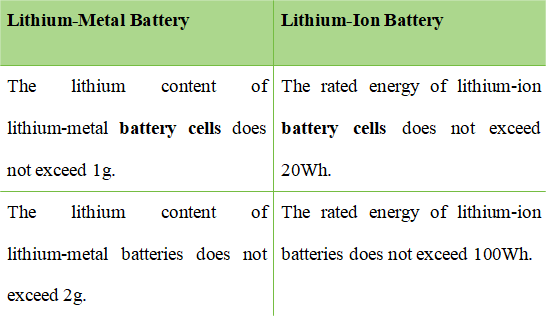
Part of SP188
Packaging requirements for shipping lithium batteries by sea are similar to those for air transportation.
Refer to the UN Recommendations P903.
Lithium Battery Shipping Labels and Marking
When transporting lithium batteries, the outer packaging needs to be accompanied by:
- UN Number
- Correct Shipping Name (e.g. “Lithium Ion Battery”)
- Full Name and Address of shipper and Consignee
- Class 9 Lithium Battery label
- Lithium Battery Handling Label
For the air transportation of fully regulated lithium batteries, the Class 9 lithium battery shipping label is necessary. Additionally, certain cases ask for the use of the Cargo Aircraft Only (CAO) label and the lithium battery handling label.
When transporting non-restricted lithium batteries, the lithium battery handling label is required. Yet, this label may not be affixed when lithium batteries are placed in equipment in no more than two packages, and each package contains no more than four cells or two batteries in the equipment. Besides, this label is also not essential when the package contains only button ion batteries (including circuit boards) installed in the equipment.

Class 9 Lithium Battery label Sample

Lithium Battery Handling Label Sample
Beginning from January 1, 2023, shippers will no longer be required to provide a phone number on the lithium battery handling label, with a transition period until December 31, 2026, during which time they may continue to use the existing label.

CAO Label Sample
All markings must be legible, in English, and able to withstand adverse weather.
Note that in air transportation, even for the same UN number, batteries with different lithium content have different lithium battery shipping labels. For example, if the lithium content in the UN3090 category cells is more than 1g, the package needs to be labeled with the Class 9 Lithium Battery label and CAO label; and when the lithium content is less than or equal to 1g, it needs to be labeled with an additional lithium battery handling label.
For more label information, refer to pages 9 to 10 of the Lithium Battery Guidelines published by IATA.
Lithium Battery Shipping Documents
To ensure the smooth transportation of dangerous goods such as lithium batteries, shippers need to provide the following documentation:
- Testing Report for Transport of Goods (by Air/Sea)
It is a document that identifies the safety of transportation of goods according to domestic and international standards on the transportation of dangerous goods.
- Material Safety Data Sheet (MSDS)
MSDS is used by chemical manufacturers and importers to describe the physical and chemical properties of a chemical (e.g., PH value, flash point, flammability, reactivity, etc.) as well as possible health hazards (e.g., carcinogenicity) to the user.
- UN38.3 Test Report (except prototype lithium batteries)
The UN38.3 testing report contains the vibration test, impact test, overcharge test, short circuit at 55℃, etc.
The Process of Shipping Lithium Batteries
As hazardous materials, the cross-border transportation of lithium batteries is more complex than that of regular items, especially in terms of export packaging and documentation requirements. Let’s take a look at how to ship lithium batteries internationally.
Order Packaging
After lithium batteries are produced, the battery supplier looks for a qualified packaging company that specializes in hazardous materials. The lithium battery supplier provides the necessary certification and transportation documents to the packaging company and places an order for the packaging.
Produce Packaging
The packaging company manufactures packaging that meets the required standards.
Customs Inspection
Once the packaging is ready, the packaging company applies to customs for inspection, submitting relevant documents such as the purchase contract and lithium battery report.
Customs responds to the application and conducts sample tests, including compression and drop tests. If the packaging passes the tests, customs issues an “Entry and Exit Cargo Packing Performance Inspection Results” certificate.
Apply for a Dangerous Goods Packaging Certificate
The packaging company gives the inspection documents to the battery manufacturer, who then submits these documents to local customs to apply for a “Dangerous Goods Packaging Certificate.”
Customs conducts a usage appraisal of the product. If everything is in order, they issue an “Identification Results of the Use of Packaging for the Transport of Dangerous Goods” certificate.
Arrange Transportation
The shipper should hire a freight forwarder to handle the transportation of lithium batteries. The freight forwarder, using the transportation documents provided by the manufacturer, books cargo space with a shipping company. They also arrange for a truck to pick up the goods from the factory and deliver them to the port.
Customs Declaration and Shipping
The freight forwarder submits the dangerous goods packaging certificate and other transportation documents to customs for clearance.
Once customs clearance is completed, the goods are transferred from the port onto a ship or plane for transportation to the destination country.
Destination Customs Clearance
The necessary customs clearance documents are submitted to local customs when arriving at the destination port. After clearing customs, the consignee picks up the goods and transports them to the final destination.
To recap, when transporting lithium batteries, first determine the battery’s UN number, package the batteries accordingly, and then apply for inspection with the customs inspection and quarantine department. Once the customs issues the Dangerous Goods Packaging Certificate, submit all corresponding transportation documents to the local customs for export declaration, and then proceed with the export transportation.
Suggestions
When shipping lithium batteries internationally, make sure that the proper packaging, labels, markings, and necessary documents are ready, meeting regulations of the countries involved.
In addition to the requirements listed above, there are many other restrictions on shipping lithium batteries:
-
Lithium batteries weighing more than 35 kilograms must be approved by the competent national authorities.
-
Defective or damaged lithium batteries cannot be transported by air.
-
Lithium batteries transported individually cannot be transported on passenger aircraft.
-
Lithium batteries must not be overcharged by more than 30%.
-
They cannot be mixed with ordinary products in a consolidated container.
-
Consider other dangerous goods transported with lithium batteries to ensure compatibility…
Look for more in the guidelines published by the U.S. Department of Transportation for various configurations of lithium batteries and battery packaging requirements.
You may find these requirements a bit of a headache, and the easiest way to fulfill them is to have your manufacturer ship the package directly to the place you specify.
If the package can’t be shipped directly from the manufacturer, you can contact a reliable freight forwarder, such as Foresmart. Let us guide you through the preparation of the package, labels, or paperwork.
Frequently Asked Questions (FAQs)
Can I print the lithium battery label on my own?
Yes, you can download the corresponding lithium battery label on the internet according to the UN number of the lithium battery, and then print it off. The image must be rectangular or square with a minimum size of 100mm × 100mm.
Can I take lithium batteries on international flights?
Lithium batteries cannot be checked in, but lithium batteries up to 100Wh are allowed to be carried on board, and those exceeding 100Wh but not exceeding 160Wh need to be approved by the airline. Lithium batteries over 160Wh are strictly prohibited.
Does it cost extra when shipping lithium batteries?
It costs more than non-dangerous goods in most cases. Lithium batteries are classified as Class 9 dangerous goods and it requires additional document fees and transportation fees.