
Warehousing and storage play a crucial role in the shipping process, and space is at a premium in a warehouse. Failure to store items in an appropriate manner may result in confusion, time wastage, and loss of capital.
An intelligent warehouse storage system assists personnel to work more quickly, minimize errors, and utilize space optimally. While the selection of an appropriate storage system is dependent on the type of goods stored, the frequency of moves, and the availability of space.
In this article, we will discuss the types of warehouse storage systems, their operation, and how to choose a suitable one.
Why Efficient Storage Matters?
An efficient storage allows a warehouse to operate well.
When items are put in the appropriate location, workers find it easy to find them. This is time-saving and cost-effective in terms of labour.
Items can not easily get lost or damaged with good warehouse storage systems. There is also improved space utilization, without businesses necessarily shifting to a larger premise.
Overall, the right warehouse storage solutions contribute to order accuracy, fewer delays, and improved supply chain efficiency. Customers will get what they order on time and in good shape.
Core Types of Warehouse Storage Systems
When it comes to warehouse storage systems, companies have different options to choose from, and each one comes with its own unique purpose. To make an effective decision, companies must decide by weighing the pros and cons of each option. The different types of warehouse systems include:
Pallet Racking Systems
Among the most popular warehouse storage systems is the pallet racking system. Under this system, goods are placed on pallets, which are elevated and positioned by forklifts. They occupy the vertical space, saving the floor space and enabling warehouses to fit more in a small area.
There are various categories of pallet racks, which are designed to store pallets in multiple vertical levels. Common pallet racks include selective racks, drive-in racks, and push-back racks. Push-back racks have rails that move pallets in a backward and forward direction.
Pallet racking systems are built to be strong and durable, capable of supporting heavy loads. They’re ideal for storing bulk products and are commonly used in equipment storage services.
Static Shelving
A simple storage system is static shelving, where the shelves are fixed. These are non-mobile shelves, and goods are handled manually. Static shelving is suitable where the items are small or light in weight, and where the products do not need to be moved frequently.
This kind of shelving is simple to fit and not demanding in terms of maintenance. Yet it occupies more space than other systems since each shelf requires its own aisle. Nevertheless, it is a cheap and stable option for numerous small warehouses or companies.
Mobile Shelving Systems
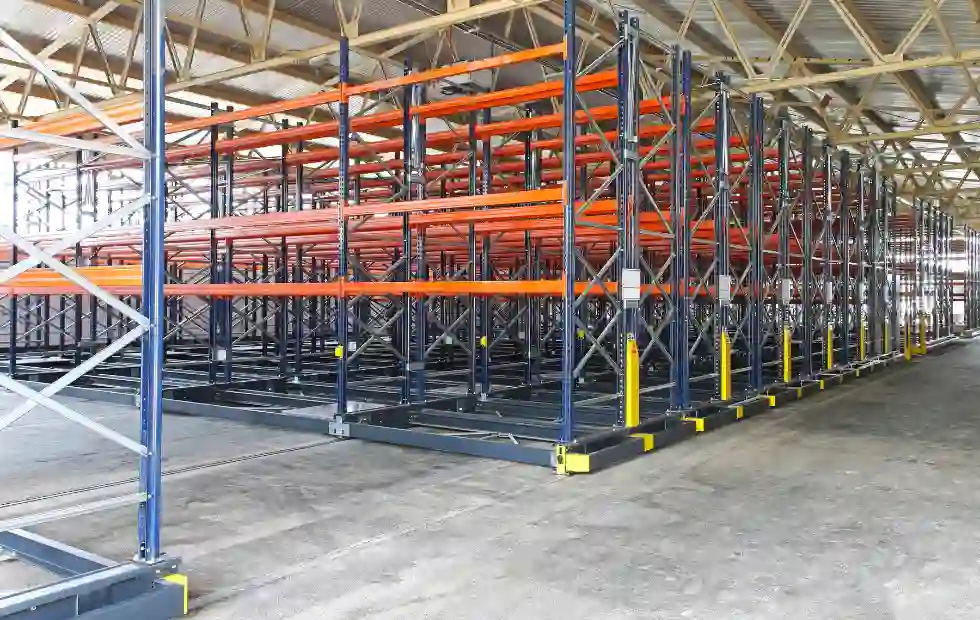
Mobile shelving systems look similar to static shelves, but unlike static shelves, they can move or slide along rails installed on the floor.
This storage for warehouse works by sliding the shelves to create an aisle only where needed. So, instead of having many fixed aisles between shelves like in static shelving, you just move the shelves to open up space where you’re working. Mobile shelving optimizes workspace in this way.
Businesses should consider their frequency of shipments and the need for space to determine if this is right for them.
Consult Foresmart’s commercial storage solutions
Multi-Tier Racking
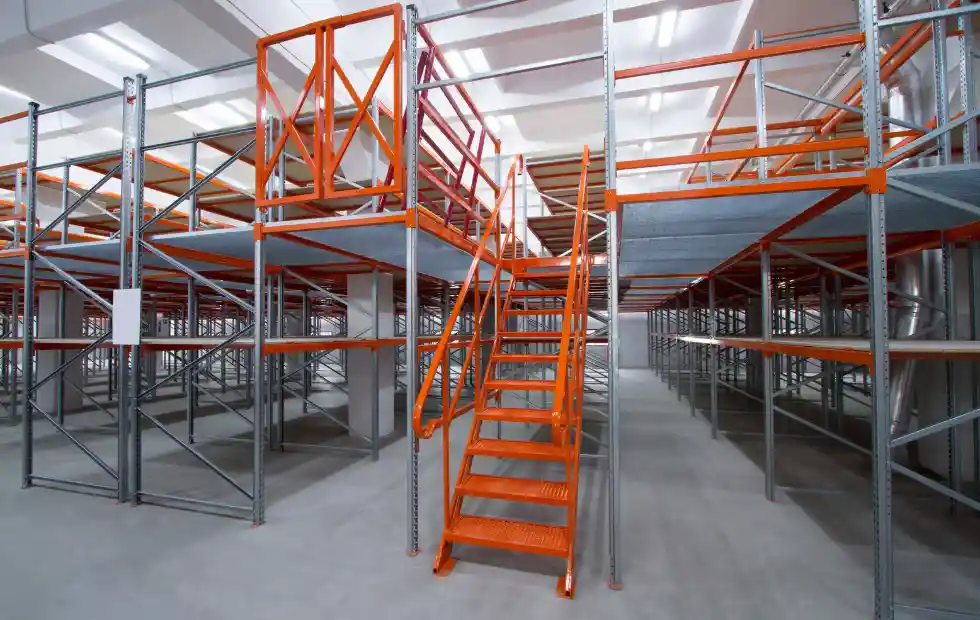
Multi-tier racking contains multiple stages of racking. They utilize the vertical space and go well with high-ceiling warehouses. Workers can use stairs or lifts to access higher levels of this racking system.
They are useful in organizing small-to-medium-sized items, particularly those businesses containing a large number of different products. Multi-tier racking is not fixed, and it can be modified or extended as the business expands.
Although this setup requires more time and money than simple shelving, the amount of storage is greatly increased. This system is widely applied in retailing, e-commerce, and warehouses for spare parts.
Mezzanine Flooring
Warehouse mezzanine flooring builds a second story within a building above the ground level. This area may be utilized as storage, offices, pack stations, or additional shelving.
Mezzanines enable a business to utilize all its available vertical space without having to construct new structures. They are more expensive to install than simple shelving, but they offer huge value and long-term cost savings.
Mezzanine flooring is becoming a very adaptable method of expanding storage areas for many companies. It helps especially when there is a lack of space in the warehouse; nevertheless, this storage structure cannot be moved to a new location.
Wire Partitions and Specialty Storage
Wire partitions are metal cages or barriers that are utilized in separating and protecting some items. This storage system is commonly applied for valuable tools, chemicals, or things that require restricted accessibility. Such partitions are lockable and simple to install or relocate.
Automated carousels, vertical lift modules, and small parts bins are also considered specialty storage systems. Such warehouse storage facilities are more costly but can be custom-made and enhance safety and efficiency within the warehouse.
Choosing the Right Warehouse Storage Systems
Choosing warehouse storage systems to use is determined by storage types. This depends on items that are being stored, their frequency of use, as well as the availability of space.
Features
Pallet racking systems are suitable for storing large items that require forklifts. Hand picking of small items might require warehouse storage units like shelving or bins. Where ceilings are high in the warehouse, multi-tier racking or mezzanine flooring can be used. Mobile shelving systems are suitable for businesses that have a constraint on storage space and need not daily handling. Mezzanines or specialty storage are advanced systems that can be more expensive yet lead to higher efficiency.
Other Considerations
Price is also a factor that comes into play. The return on investment (ROI) must be addressed when choosing warehouse storage systems. One system may be more expensive to install but save money in the long run by helping to quicken work, lessen mistakes, and cut labor expenses.
Maintenance, training, and future growth ought to be factored in as well. For example, shelving methods are inexpensive and simple, but they might not be suitable for rapidly developing companies.
Considering cost and ROI, an optimal system would be the one that fulfills the present requirements and has the potential to be expanded with the company and continues to provide value in the long term.
In many cases, the combination of various types of warehousing and storage systems is the most effective, as it provides flexibility and more adequate space utilization.
Conclusion
Warehouse storage systems contribute significantly to the efficient, safe, and productive warehouse processing. There are multiple methods of organizing goods in a warehouse. These include racking systems and shelving, mezzanine flooring, specialty storage, and more. An efficient storage system can save space, enhance workflow, cut down costs, and help a business develop.
While each system is beneficial in its own way, companies must consider the pros and cons and the sustainability of each option to determine whether one is right for them or not.
Frequently Asked Questions (FAQs)
What is the most efficient warehouse storage system?
The most effective system would be based on your goods. For instance, when the goods are heavy and the movement is rapid, pallet racking systems may be excellent. Mobile or multi-tier could be a better option where the items are small or the space is restricted.
What is the difference between static and mobile shelving?
The static shelving is firm and simple to utilize, yet it occupies more space. Mobile shelving runs on rails and conserves space by permitting only one open aisle at a given period of time.
Is mezzanine flooring worth the investment in a warehouse?
Warehouse mezzanine flooring can provide additional room without relocating and constructing a new facility. It works well as an additional storage area and is a long-term investment due to its utilization of all available vertical space.