
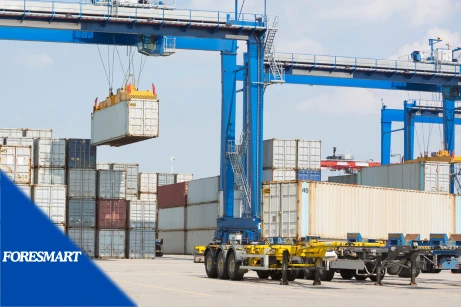
When checking the shipping fees with your freight agent, you may come across a fee labeled “Drayage” on the freight bill. What is drayage? Drayage refers to the procedure in which freight is transported over a short distance such as in or around the port or the rail terminals.
It is a service necessary to maintain the efficient flow of goods at particular points of the supply chain. This process plays a large part in bridging the gap between the other major methods of transportation like sea freight. Drayage services also prove to be significant in logistics especially when it comes to intermodal transportation, since cargo has to be transported by both ship and rail modes of transport.
If businesses understand what drayage service is, along with its costs and advantages, they may plan their logistic operations in the future more effectively.
What Is Drayage?
Many people assume that only larger modes of transportation such as ships or planes are used for moving cargo or goods, however this is not the case. Drayage is one of the smaller modes of transportation that has a substantial contribution to the transport supply chain, making multimodal transport a success.
But how do we define drayage? In a typical freight shipping process, drayage refers to the short-distance transport of freight, usually between a rail terminal or port and locations such as a factory, warehouse, or distribution center.
It is necessary to understand that drayage trucking does not cover long distances such as in the case of long-haul trucking. The drayage service is limited to local deliveries, very often in the same metropolitan area. It serves as the initial or the final leg in the entire shipping operation amongst other ways of transportation for most international shipping.
Moreover, container drayage serves to transport cargo containers from ships/rail yards to warehouses or vice versa. For efficient intermodal logistics, particular drayage carriers are used for the movement of containerized cargo.
Types of Drayage Services
Drayage is split into several types that are mentioned below:
Port Drayage – Port Drayage is defined as the transportation of containers from one port terminal to a close place around the port, this could be a warehouse. This drayage service is required for the efficient management of goods from the ships, especially in extremely busy ports where shipments arrive in huge amounts.
Expedited Drayage – Some shipments require extremely fast transport which is why expedited drayage service appears. It is known for its quicker transfer option, which allows goods to be moved over the road. This drayage service aims to operate with minimal delays so that time-sensitive shipments can reach their destination on time.
Inter-Carrier Drayage – In this kind of drayage service, containers are transferred between various carriers. An example is that a shipment has just arrived via truck and needs to be moved onto a rail carrier. Inter-carrier drayage service makes sure that goods continue on their journey efficiently between different transport providers.
Intra-Carrier Drayage – Intra-Carrier Drayage refers to the transportation of goods within the same carrier’s network. This includes moving shipments from one location to another within the same carrier’s control, such as from the carrier’s ship or terminal to one of the carrier’s drayage trucks for further transportation.
Door-to-Door Drayage – Door-to-Door Drayage is mentioned when picking containers up directly from the rail terminal or port to drop them off at their final destination, this could be the warehouse or the customer’s given address. This option proves to be a comprehensive solution for businesses that require their logistics processes to be streamlined.
Shuttle Drayage – This kind of Drayage service is used when overcrowding occurs in the hub so some of the intermodal units are transferred temporarily to the parking lot from its origin.
Pier Drayage – This type of drayage service uses roadways to transport an intermodal unit from a rail hub to a pier or dock.
How Do Drayage Costs and Pricing Work?
Drayage service costs as well as pricing depend on various factors that include the distance, time, type of service, and how urgently you want the delivery. Shorter hauls such as from a port to a warehouse within the port might cost less than transportation over a long distance. Costs are also affected when the need for drayage carriers rises at a particular port.
However, the total drayage service price is determined by the mileage and time and this is usually taken as a flat fee for the entire round trip. Fuel surcharges depending on the carrier’s total fuel costs and accessory fees depending on the specifics of the shipment are also included in the total fees.
Drayage Carriers vs. Truckload Carriers
Drayage and truckload carriers are both an important part of the shipping and logistics industry. Let’s explore some significant differences between the two:
-
Specifically speaking, drayage truck carriers are only used to pick up and drop off cargo containers, while there are many options when it comes to truckload carriers such as trailers, flatbeds, containers, reefers, and more. Truck carriers are broader in scope, They may focus on longer-distance, over-the-road trucking to transport freight across cities, states, and even countries
-
Drayage carrier drivers require a license called a CDL as well as a special local (Drayage truck registry) DTR sticker. This is because drayage services require the use of Class 8 tractors that need a license to be operated. Truckload carrier drivers only need a CDL license.
-
Drayage service is operated mostly by small carriers and owner-operators. Their market size is roughly a little over 6,000 locally operating in metro areas. Whereas, truckload carrier service is operated by both large carriers as well as owner-operators. Their market size crosses 900,000 and all are operating nationally.
-
Drayage carriers and truckload carriers both can be hired by contract or spot service with the exception that drayage carriers can also be hired by your local intermodal provider (IMC).
Conclusion
Drayage has a substantial role in the shipping industry and bridges the gap between the various transport hubs and their subsequent delivery points.
Companies can choose from various kinds of drayage services to ensure the smooth transportation of their container cargo, as well as reduce storage time and the total costs spent in shipping operations.
FAQs
Is Using Drayage Service Risky?
Drayage services are generally considered low-risk when partnered with reputable providers. The professional drayage carriers make sure that goods are properly handled and delivered on time.
What Kind of Information Do I Need to Coordinate a Drayage Service?
Particular information on pick-up and delivery location as well as container and shipment information, and cargo handling requirements are needed in order to coordinate efficient transport service.