
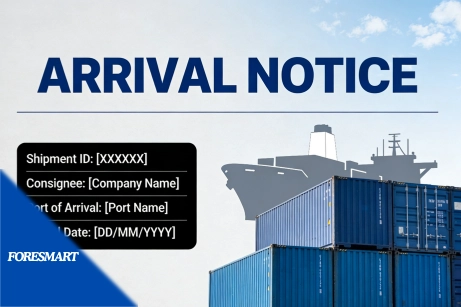
An arrival notice tells you your cargo is almost at the destination port. It is usually sent by the carrier or agent a few days before arrival, and it contains the details you need to clear, pay, and pick up the goods. It is commonly used in sea freight and air freight.
What Is an Arrival Notice?
An arrival notice, sometimes called an arrival notification or notice of arrival (NOA), is a message from the carrier, shipping line, or their agent that tells the cargo receiver that their shipment is approaching or has reached the destination port or terminal. It is not the bill of lading, but it lists the vessel/voyage, container or AWB numbers, ETA, arrival location, and instructions for pickup, customs, or payment. Think of it as the shipment’s heads-up.
Who Sends It and Who Gets It?
Carriers and their local agents normally issue the notice of arrival.
Recipients are normally the consignee, but also include the freight forwarder and customs broker, if they are acting on behalf of the consignee.
Big carriers publish specific timing and distribution rules; small carriers and NVOCCs may do the same in their systems. If you named a “first notify” on a bill of lading, that person will often receive the notice.
What’s Inside an Arrival Notice?
Typical fields are:
-
Vessel name and voyage number.
-
Container or airway bill numbers.
-
Estimated time and place of arrival.
-
Party details: consignee, notify party, shipper.
-
Outstanding charges, demurrage or detention warnings when applicable.
-
Pickup instructions and documentation required for customs.
This arrival note paper enables the consignee book a truck, arrange unloading, prepare customs documents, and pay necessary fees. If any of these entries are wrong, the cargo cannot be released by the terminals or customs smoothly.
When Is It Sent, and Why Timing Matters?
Carriers usually send the arrival notice within 24 to 96 hours before vessel/flight arrival, although practices vary by carrier and trade lane. That window gives you a short runway to finish customs clearance, settle charges, and arrange inland transport.
Some carriers may send earlier updates as “pre-arrival” messages. Missing that window or having inconsistent timing is one of the main causes of delays at ports.
What to Do When You Receive a Notice of Arrival?
-
Check the container/AWB number against your booking or B/L.
-
Share it with your customs broker immediately. They need it to start or finish clearance.
-
Verify and pay for the outstanding fees. Avoid unexpected charges.
-
Book pickup and inland transport. Terminals often need a window for appointments.
-
If details are wrong, escalate to the carrier or agent right away. Don’t wait.
The Cost of Bad or Missing Notices
Paperwork problems have real money consequences. Industry surveys report that document errors are a leading cause of shipment delays.
A logistics survey found 57% of executives experienced shipment delays caused by document errors in the past year. Industry reporting also links documentation hold-ups to billions in added costs across the supply chain. In short, sloppy arrival notice handling and poor documentation add days and extra fees.
Digital Arrival Notices and Standards
The industry is shifting toward structured, machine-readable arrival notices. The Digital Container Shipping Association and other bodies publish standards so carriers and systems can exchange arrival information automatically. That reduces manual retyping, speeds customs handoffs, and lowers error rates.
Carriers and integrators are rolling out APIs and notification services to make NOAs real-time and more reliable.
Real-World Examples
You might get multiple notices: a pre-arrival with ETA, then a final arrival. Treat each as actionable.
NOA is not a title document. It does not replace a bill of lading or air waybill. Bring the correct legal documents to claim cargo where required.
For some ports and shipments, terminals require specific electronic release forms. Check local rules with your freight forwarder.
How to Make Arrival Notices Work for You?
Use a freight forwarder or a customs broker who can deal with NOA and customs clearance immediately.
Set clear notification instructions when you book the shipment so the arrival notice goes to the right people the first time.
Automate NOA handling if you ship frequently. For high shipment volumes, connect carrier systems to your TMS so arrival notices are received and processed automatically, reducing manual errors and missed messages.
If arrival notices are late or wrong, track the issue and raise it with the carrier or forwarder. Patterns repeat unless fixed.
Closing Words
Arrival notices are small but powerful. They let everyone know the show is about to start. Treat them like time-sensitive tickets.
Handle them fast, and your cargo clears and leaves the port with minimal drama. Ignore them, and you buy yourself extra days of waiting and fees.
FAQs
Is an arrival notice the same thing as a bill of lading?
No, they aren’t. Think of the arrival notice as a “heads-up” text saying your package is almost at the door. The bill of lading (B/L), however, is the legal deed to your cargo. You can’t just walk off with your goods because you got a notification; you’ll need the original B/L or the right release forms to actually claim ownership and pick up the cargo.
Who receives the NOA?
The consignee, sometimes the customs broker, and the freight forwarder. Carriers decide recipients based on the shipping documents.
What happens if I miss the notice?
The ship won’t wait for you to check your inbox! Your cargo will still arrive, but you’ll likely run into a wall of delays. If you don’t pick it up on time, you’ll start racking up fees like demurrage, which is just a fancy way of saying you’re paying expensive rent for your container to sit at the port. If you realize you’ve missed a notice, call your forwarder immediately to stop the bleeding.
How early will it show up?
You’ll see it hit your inbox 24 to 96 hours before the ship docks. Every carrier and route is a little different, but most try to give you a few days’ notice. Some even send “pre-arrival” alerts much earlier, so you aren’t scrambling at the last minute.
Are shipment notice and arrival notice the same?
They are not the same, though they are often confused.
A shipment notice, or an advance shipping notice (ASN), is sent before or shortly after cargo departure. It is about what cargo is shipped. While the arrival notice tells you what to do to receive the cargo.
No, they aren’t. Think of the arrival notice as a “heads-up” text saying your package is almost at the door. The bill of lading (B/L), however, is the legal deed to your cargo. You can’t just walk off with your goods because you got a notification; you’ll need the original B/L or the right release forms to actually claim ownership and pick up the cargo.
The consignee, sometimes the customs broker, and the freight forwarder. Carriers decide recipients based on the shipping documents.
The ship won’t wait for you to check your inbox! Your cargo will still arrive, but you’ll likely run into a wall of delays. If you don’t pick it up on time, you’ll start racking up fees like demurrage, which is just a fancy way of saying you’re paying expensive rent for your container to sit at the port. If you realize you’ve missed a notice, call your forwarder immediately to stop the bleeding.
You’ll see it hit your inbox 24 to 96 hours before the ship docks. Every carrier and route is a little different, but most try to give you a few days’ notice. Some even send “pre-arrival” alerts much earlier, so you aren’t scrambling at the last minute.
They are not the same, though they are often confused.
A shipment notice, or an advance shipping notice (ASN), is sent before or shortly after cargo departure. It is about what cargo is shipped. While the arrival notice tells you what to do to receive the cargo.