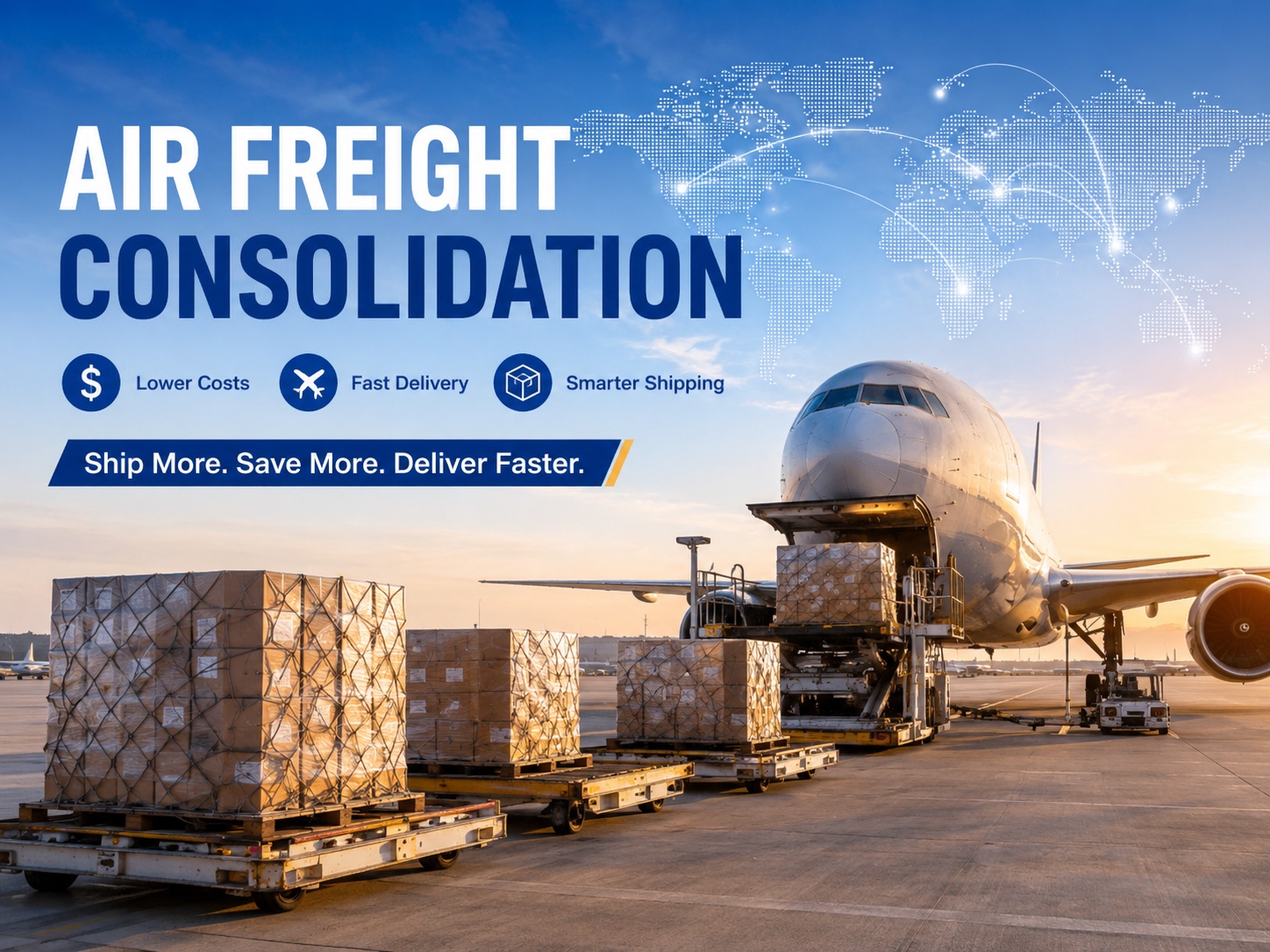
Air freight is fast—but it’s also expensive, especially when you’re shipping smaller volumes that don’t justify the cost of a direct booking. So how do importers and e-commerce sellers get the speed of air without paying full price for it? The answer is air freight consolidation.
In simple terms, consolidation combines multiple shippers’ smaller shipments into one larger one, unlocking lower per-kilogram rates that no single small shipment could reach on its own. In this guide, we’ll cover what air freight consolidation is, how it works, its key benefits, and the use cases where it makes the most sense—so you can decide whether it’s the right fit for your supply chain.
What Is Air Freight Consolidation?
Air freight consolidation is the practice of combining multiple smaller shipments—often from different shippers—into a single larger shipment that travels under one Master Air Waybill. Think of it like carpooling instead of hiring a private car: rather than each small shipment booking its own space and footing the full cost alone, several shipments share the ride and split the bill. A freight forwarder or consolidator gathers these scattered cargoes at a consolidation warehouse, books and ships them together as one unit, then separates them at the destination for final delivery to each consignee.
The end result: you keep most of air freight’s speed advantage while bringing the per-kilogram rate down substantially—making air shipping affordable even for businesses whose volumes would otherwise be too small to justify it.
Consolidated Air Freight vs Direct Air Freight
|
Factor |
Consolidated Air Freight |
Direct Air Freight |
|---|---|---|
|
Cost per kg |
Lower—bulk rates shared across multiple shippers |
Higher—you carry the full rate alone |
|
Transit time |
Slightly longer—waits for consolidation and deconsolidation |
Faster—moves on its own flight schedule |
|
Best for |
Small to mid-sized, non-urgent shipments |
Urgent, time-sensitive, or very large shipments |
|
Flexibility |
Tied to the consolidator’s schedule and routes |
Book on your own timing |
|
Handling |
Extra steps at both origin and destination |
Minimal handling, point to point |
The core difference is simple: a direct shipment travels on its own standalone booking, while a consolidated shipment shares space with others under one combined booking. That single difference gives rise to several practical trade-offs.
The Air Freight Consolidation Process Step by Step
While the details vary by forwarder, the consolidation process generally follows the same six stages from pickup to final delivery:
- Collection. The forwarder picks up individual shipments from multiple shippers, or receives them at a designated consolidation warehouse near the origin airport.
- Consolidation. At the warehouse, the separate cargoes are sorted, checked, and combined into a single unit—palletized or containerized—under one Master Air Waybill, while each shipper’s goods are tracked individually under their own House Air Waybill.
- Booking and customs clearance. The consolidator books the combined shipment with the airline and handles export documentation and customs clearance as one consignment, simplifying the paperwork for everyone involved.
- Air transport. The consolidated shipment flies to the destination airport on a single booking, benefiting from the bulk rate negotiated for its combined weight.
- Deconsolidation. On arrival, the shipment is broken down at a destination warehouse and sorted back into individual consignments, with import clearance handled for each as needed.
- Final delivery. Each shipper’s goods are released and delivered to their respective consignees, completing the journey.
This added handling at both ends is the main reason consolidated shipments take slightly longer than direct ones—but for non-urgent cargo, that modest time trade-off is exactly what makes the cost savings possible.
Is Air Freight Consolidation Right for Your Shipment?
It comes down to four things: how urgent your cargo is, how much you’re shipping, how cost-sensitive you are, and how flexible your timeline is.
Freight consolidation is usually the right call if your shipment is small to mid-sized, not in a rush, and cost is a priority—or if you’re sourcing from multiple suppliers in one region and want to combine orders into a single, better-priced shipment.
Direct air freight is the better choice if your cargo is time-critical, you’re shipping large volumes that already earn competitive rates on their own, or you need maximum control and traceability for high-value goods.
When you’re on the fence, ask your freight forwarder to quote both options side by side—the real numbers for your route, weight, and timeline will make the choice clear.
How to Choose the Right Freight Forwarder
Once you understand consolidation, choosing a partner comes down to a few practical checks:
- Service coverage. Look for true end-to-end capability—pickup, consolidation, ocean and air freight, customs clearance, and last-mile delivery—under one accountable partner.
- Consolidation expertise. If you buy small quantities from multiple suppliers, confirm the forwarder runs its own warehouse network and can consolidate nationwide, not just in one city.
- Responsiveness and transparency. You want clear progress updates and a real person to reach when something goes wrong.
- Credentials and experience. Check for industry licenses and memberships (NVOCC, FMC, WCA) and a track record at your key ports.
- Fair, transparent pricing. Prioritize clear rate structures and long-term reliability over a one-time bargain.
ForeSmart is a global freight forwarder providing reliable, one-stop shipping from China to anywhere in the world: pickup, consolidation, ocean and air freight, customs clearance, and final-mile delivery under one roof.
Consolidation is our specialty. Buying small quantities from multiple suppliers across China? We combine everything into one shipment, saving you the cost of multiple separate freight charges—and we cover all of China, not just one city.
Backed by 20 years in the business, NVOCC/FMC/WCA credentials, and transparent communication with a guaranteed 24-hour response. Get in touch for a quote tailored to your route, volume, and timeline.
Conclusion
Consolidated air freight works best for small shipments that can allow time for consolidation and need lower air shipping costs. Direct air freight is usually a better fit for urgent orders, reserved-space shipments, and cargo that requires separate handling.
Before requesting a quote, provide the cargo weight, dimensions, supplier addresses, destination, delivery deadline, and special handling requirements. Compare the service scope, additional fees, and estimated arrival date before booking.
FAQ
How Much Does Consolidated Air Freight Cost?
Consolidated air freight costs depend on chargeable weight, route, pickup location, destination, and additional services. Compare pickup charges, storage fees, consolidation fees, customs clearance fees, and final delivery costs before booking.
Can Consolidated Air Freight Handle Time-Sensitive Cargo?
Consolidated air freight works for shipments that need fast delivery but can allow time for consolidation. Production shortages, urgent restocking, and fixed-date deliveries are usually better suited to direct air freight.
Is My Cargo Safe in Consolidated Air Freight?
Consolidated air freight can be arranged safely when packaging, labeling, and warehouse checks meet shipping requirements. Fragile goods, high-value cargo, batteries, liquids, and temperature-sensitive shipments may require special packaging, additional documents, or cargo insurance.
Consolidated air freight costs depend on chargeable weight, route, pickup location, destination, and additional services. Compare pickup charges, storage fees, consolidation fees, customs clearance fees, and final delivery costs before booking.
Consolidated air freight works for shipments that need fast delivery but can allow time for consolidation. Production shortages, urgent restocking, and fixed-date deliveries are usually better suited to direct air freight.
Consolidated air freight can be arranged safely when packaging, labeling, and warehouse checks meet shipping requirements. Fragile goods, high-value cargo, batteries, liquids, and temperature-sensitive shipments may require special packaging, additional documents, or cargo insurance.