
If you’ve ever requested an ocean freight quote or compared the world’s busiest ports, you’ve run into three letters: TEU. It’s one of the most fundamental units in global shipping—yet for many importers and e-commerce sellers, it stays vague jargon rather than a number they truly understand.
TEU stands for Twenty-foot Equivalent Unit, the standard measure carriers use to count container capacity and quote ocean freight. In this guide, we’ll break down what TEU means, how it’s calculated, how it differs from FEU, and where it matters most—so next time, it’s a tool you can use rather than a term you skip over.
What is TEU?
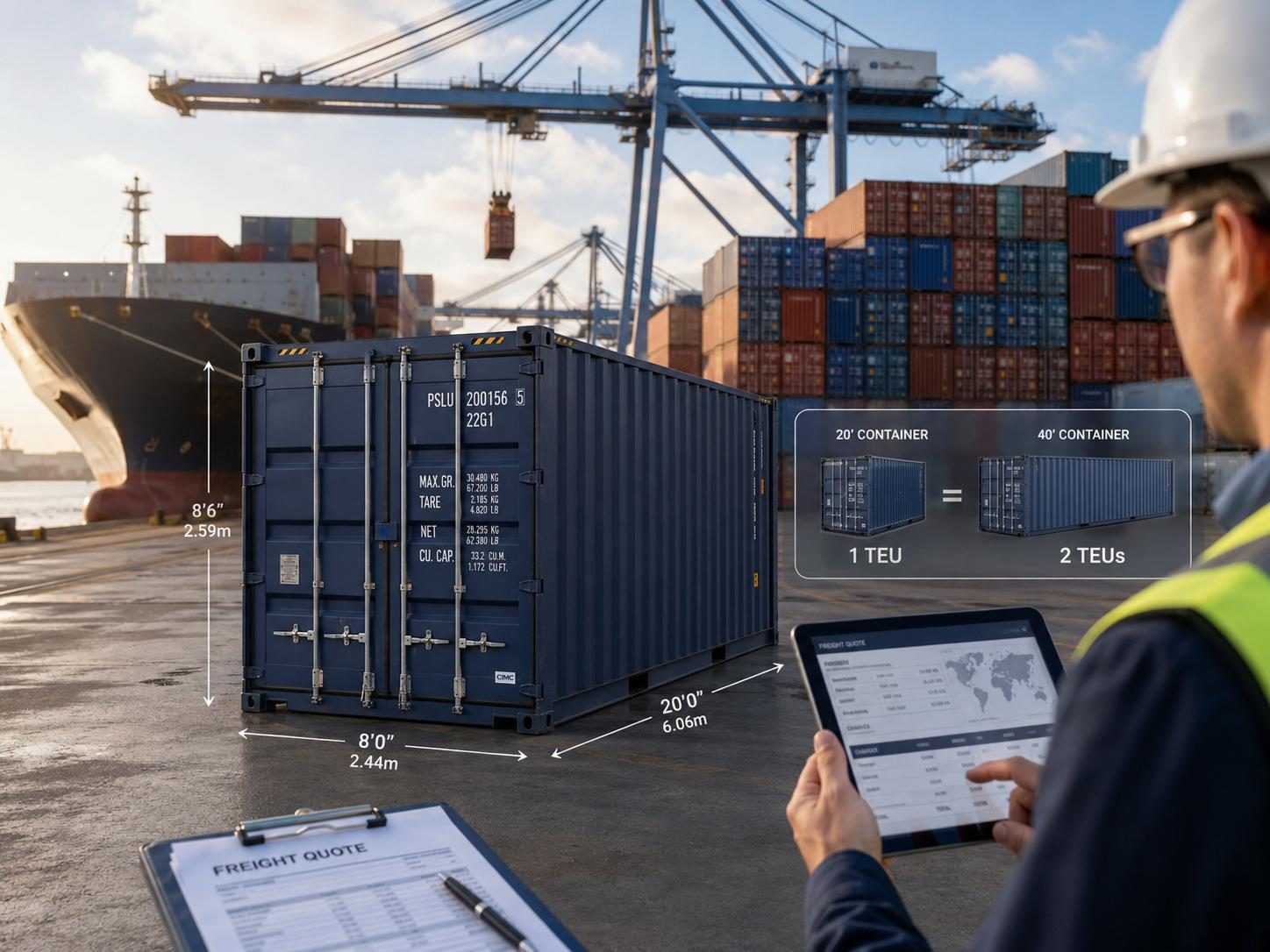
TEU stands for Twenty-foot Equivalent Unit—the standard unit carriers use to measure container capacity and cargo volume in ocean freight. One TEU equals a single standard 20-foot shipping container. It’s the universal “counting unit” of the shipping world.
The reason the industry needs this unit is simple: containers come in different lengths (mainly 20-foot and 40-foot), so counting raw “boxes” wouldn’t reflect actual capacity. TEU solves this by converting every container into a common baseline—the 20-foot box—so capacity, throughput, and pricing can be compared on equal terms.
Here’s how the common container sizes translate into TEU:
|
Container Type |
Length |
TEU Equivalent |
|---|---|---|
|
Standard 20-foot (20′ GP) |
20 ft |
1 TEU |
|
Standard 40-foot (40′ GP) |
40 ft |
2 TEU |
|
40-foot High Cube (40′ HC) |
40 ft |
2 TEU |
|
45-foot High Cube (45′ HC) |
45 ft |
2.25 TEU* |
FEU vs TEU
You’ll often see TEU mentioned alongside FEU—Forty-foot Equivalent Unit. The relationship is straightforward: one FEU equals two TEU, because a 40-foot container is simply twice the length of a 20-foot one. Comparing a 20ft vs. 40ft shipping container side by side shows how that doubling plays out in usable space and freight cost.
The two units serve slightly different purposes. TEU is the universal standard for reporting fleet capacity, port throughput, and global trade statistics—it’s the number you’ll see in industry headlines. FEU, on the other hand, shows up more in practical booking and pricing contexts, since the 40-foot container is the most commonly shipped size in real-world freight. In short: TEU is the measuring stick, FEU is the workhorse—and converting between them is as easy as multiplying or dividing by two.
How Many TEUs Can Be Loaded on a Cargo Ship?
There’s no single answer, because ships vary enormously in size—from small feeder vessels carrying just a few hundred containers to mega-ships that hold well over twenty thousand. Here’s a breakdown by vessel class, from smallest to largest.
- Feeder vessels: roughly 1,000–3,000 TEU. These move cargo from major hub ports to smaller regional ones. With shallow drafts and flexible berthing, they’re the “shuttle buses” that connect to the big mainline ships.
- Panamax: roughly 3,000–5,000 TEU. Sized to fit the locks of the original Panama Canal, this class was once the industry workhorse.
- Neo-Panamax: roughly 10,000–14,000 TEU. The larger vessels were able to transit the Panama Canal after its 2016 expansion.
- Ultra Large Container Vessels (ULCVs): 18,000–24,000+ TEU. The biggest container ships in the world today, primarily running long-haul routes like Asia–Europe.
The largest container ships in service now exceed 24,000 TEU—meaning a single vessel can carry more than twenty-four thousand standard 20-foot containers in one trip. To put that in perspective: lined up end to end, those boxes would stretch nearly 150 kilometers.
One important caveat: a ship’s rated TEU is its theoretical maximum capacity, and real-world voyages are rarely loaded to that limit. Actual load depends on cargo weight, the mix of container types, each port’s loading plan, and the vessel’s draft and stability limits—a ship full of heavy cargo often hits its weight ceiling before all the container slots are filled.
In short: anywhere from a thousand to twenty-four thousand TEU, depending on the vessel class—and how much it actually carries comes down to what’s being shipped on that particular trip.
What If Your Cargo Won’t Fill a 20-Foot Container?
If you don’t have enough cargo to fill a full 20-foot container, you don’t have to pay for space you won’t use. You have several practical options—the right one depends on your volume, budget, and timeline.
- Ship LCL (Less than Container Load). This is the most common solution. Your goods share a container with other shippers’ cargo, and you only pay for the space you actually use—typically billed by cubic meter (CBM) or by chargeable weight, whichever is greater. LCL is ideal for small shipments, but keep in mind it involves consolidation and deconsolidation at both ends, so transit times are longer and there’s more handling.
- Consider FCL anyway if the math works. Sometimes booking a full 20-foot container (FCL) is cheaper than LCL once your volume passes a certain threshold—often around 13–15 CBM. Above that point, the per-unit cost of LCL can exceed the flat rate of a full container, and FCL also means faster transit and less handling. It’s always worth comparing both FCL and LCL shipping quotes before deciding.
- Use a consolidation (buyer’s consolidation) service. If you’re sourcing from multiple suppliers in the same region, a freight forwarder can combine all your shipments into one container. This lets you reach FCL volume—and FCL pricing—even when no single supplier fills a box on their own.
- Look into air freight or express for urgent, small shipments. If your cargo is light, high-value, or time-sensitive, air freight or international courier may be more economical than ocean LCL once you factor in speed and lower minimums.
A quick rule of thumb: under ~15 CBM, LCL usually wins; approaching or above that, price out an FCL 20-foot container—you may find it costs about the same or less. When in doubt, ask a Foresmart to quote both side by side, since the breakeven point shifts with route, season, and fuel rates.
Conclusion
TEU is a standard unit for measuring container capacity in ocean shipping. One 20-foot container equals 1 TEU, and one 40-foot container equals 2 TEUs. Shipping lines use TEU to measure vessel capacity, while ports use TEU to track container throughput.
TEU can help compare shipment sizes, but TEU does not determine the final shipping cost. Cargo weight, cargo volume, container type, shipping route, and local fees can all affect the freight quote. If a shipment does not fill a 20-foot container, comparing LCL and FCL rates before booking can help control shipping costs.
FAQ
Is TEU the Only Unit of Measurement for Cargo Ships?
No. TEU is the standard unit for container capacity, but it isn’t the only one. FEU (Forty-foot Equivalent Unit) is also widely used, and ships are measured by other metrics too—such as deadweight tonnage (DWT) for how much weight a vessel can carry, and gross tonnage (GT) for its overall internal volume. TEU specifically counts container slots, so it applies mainly to container ships rather than bulk carriers or tankers.
Does TEU Include Empty Containers?
Yes. TEU can be used to count both loaded and empty containers. TEU measures container capacity, not the amount of cargo inside a container.
Does TEU Measure Cargo Weight or Container Capacity?
TEU measures container capacity, not cargo weight. One 20-foot container equals 1 TEU, and one 40-foot container equals 2 TEUs. Cargo weight must be calculated separately.
Are High-Cube Containers Counted Differently?
Not for TEU reporting. A 40-foot high-cube container is still recorded as 2 TEUs because TEU is not calculated from cubic volume. The added height increases the usable space inside the container, but it does not change the TEU value.
Does a 20-Foot Container Have a Maximum Weight Limit?
Yes. A standard 20-foot container often has a maximum gross weight of about 30,480 kilograms, or 67,200 pounds. The payload limit is lower because the container’s tare weight must be deducted from the maximum gross weight. The final limit can also depend on the container type, carrier rules, and local regulations.
Why Can a 20-Foot Container Cost More per TEU Than a 40-Foot Container?
Some shipping costs are charged per container, not per TEU. Booking, container pickup, trucking, and terminal handling fees do not always rise in direct proportion to container size. Since a 40-foot container equals 2 TEUs, the cost per TEU may be lower.
No. TEU is the standard unit for container capacity, but it isn’t the only one. FEU (Forty-foot Equivalent Unit) is also widely used, and ships are measured by other metrics too—such as deadweight tonnage (DWT) for how much weight a vessel can carry, and gross tonnage (GT) for its overall internal volume. TEU specifically counts container slots, so it applies mainly to container ships rather than bulk carriers or tankers.
Yes. TEU can be used to count both loaded and empty containers. TEU measures container capacity, not the amount of cargo inside a container.
TEU measures container capacity, not cargo weight. One 20-foot container equals 1 TEU, and one 40-foot container equals 2 TEUs. Cargo weight must be calculated separately.
Not for TEU reporting. A 40-foot high-cube container is still recorded as 2 TEUs because TEU is not calculated from cubic volume. The added height increases the usable space inside the container, but it does not change the TEU value.
Yes. A standard 20-foot container often has a maximum gross weight of about 30,480 kilograms, or 67,200 pounds. The payload limit is lower because the container’s tare weight must be deducted from the maximum gross weight. The final limit can also depend on the container type, carrier rules, and local regulations.
Some shipping costs are charged per container, not per TEU. Booking, container pickup, trucking, and terminal handling fees do not always rise in direct proportion to container size. Since a 40-foot container equals 2 TEUs, the cost per TEU may be lower.