
The uninterrupted movement of goods across borders maintains the international supply chain. As customer demands are growing, businesses turn to imports for competitive pricing. The logistics process needs to be handled efficiently and in compliance with regulations. One of those regulatory requirements is the customs bond.
With an import bond in place, the U.S. Customs and Border Protection (CBP) receives the duties and taxes on the importation of goods. Without it, shipments can be seized, subjected to penalties, resulting in increased costs and business operations being disrupted. Whether you’re a seasoned importing professional or a first-time importer, you need to understand everything about customs bonds and how they function.
In this article, we’ll take a closer look at what a customs bond is, how it supports customs operations, and different types of customs bonds.
What Is a Customs Bond?
In essence, a customs bond serves as a legal agreement for anyone involved in the importation of goods into the United States.
It’s a financial guarantee forcing the importer to comply with the regulations of the U.S. Customs and Border Protection, also the CBP. In other words, it’s a legal way of holding the importer responsible for paying all applicable taxes, fees, and duties related to the shipment of goods.
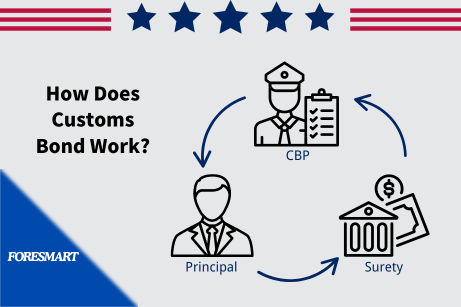
The customs bond is an agreement between three parties:
-
The Principal: This is the importer or any business entity bringing goods into the U.S.
-
The Obligee: In most cases, this is the CBP, which enforces compliance and collects fees.
-
The Surety: A licensed company issuing the bond and assuming financial responsibility in case the importer fails to do so.
So, if an importer defaults by failing to pay the duties or basically violating any customs regulations, the surety company has to step in and pay the amount owed to CBP. It’s not a free pass for the importer. The surety companies are individual entities, and they will seek reimbursement from the importer for the full amount. The goal here is to ensure that CBP is protected financially and government resources are not unnecessarily burdened in enforcing trade regulations.
When Is a Customs Bond Required
Strictly speaking, not every shipment imported into the country requires a CBP bond. That said, knowing when a bond is important for imports is crucial information for any importer, customs broker, or freight forwarder to avoid any potential penalties or unnecessary expense. Here are some examples of when a customs bond is needed:
Any commercial imports valued over $2500
If you’re importing any commodities valued at $2500 or more, you are required to have an import bond. This applies to duty-free goods, as well, and to many commercial transactions. In fact, this remains the most basic trigger for the bond requirement.
Regulated Commodities
If you’re importing goods that fall under the jurisdiction of other regulatory agencies like the FDA, the USDA, or the ATF, then getting a CBP bond is mandatory. Even if the value of your shipment falls below $2500.
Some common examples include pharmaceuticals, cosmetics, agricultural goods, firearms, and even alcohol.
International Carriers
Every international carrier that transports goods by land freight, sea freight, or air freight into the U.S. is required to have a bond.
An example can be the trucking companies handling across states in-bond shipments, that is, cargo that enters the U.S. but is not yet cleared by Customs and is moving between U.S. ports or facilities (like from a seaport to an inland port or bonded warehouse). This bond is also called an international carrier bond.
In all these cases and more, a U.S. customs bond means a lot more than just a bureaucratic requirement. It acts as a safeguard for the government and a tool for the business, ensuring faster clearance and seamless trade.
Types of Customs Bonds
Importers have two main options when it comes to selecting a customs bond: a single entry bond or a continuous bond.
Single Entry Bond (SEB)
SEB is exactly what it sounds like. It covers a single shipment entering the U.S. through a specific port. It’s ideal for importers who are testing international trade, or are having one-off or seasonal import needs.
So, for infrequent importers, the SEB offers flexibility. It’s not really ideal for frequent shipments as it ends up becoming more expensive, especially when there are multiple ports in use.
Continuous Bond
A continuous bond, or an annual bond, is designed for businesses dependent on regular imports. As the name suggests, this bond is active for 12 months and is applicable to all entries made by the importer in that time period, regardless of volume or location. That means various ports of entry are also covered by the continuous bond. It saves time and reduces paperwork, especially for businesses importing frequently.
Besides, a continuous bond isn’t just for customs clearance, it also covers in-bond shipments, warehouse entries, Foreign Trade Zone (FTZ) entries, and duty drawback programs.
ISF Bond vs Customs Bond
An ISF Bond (Importer Security Filing bond) is a specific type of customs bond. It is required for all ocean shipments into the U.S. and can be a part of a continuous bond.
While an import bond is applied to all types of shipments over $2,500 into the U.S.
Most importers use a continuous customs bond, which covers both ISF and customs clearance, making it simpler and more cost-effective.
How Much Is a Customs Bond?
The bond is a legal necessity, but the cost remains a common concern for importers. The types of bonds are priced differently, and other factors can also influence the cost of customs bonds.
The customs bond cost is mainly tied to the import volume and risk. The single entry bond fee typically ranges between 0.5%-0.7% of the goods’ value, with a minimum charge of $50. For example, a $10,000 shipment with moderate risk may result in a bond cost between $50 to $70.
Aside from the bond fees, there are other fees, like the ISF bond fee, to consider. So it may turn out to be expensive for frequent importers. Yet the continuous bond can cover the ISF bond and acts as an annual premium, costing around $500 to $600 per year.
Another variable that can influence the cost is the importer’s creditworthiness. So if your company has strong financials, you could receive better rates.
How to Get a Customs Bond?
The process of securing an import bond is straightforward, but it should be done correctly. Here’s a step-by-step breakdown of how to obtain it:
Analyzing your import activity
Are you importing once or twice a year, or are you shipping frequently using multiple ports? This will help you decide which bond is more efficient and cost-effective for your operations.
Choosing a Customs Broker/Surety Provider
You only have two options here that you need to work with either a licensed surety company or a licensed customs broker that can obtain the bond through their network for you.
Working with an experienced freight forwarder like Foresmart can also help simplify the process, and it’s recommended for businesses involved in having complex logistics and bonded shipments.
Completing CBP Form 301
A CBP Form 301 includes the Importer of Record (IOR) number, the type of bond requested (single or continuous), the value of merchandise, and the estimated duties, taxes, and fees. Every customs bond must be filed using this form. If you’re importing for the first time, they ask for estimates rather than exact values and basic information about your shipments.
Submitting and Activating the Bond
Once all that is completed, the bond is submitted to the CBP for approval. It can take anywhere between a few hours to a couple of days to get the approval. As for continuous bonds, they remain valid for 12 months, once approved, and automatically renew unless canceled.
Maintaining Compliance
Once you secure the bond, it’s your responsibility to be compliant. This means paying your dues on time. It’s also important to notify CBP or your bond provider about any changes in your import activity or business structure. Failure to comply results in penalties and unnecessary customs delay.
Related Reading: How Long Does Customs Take?
Conclusion
Whether you’re a small business looking to get into global trade or a large-scale importer managing regular shipments, you need to understand how the customs bond works. It protects your shipments from penalties and costly delays while also guaranteeing the timely payment of duties to the CBP.
Customs bonds help fasten the clearance speed, offer peace of mind to both importers and CBP, and improve logistics performance.
Frequently Asked Questions (FAQs)
Why is a customs bond necessary?
According to the U.S. Customs and Border Protection, it’s a requirement to have a customs bond. It ensures importers pay all the necessary duties, fees, and taxes when bringing goods into the country.
How do I decide which type of bond I need?
If your business imports occasionally, then a single entry bond might be sufficient. If you import regularly or through different ports, then a continuous bond offers value and efficiency.
What are bonded shipments?
Bonded shipments are goods held by customs authorities without requiring the immediate payment of duties. They’re kept in bonded warehouses and transported using bonded carriers.
Can my customs broker provide the bond?
Yes, a licensed customs broker can help you choose the right bond and obtain it on your behalf.
What happens if I don’t get a customs bond?
Without a valid import bond, the CBP has every right to detain or reject your shipments. You are also subject to potential fines, delays, and even the potential loss of import privileges.