
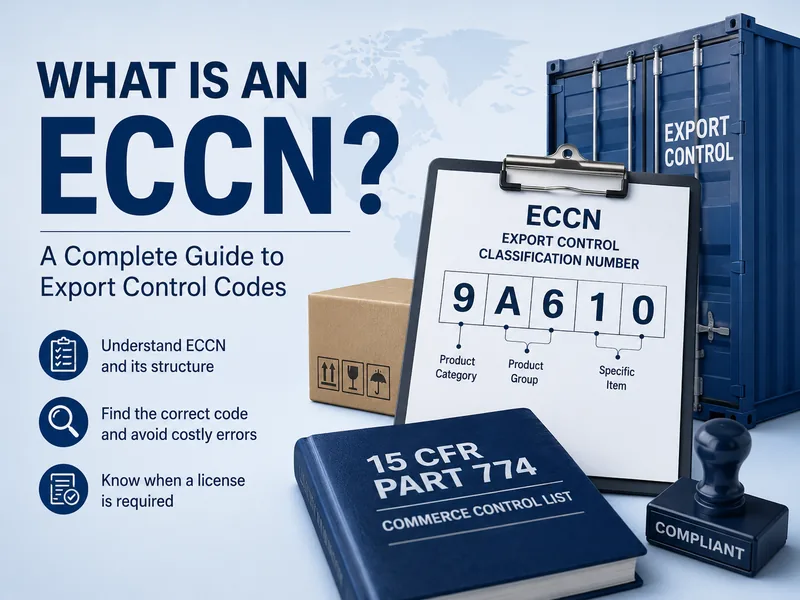
An Export Control Classification Number (ECCN) is a 5-character code used by the Bureau of Industry and Security (BIS). The code identifies controlled commodities, software, and technology, and helps determine whether a license may be required before export, reexport, or transfer. BIS assigns these codes through the Commerce Control List (CCL) under 15 CFR Part 774.
Skipping classification can expose companies to civil penalties. The same risk applies when a company defaults to EAR99 without a technical review. BIS adjusts these penalties for inflation, with a current maximum of $374,474 per violation or twice the transaction value, whichever is greater.
What Is an ECCN and How Does It Work?
The ECCN tells exporters how the item is categorized, why the item may be controlled, and whether a license review is needed.
What Does ECCN Stand For?
ECCN stands for Export Control Classification Number. This BIS-assigned code appears on the Commerce Control List and helps U.S. exporters check whether their item may require a license before shipment.
Every physical good, software package, or technology type subject to the EAR needs a classification result. The item must be classified under a specific ECCN or designated as EAR99. Items that do not meet any CCL entry’s technical threshold default to EAR99, which still carries active compliance obligations.
How Is a Five-Character ECCN Code Structured?
The ECCN format shows product category and product group in one string, so exporters can start the license review from the correct CCL entry.
The first digit, from 0 to 9, identifies the CCL Product Category. Category 1 covers chemicals, biological agents, and toxins. Within Category 1, ECCN 1C350 lists over 60 chemical weapons precursors by CAS number, including thiodiglycol and phosphorus trichloride.
Category 8 covers marine and submersible vehicles. Within Category 8, ECCN 8A620 controls military marine vessels and related systems. Category 9 covers aerospace and propulsion, where ECCN 9A610 targets military aircraft and components.
The second character, from A to E, defines the Product Group. A covers equipment and assemblies, B covers test and production equipment, C covers materials, D covers software, and E covers technology. The final three digits identify the specific controlled item within that category and group.
How Is ECCN Different From EAR99?
EAR99 is not a specific ECCN. Items subject to the EAR that are not described under a specific CCL entry are designated EAR99.
EAR99 status often reduces licensing requirements for most destinations, but EAR99 status does not remove end-use and end-user screening obligations under EAR Part 744. A specific ECCN carries named Reasons for Control, such as NS for National Security, AT for Anti-Terrorism, MT for Missile Technology, and CB for Chemical and Biological. These control reasons help determine which destinations and end-uses require a license.
Treating EAR99 as a compliance endpoint is a common compliance mistake. EAR99 items can still require a license when the shipment involves restricted end users, restricted end uses, or destinations of concern.
How Do You Find the Correct ECCN?
A classification error does not just delay a shipment. The error can turn an otherwise authorized export into an EAR violation if the wrong license basis was used.
Confirm Whether the Item Is Subject to the EAR
Before searching the CCL, exporters must confirm the correct agency jurisdiction. The item may fall under BIS jurisdiction, or the item may fall under the State Department’s DDTC.
Items on the U.S. Munitions List (USML) are controlled under ITAR, not the EAR. Treating a USML item as an EAR item can create a serious compliance violation. BIS jurisdiction covers dual-use commercial items, while DDTC jurisdiction covers items designed or modified for military end-use.
When the item sits near that line, a legal review before CCL classification helps prevent a misfiled export.
Check the Manufacturer First
Manufacturers often provide an ECCN on export control documentation or product spec sheets. Exporters carry independent responsibility for classification accuracy, so accepting a manufacturer’s ECCN without verification may not protect the exporter if the code is wrong.
Use the manufacturer’s classification as a cross-reference. Then verify the code against the current CCL.
Search the Commerce Control List
Open 15 CFR Part 774, Supplement No. 1 at ecfr.gov. Then identify the closest CCL category by the item’s technical function, not by the item’s commercial name or material composition.
Read each ECCN entry’s technical parameters line by line. ECCNs use performance thresholds, so specifications above a threshold can trigger control, while specifications below the threshold may qualify for EAR99.
Check the “Related Controls” field within each entry for USML cross-references before finalizing the classification.
Request an Official BIS Classification
When the technical read is ambiguous, submit a Commodity Classification Request using BIS Form BIS-748P. BIS review times can vary, especially for dual-use items near control thresholds.
An official classification gives the exporter a documented basis if BIS later questions the code. For high-value, repeated, or borderline shipments, BIS-748P can be a useful path.
How Do You Know If an ECCN Needs an Export License?
The right ECCN does not automatically answer the license question. Exporters still need to check the reason for control, destination country, end user, and end use.
Check the Reason for Control
Each CCL entry lists specific Reasons for Control, including NS, AT, MT, CB, and NP. Each control reason is tied to a separate BIS licensing policy.
The Reason for Control column is the first field to read after confirming classification. This column shows which countries and end-uses may trigger a license requirement, and it also helps determine whether a shipment may qualify for a License Exception under 15 CFR Part 740.
Match the Destination Country
The Country Chart appears in 15 CFR Part 738, Supplement No. 1. The chart maps each Reason for Control to specific destination countries and shows whether a license is required or a License Exception may apply.
Shipments to certain Country Group D destinations, including China and Russia, often face stricter licensing review across many ECCN categories. A product may ship to Germany under a License Exception, while the same product may require an Individual Validated License (IVL) for another destination, depending on the specific control reason column in the chart.
Review End User and End Use
EAR Part 744 can prohibit certain shipments regardless of ECCN or license status. This prohibition may apply when the end-user appears on a restricted party list or when the end-use involves WMD, military intelligence, or sanctioned programs.
An EAR99 item cannot legally ship to a buyer on BIS’s Entity List without the required authorization. A licensed ECCN shipment can become invalid if the declared end-use is falsified at any point in the transaction chain.
Denied-party screening should be performed on every export transaction, not only on licensed ones.
Where Is ECCN Information Used in Export Shipping?
A correct ECCN classification is easier to defend when the code appears consistently across every required document in the shipment chain.
AES or EEI Filing When Required
The Automated Export System (AES) requires an Electronic Export Information (EEI) filing in two common cases. One case is a shipment valued over $2,500 per Schedule B number. The other case is any shipment that requires an export license, regardless of value.
The ECCN should appear consistently in the EEI filing when an ECCN is required. The ECCN should also match the license, License Exception, or NLR basis used for the shipment.
A mismatch between the EEI, invoice, license authorization, and shipping instructions can trigger review questions. That mismatch can also require corrections or cause port-of-export delays.
Export Compliance Records
BIS requires exporters to retain classification records, license documentation, and shipping documents for five years from the export date under 15 CFR Part 762. Records must include the classification rationale, not just the ECCN code, so a BIS audit can verify the technical review process that produced the classification.
Storing only the final code creates audit risk. Without supporting documentation, exporters may be unable to defend the classification during an inspection.
What Mistakes Should Importers and Exporters Avoid?
Many ECCN problems start with two risky assumptions: treating HS codes as ECCNs and relying on old EAR99 or ECCN data.
Treating HS Code and ECCN as the Same Code
HTS codes and ECCNs are independent systems with no direct conversion formula. HS, HTS, and Schedule B codes do not replace an ECCN review. A single HTS code can branch into multiple ECCNs based on technical specifications. For example, HTS 8802.29 for helicopters may range from EAR99 for basic civil models to 9A610 for aircraft with military-grade avionics or defense-contract history.
Freight forwarders may create risk when ECCNs are pulled from HTS-matching software without technical parameter review. Those classifications may fail a BIS review and push liability risk back to the exporter.
Assuming EAR99 or Old ECCN Data Means No Risk
BIS updates the CCL through Federal Register rulemaking. An ECCN that was accurate 18 months ago may have moved to a stricter entry or been reclassified entirely.
Using outdated classification documentation without re-verification can create violation risk, particularly for dual-use electronics, encryption software, and chemical intermediates. Some BIS enforcement actions have involved multi-million-dollar penalties, so old classification data should be checked before repeat exports.
How Can a Freight Forwarder Support ECCN-Related Shipping?
Forwarders usually do not replace the exporter’s ECCN classification review. Their role is to catch document gaps before those gaps create port holds, correction requests, or added liability risk.
Review Shipping Documents for Missing Details
Forwarders should verify the ECCN, license number or exception citation, and country of ultimate destination before cargo moves. For air shipments, these details should also match the commercial invoice, SLI, AES or EEI filing, and other required air freight shipping documents.
A mismatch in any one field can delay the shipment, require correction, or flag the transaction for further review. Document gaps also delay cargo and push liability risk back onto the exporter.
Coordinate Customs Paperwork Before Cargo Moves
For time-sensitive sea freight, late resolution can also cause missed vessel cutoffs. Forwarders can request classification documentation at booking rather than at cargo receipt. This timing helps catch missing license citations and EEI discrepancies before cargo reaches the port.
For China-origin shipments, Foresmart can support document coordination across pickup, consolidation, air or ocean freight, customs paperwork, and final delivery. The exporter still remains responsible for confirming the correct ECCN and license basis.
Frequently Asked Questions (FAQs)
Where Can I Look Up an ECCN Code?
The official CCL is published at ecfr.gov under 15 CFR Part 774, Supplement No. 1. BIS also maintains a searchable version at bis.gov. For ambiguous cases, BIS Form BIS-748P can produce an official classification from BIS.
What Is ECCN 880?
ECCN 880 is not a standard 5-character ECCN. Users often mean a Category 8 ECCN, where the first digit 8 covers marine-related items. A valid Category 8 ECCN must follow the standard ECCN format, such as 8A620.
Controlled Category 8 entries may include surface vessels, submarines, autonomous underwater systems, and related software and technology. These ECCNs may carry NS, AT, or MT control reasons, and each control reason can create different license requirements by destination.
What Happens if I Use the Wrong ECCN?
BIS can impose civil penalties that are adjusted for inflation. The current maximum is $374,474 per violation or twice the transaction value, whichever is greater.
Criminal penalties under the Export Control Reform Act can reach 20 years of imprisonment for willful violations. An incorrect ECCN can make the license basis invalid for that shipment. In some cases, the shipment may be treated as an unauthorized export.
Do I Need an ECCN for Software or Technology Exports?
Yes. Software falls under CCL Product Group D, while technology falls under CCL Product Group E.
Encryption software may fall under ECCN 5D002 or 5E002, depending on the software’s technical features and license exception eligibility. Technology transfers can also create licensing obligations, including transfers through email, training, and technical assistance.
Can EAR99 Items Still Need an Export License?
Yes. EAR99 items can still require a license.
EAR99 shipments may also be prohibited when the end-user appears on BIS’s Entity List or Denied Persons List, or when the end-use involves WMD-related programs under EAR Part 744. EAR99 status reduces licensing requirements for most destinations, but EAR99 status does not remove end-user and end-use screening obligations from any transaction.
The official CCL is published at ecfr.gov under 15 CFR Part 774, Supplement No. 1. BIS also maintains a searchable version at bis.gov. For ambiguous cases, BIS Form BIS-748P can produce an official classification from BIS.
ECCN 880 is not a standard 5-character ECCN. Users often mean a Category 8 ECCN, where the first digit 8 covers marine-related items. A valid Category 8 ECCN must follow the standard ECCN format, such as 8A620.
Controlled Category 8 entries may include surface vessels, submarines, autonomous underwater systems, and related software and technology. These ECCNs may carry NS, AT, or MT control reasons, and each control reason can create different license requirements by destination.
BIS can impose civil penalties that are adjusted for inflation. The current maximum is $374,474 per violation or twice the transaction value, whichever is greater.
Criminal penalties under the Export Control Reform Act can reach 20 years of imprisonment for willful violations. An incorrect ECCN can make the license basis invalid for that shipment. In some cases, the shipment may be treated as an unauthorized export.
Yes. Software falls under CCL Product Group D, while technology falls under CCL Product Group E.
Encryption software may fall under ECCN 5D002 or 5E002, depending on the software’s technical features and license exception eligibility. Technology transfers can also create licensing obligations, including transfers through email, training, and technical assistance.
Yes. EAR99 items can still require a license.
EAR99 shipments may also be prohibited when the end-user appears on BIS’s Entity List or Denied Persons List, or when the end-use involves WMD-related programs under EAR Part 744. EAR99 status reduces licensing requirements for most destinations, but EAR99 status does not remove end-user and end-use screening obligations from any transaction.