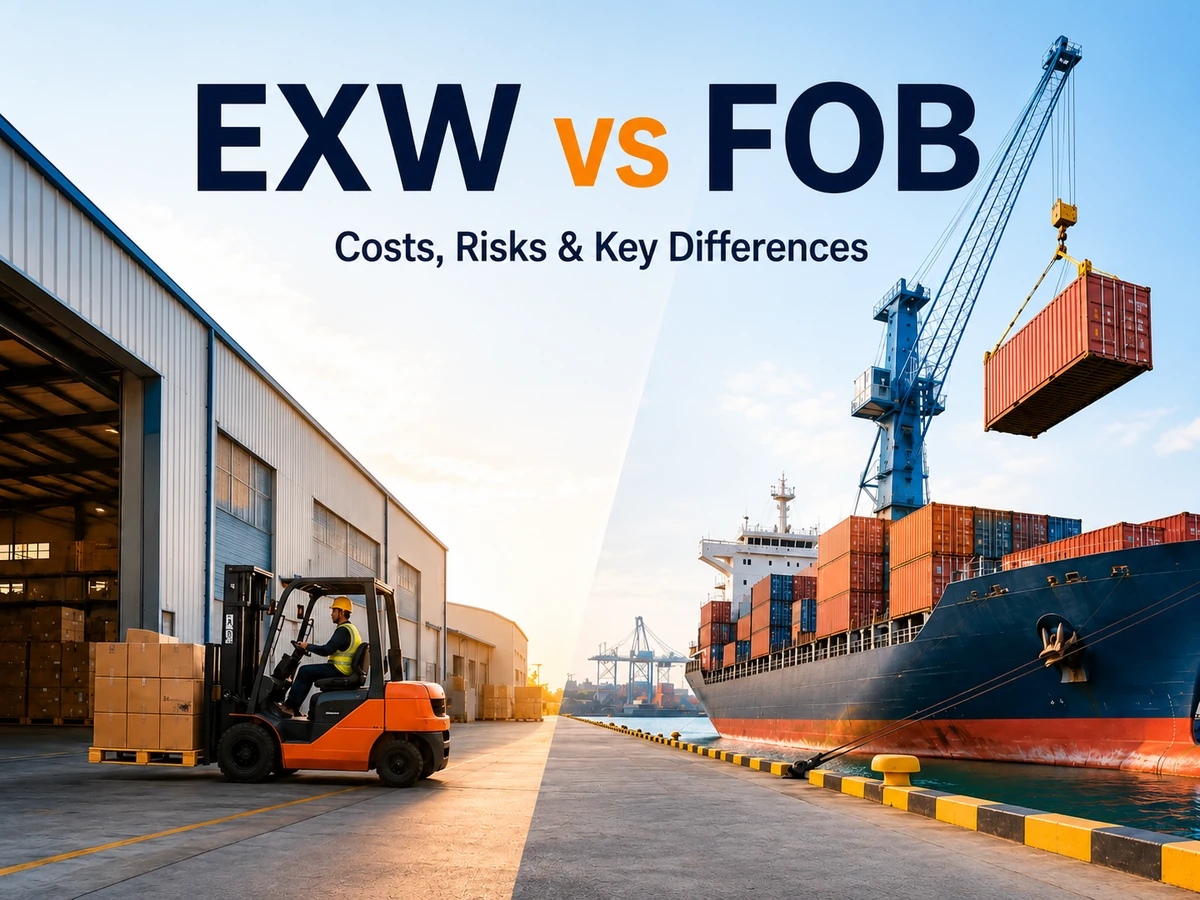
FOB usually reduces the buyer’s origin workload because the seller clears the export and delivers the goods on board the vessel. EXW gives the buyer more control but makes the buyer arrange pickup, loading, and export formalities. Importers should choose based on transport mode, cargo type, and their ability to manage origin operations. For containerized or multimodal freight, FCA often matches the actual carrier handoff better than EXW or FOB.
What Are the Main Differences Between EXW and FOB?
EXW transfers delivery risk at the named place before loading, while FOB transfers risk after the goods are on board the nominated vessel. That difference changes who controls origin handling, who clears the export, and which charges belong in the seller’s price.
|
Decision point |
EXW |
FOB |
|---|---|---|
|
Delivery and risk transfer |
Goods are available at the named place, usually the seller’s facility, not loaded |
Goods are on board the buyer-nominated vessel at the named port of shipment |
|
Origin loading and delivery |
Buyer arranges loading at the EXW named place |
Seller bears the cost and risk until delivery on board |
|
Export clearance |
Buyer responsibility |
Seller responsibility |
|
Main carriage |
Buyer arranges and pays |
Buyer arranges and pays |
|
Suitable transport |
Any mode, though ICC describes EXW as primarily suited to domestic trade |
Sea or inland waterway only, mainly when cargo moves directly on board |
|
Main buyer concern |
Local pickup and export authority |
Loss of control before containerized cargo reaches the vessel |
Incoterms define delivery, risk, cost, and task allocation between seller and buyer. They do not replace the sales contract, carrier contract, customs law, or insurance policy.
Delivery and Risk Transfer Points
Risk timing decides who bears accidental loss or damage during origin handling. Under EXW, risk transfers when the seller makes the goods available at the named place, before loading. Under FOB, risk transfers when the goods are on board the nominated vessel. If a forklift damages EXW cargo after delivery, the buyer may bear the loss. If an FOB buyer fails to provide required vessel or loading notice, the buyer may bear the resulting risk and costs.
Loading and Export Clearance Responsibilities
EXW makes the buyer arrange loading and export clearance. FOB makes the seller clear the export and deliver the goods on board. Before booking, the contract should identify:
- Who supplies loading labor and equipment at the named place
- Who files the export declaration and provides supporting documents
- Which vessel, loading point, and timing notices the buyer must provide
- Who pays if missing instructions cause storage or handling charges
An EXW buyer may lack the local registration needed to act as exporter. National customs law, rather than the Incoterms rule, decides who may file the declaration. The seller must provide specified EXW assistance when requested, but the buyer bears the related cost and risk.
Transport Mode and Cargo Suitability
Match the term to the transport mode and the point where the carrier receives the cargo.
EXW applies to any transport mode, although the ICC describes it as primarily suitable for domestic trade. For cross-border shipments, FCA often gives the buyer a more practical handoff because the seller clears the export and delivers to the carrier.
FOB applies only to sea and inland waterway transport. It fits bulk, breakbulk, and other sea freight from China delivered directly on board. FOB does not apply to air, rail, road, or courier shipments.
FOB can leave a control gap for containerized freight. The seller may hand a sealed container to the terminal, lose physical control, and retain risk until delivery on board.
Origin Cost Allocation
Compare EXW and FOB at the same service boundary, because the supplier prices cover different origin work.
|
Origin cost |
EXW |
FOB |
|---|---|---|
|
Checking and packaging |
Seller |
Seller |
|
Factory loading |
Buyer |
Seller bears cost and risk through delivery on board |
|
Export clearance |
Buyer |
Seller |
|
Origin transport and terminal handling |
Buyer |
Seller through delivery on board |
|
Main carriage |
Buyer |
Buyer |
A higher FOB goods price can still produce a lower landed cost. Local trucking, export filing, terminal handling, and coordination charges decide the result.
Quote Scope and Landed Cost
An EXW or FOB label does not make a freight quote complete. A comparable quote should identify:
- Supplier price and exact named place or port
- Factory loading, pickup, and export clearance
- Origin terminal charges and main freight
- Destination handling, brokerage, duties, and final delivery
Start with the supplier’s price, then add every cost from that term’s delivery point to the final destination. A useful comparison looks like this:
Supplier price + origin costs paid by the buyer + main freight + destination costs + customs charges + final delivery = estimated landed cost
Do not assume a prepaid freight line includes destination terminal fees. The buyer should identify each destination charge before accepting the sales term or booking freight.
What Risks Can Importers Face Under EXW and FOB?
EXW exposes the buyer to risk before pickup, while FOB can leave a control gap between terminal handoff and delivery on board. Importers need written loading terms, a lawful export setup, and a complete origin quote.
Coordinating Factory Pickup and Loading
Under EXW, the buyer must send a suitable vehicle and arrange loading. Problems start when the factory loads as a courtesy but the contract does not state who bears the loading risk. A dropped pallet can then trigger a dispute between the supplier, pickup carrier, and buyer.
The buyer should confirm these points before pickup:
- Exact collection address, gate, warehouse, and contact
- Cargo dimensions, weight, packaging, and handling limits
- Loading party, equipment, appointment, and waiting time terms
- Condition records and the point when the carrier signs for the cargo
When an importer buys from multiple suppliers, a cargo consolidation service can collect, repack, palletize, and combine shipments before export. The service scope still needs to state where each supplier’s risk ends and where the consolidator accepts the cargo.
Managing Export Clearance and Documentation
EXW creates an export problem when the buyer cannot legally file in the seller’s country. The seller may control records, licenses, product details, or tax documents needed for clearance. The buyer may also need a locally authorized customs representative. FOB avoids this split at export because the seller clears the goods, but the buyer still handles import clearance. Before pickup, importers using a global freight forwarder should confirm the declarant, document owner, filing deadline, and correction process.
Handling Containers Before Onboard Delivery
FOB risk transfers when the goods are on board, not when a container reaches the terminal. During that gap, the terminal may control the container while the seller still bears risk. The buyer controls the vessel booking, so late details or a missed cutoff can create storage and handling costs.
For containerized shipments, FCA at the seller’s premises or a named terminal usually creates a clearer carrier handoff. If the parties keep FOB, they should confirm:
- Terminal delivery point and receiving cutoff
- Responsibility for storage after a booking change
- Required vessel and loading notices
- Evidence that confirms delivery on board
Which Term Should Importers Choose?
Choose EXW only when the buyer has reliable origin support and can lawfully manage export work. Choose FOB for suitable sea cargo when the seller can handle origin transport, export clearance, and delivery on board. For containers or multimodal shipments, compare FCA before selecting either term.
EXW for Buyers With Origin Logistics Support
EXW Incoterms may fit an importer with reliable origin support and a reason to control the pickup carrier.
Before using EXW, confirm who will load the vehicle and who may file the export declaration. The origin team also needs the required documents and a complete cost breakdown through the departure terminal. EXW is usually unsuitable if the buyer lacks local authority or no party accepts loading responsibility.
FOB for Buyers Needing Seller-Managed Origin Handling
FOB Incoterms may fit bulk, breakbulk, or other sea cargo loaded directly on board. The seller must be able to clear the export and complete onboard delivery. The buyer still nominates the vessel, manages main carriage, and verifies which origin charges the FOB price includes.
Container buyers should not choose FOB only because suppliers quote it often. FCA may match the actual handoff more closely because risk can transfer when the seller delivers to the carrier.
FAQs
Do EXW or FOB Determine When Ownership of the Goods Transfers?
No. EXW and FOB allocate delivery tasks, costs, and risk of loss, but Incoterms 2020 does not determine when title or ownership transfers. The sales contract should state the title transfer point and governing law because that point may differ from the transfer of risk.
Does Either EXW or FOB Require Cargo Insurance?
No. Incoterms 2020 does not require either party under EXW or FOB to arrange cargo insurance for the other. The party bearing transit risk should consider coverage from the transfer point and review the insured value, exclusions, route, deductible, and claims process.
Is FOB Destination Under the U.S. UCC the Same as FOB Under Incoterms 2020?
No. FOB under Incoterms 2020 applies only to sea or inland waterway transport. Risk transfers when the goods are on board at the port of shipment. Under U.S. UCC Section 2-319, “FOB destination” generally keeps transport cost and risk with the seller until tender at the named destination. The contract should identify the rule system and governing law.
Does Choosing EXW or FOB Change the Customs Value or Import Duty?
Not by itself. EXW or FOB does not set the customs valuation method or duty rate, but the invoice components may affect required valuation adjustments. For U.S. imports using transaction value, CBP may exclude international freight and insurance when the importer identifies those costs correctly. Customs value may also require additions for assists, selling commissions, royalties, packing, or certain proceeds. Give the customs broker a cost breakdown instead of using the Incoterms label as the declared value.