
The Federal Register confirmed that the Federal Maritime Commission’s demurrage and detention billing rule became effective on May 28, 2024. The rule matters to importers because destination-side disputes often turn on invoices, free-time limits, and release timing after cargo arrives.
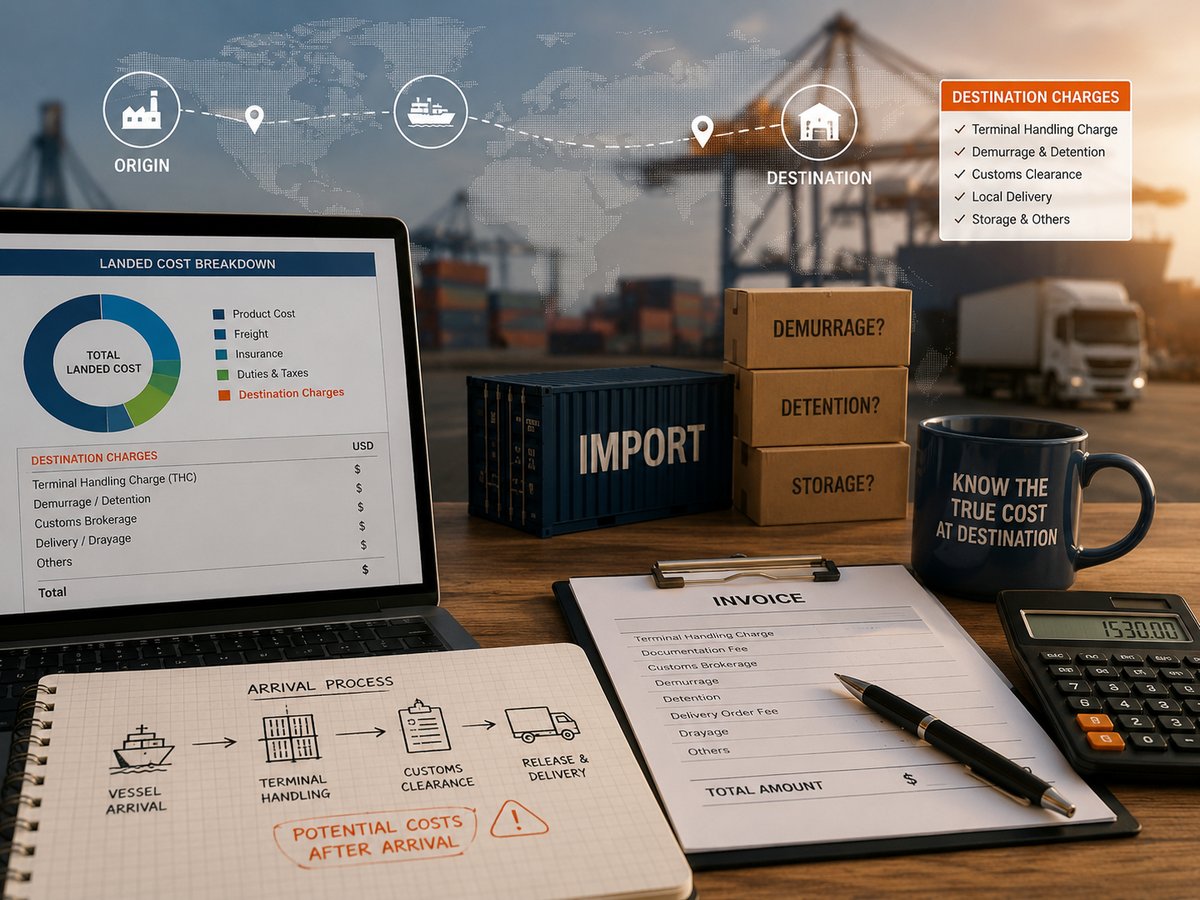
A destination charge is a local cost at the arrival side of an international shipment. This guide explains what destination charges include, who pays under common trade terms, how these fees affect landed cost, and how Foresmart helps importers check quote scope before booking.
What Is a Destination Charge in Shipping?
A destination charge is a local import-side fee billed after cargo arrives. Importers may see it on an arrival notice, terminal invoice, customs invoice, or delivery bill.
Destination charges cover release, customs support, storage, local handling, and delivery after arrival. The main risk is quote scope. A port-to-port rate may exclude these fees, while door-to-door or DDP quotes should state what the seller covers, estimates, or leaves buyer-paid.
What Fees Make up Destination Charges?
Destination charges usually fall into arrival handling, release, customs, delivery, and delay fees. Some appear on most shipments. Others appear only when cargo needs storage, inspection, appointment delivery, or extra handling.
|
Fee group |
Examples |
Buyer action |
|---|---|---|
|
Terminal and release |
Destination THC, CFS, delivery order |
Ask whether the quote includes release fees |
|
Customs and documents |
Entry, brokerage, duties, taxes |
Confirm who files entry and quotes duties |
|
Delivery and accessorials |
Drayage, appointment, liftgate, waiting time |
Share delivery rules before booking |
|
Storage and delay |
Storage, demurrage, detention, missed free time |
Track free days and clear release items before deadlines |
Who Pays Destination Charges?
The party that pays destination charges depends on the Incoterms rule, sales contract, and freight quote scope. FOB, CFR, and CIF imports often leave destination-side costs with the buyer, while DAP and DDP move more destination work to the seller or its freight partner.
|
Trade term |
Common destination charge responsibility |
What the seller commonly covers |
Importer risk |
|---|---|---|---|
|
FOB |
Buyer often pays destination charges |
Origin export steps and loading under the rule |
Destination THC, customs, delivery, and delay fees may sit outside the freight rate |
|
CFR |
Buyer often pays destination charges |
Main ocean freight to named destination port |
Arrival-side release, customs, and delivery can still be buyer-paid |
|
CIF |
Buyer often pays destination charges |
Main ocean freight and cargo insurance to named destination port |
Insurance does not pay destination handling |
|
DAP |
Seller often covers delivery to named place, buyer handles import clearance and duties unless agreed otherwise |
International freight and delivery to named place |
Customs, duties, taxes, or clearance fees may still be buyer-paid |
|
DDP |
Seller usually covers import clearance, duties, taxes, and delivery when priced correctly |
Door delivery with import cost responsibility |
Buyer should confirm exclusions, product restrictions, and local accessorial fees |
FOB, CFR, and CIF Terms
FOB, CFR, and CIF can confuse buyers because main freight may be prepaid while destination handling stays buyer-paid. CIF is the common trap: insurance and ocean freight to the named port do not include customs clearance, terminal release, storage, delivery, duties, or taxes after arrival. That is why the named place in Incoterms in shipping matters more than the three-letter term alone.
DAP and DDP Terms
DAP and DDP can reduce buyer-side surprise when the quote is clear. Under DAP, the seller commonly arranges transport to the named destination, while the buyer may still handle import clearance and pay duties or taxes. Under DDP, the seller takes broader import cost responsibility, including customs clearance and duties paid.
Importers should still ask for exclusions. DDP may exclude limited-access delivery, waiting time, product-specific customs issues, inspections, or storage caused by buyer documents.
Port-to-Port and Door-to-Door Quotes
Port-to-port quotes usually end at the destination port or terminal, so release, customs clearance, local trucking, delivery appointment, and delay fees may remain open. Door-to-door quotes are easier to compare when the quote names the final address and lists which destination charges the seller covers or bills separately.
How Do Destination Charges Affect Your Total Shipping Cost?
Destination charges affect total shipping cost by adding local arrival, release, customs, storage, and delivery costs after the importer pays main freight. For small LCL shipments, these arrival-side costs can be a large share of landed cost.
Separating Destination Charges from Freight Charges
Freight charges and destination charges serve different parts of the shipment, so importers need both numbers to compare landed cost on the same basis.
|
Cost type |
Purpose |
Billing timing |
Examples |
Importer risk |
|---|---|---|---|---|
|
Freight charge |
Moves cargo through the main transport leg |
Quoted before booking and paid before or during shipment |
Ocean freight, air freight, fuel surcharge, origin pickup if included |
A cheap freight rate may exclude local arrival costs |
|
Destination charge |
Releases, clears, stores, or delivers cargo after arrival |
Often billed near arrival or before cargo release |
Destination THC, CFS, delivery order, customs entry, storage, demurrage, drayage |
Fees may appear after the importer has already paid freight |
When comparing quotes, ask whether the amount is freight-only, port-to-port, or door-to-door. Importers who separate freight charges in shipping from local arrival costs can compare landed cost on a cleaner basis.
Spotting Fees After Freight Payment
Importers often spot destination charges when the arrival notice arrives. Compare the notice against the original quote, then ask who charged any new fee: carrier, terminal, customs broker, warehouse, trucker, or forwarder.
Checking Quote Scope Before Booking
Quote scope matters more than the headline freight rate. Before booking, ask the forwarder to mark included, excluded, and estimated items so destination-side costs do not appear only after arrival.
|
Quote item |
Should ask |
Why it matters |
|---|---|---|
|
Trade term |
Which Incoterms rule and named place apply? |
Cost responsibility changes by term and destination point |
|
Mode and service scope |
Is the quote port-to-port, airport-to-airport, door-to-port, or door-to-door? |
The service scope controls which destination charges remain open |
|
Destination terminal charges |
Are destination THC, CFS, and release fees included? |
These fees often appear before cargo release |
|
Customs clearance |
Is brokerage or customs entry support included? |
Clearance gaps can create storage and delay fees |
|
Duties and taxes |
Are duties and taxes included, estimated, or buyer-paid? |
Duties and taxes are separate from handling charges |
|
Free time |
How much free time applies for storage, demurrage, and detention? |
Missed deadlines can raise cost quickly |
|
Delivery details |
Is final delivery included to the named address? |
Residential, liftgate, appointment, and waiting fees can change the bill |
|
Exclusions |
Which destination charges are not included? |
Clear exclusions reduce quote disputes after arrival |
How Does Foresmart Help Importers Manage Destination Charges?
Foresmart helps importers manage destination charges by turning arrival-side costs into named quote items before booking. The team checks trade terms, destination handling, customs scope, delivery needs, and known exclusions so importers can compare the full cost before cargo leaves China.
Line-Item Quote Review
Foresmart is a China-origin global freight forwarder founded in 2007, with NVOCC credentials, FMC code 031352, and WCA ID 130815. Importers can ask Foresmart to separate freight, origin charges, destination charges, customs-related items, duties or taxes if applicable, delivery, and known exclusions.
DDP Quote Planning
For buyers who want fewer open destination items, Foresmart can quote door-to-door shipping with customs clearance and duties paid under DDP when the cargo, destination country, and product details fit that service. DDP does not remove duties. It plans those import costs into the quote instead of leaving them as separate buyer-side bills.
Consolidation for Multiple Suppliers
Foresmart’s consolidation service also helps buyers who purchase from multiple Chinese suppliers. Foresmart can receive cargo in 10 China cities, including Shenzhen, Guangzhou, Yiwu, Xiamen, Shanghai, Dalian, Qingdao, Tianjin, Ningbo, and Foshan, then repack, palletize, and combine shipments. One planned consolidated shipment can reduce repeated local handling steps compared with multiple scattered small shipments.
FAQs
Why are LCL destination charges sometimes high for small shipments?
LCL destination charges can feel high because arrival-side fees often use minimum charges, not pure weight-based rates. A small shipment may still need CFS handling, document release, customs entry, storage control, and delivery coordination, so the fixed local cost can take up a large share of the total bill.
What happens if I pay destination charges late?
Late payment can delay cargo release and may trigger storage, demurrage, detention, or missed delivery appointment fees. The exact result depends on the carrier, terminal, CFS, warehouse, and local free-time rules. Importers should pay approved release items before the deadline and dispute unclear charges fast.
Can I dispute destination charges on an arrival notice?
Yes, importers can question destination charges on an arrival notice when a fee looks duplicated, undisclosed, wrongly applied, or tied to a service that was not provided. Ask for the charging party, tariff basis, invoice detail, and contract reference. Pay time-sensitive release items first when delay fees would be worse.
What documents help prevent extra destination charges?
Clean documents help prevent extra destination charges by reducing clearance delays and release problems. Importers should prepare the commercial invoice, packing list, bill of lading or air waybill, arrival notice, import permits when required, customs bond details for the United States, and accurate consignee information before cargo arrives.
How do consolidated shipments change destination charges?
Consolidated shipments can reduce repeated destination handling because multiple supplier orders move as one planned shipment instead of separate small shipments. The importer may still pay destination charges, but the fee structure can be easier to review because one shipment plan groups release, customs, and delivery steps.
LCL destination charges can feel high because arrival-side fees often use minimum charges, not pure weight-based rates. A small shipment may still need CFS handling, document release, customs entry, storage control, and delivery coordination, so the fixed local cost can take up a large share of the total bill.
Late payment can delay cargo release and may trigger storage, demurrage, detention, or missed delivery appointment fees. The exact result depends on the carrier, terminal, CFS, warehouse, and local free-time rules. Importers should pay approved release items before the deadline and dispute unclear charges fast.
Yes, importers can question destination charges on an arrival notice when a fee looks duplicated, undisclosed, wrongly applied, or tied to a service that was not provided. Ask for the charging party, tariff basis, invoice detail, and contract reference. Pay time-sensitive release items first when delay fees would be worse.
Clean documents help prevent extra destination charges by reducing clearance delays and release problems. Importers should prepare the commercial invoice, packing list, bill of lading or air waybill, arrival notice, import permits when required, customs bond details for the United States, and accurate consignee information before cargo arrives.
Consolidated shipments can reduce repeated destination handling because multiple supplier orders move as one planned shipment instead of separate small shipments. The importer may still pay destination charges, but the fee structure can be easier to review because one shipment plan groups release, customs, and delivery steps.