

When you are looking for international suppliers for your business, you will normally find that those prices are based on some trade terms. These trade terms are officially called Incoterms, formulated by ICC. Incoterms standardize buyers’ and sellers’ obligations and aim to minimize any misunderstanding and divisions.
Here we will introduce one of the frequently used Incoterms, EXW Incoterms. We’ll also examine EXW’s meaning and how it differs from other popular terms like FOB and DDP, as well as its advantages, best uses, and common questions.
What are EXW Incoterms?
EXW stands for Ex Works. It is one of the 11 shipping Incoterms, which divide duties between buyers and sellers.
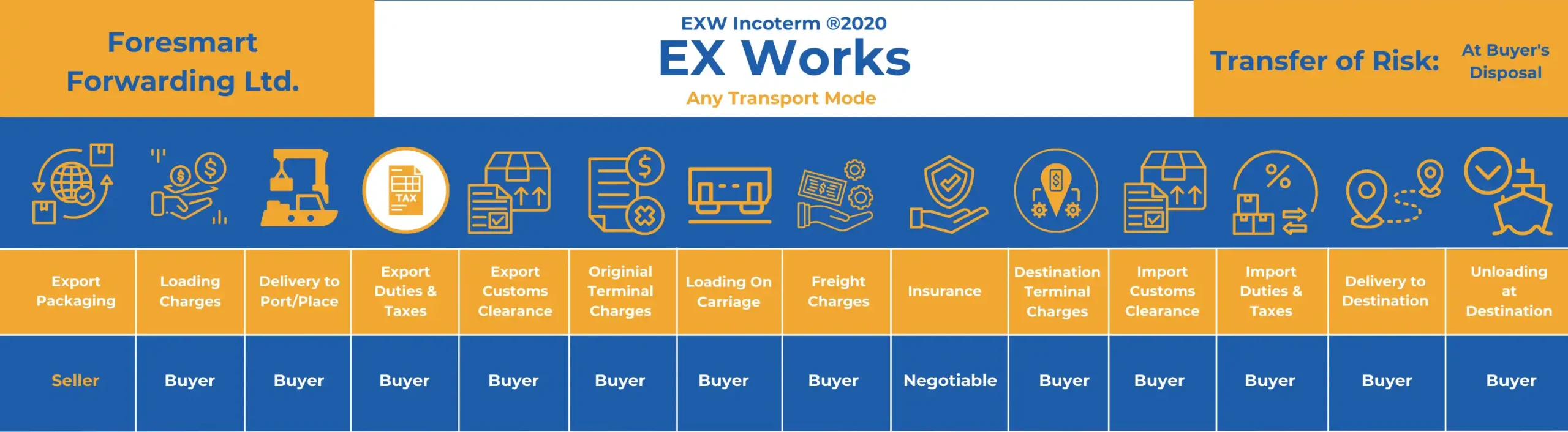
EXW Incoterms represents the minimum responsibility for sellers. With EXW terms, the seller makes goods available at their premises. They do not handle loading or any export procedures. Buyers arrange the pickup of goods from the seller’s location and take responsibility for it from there.
Key EXW Incoterms responsibilities
EXW has a clear division of obligations between seller and buyer:
Seller Responsibilities
- Make goods available for pickup at the premises.
- Provide commercial invoices and documents necessary for export.
Buyer Responsibilities
- Arrange pickup of goods from the seller’s warehouse: load the goods and deliver them to the port.
- Handle export and import customs, duties, and taxes.
- Arrange international shipping.
- Deliver goods to the final destination and unload the goods.
- Pay all transportation costs and take all risks since goods are received at the seller’s factory.
We always recommend you insure goods. It is negotiable between buyers and sellers who should insure the goods.
EXW shipping transfers almost all logistics duties to the buyer. The seller simply prepares items for collection on the date or within the period agreed upon. The buyer takes on nearly full logistics responsibility, but buyers also have maximum control over pick-up, transport, timing, and costs.
Advantages and disadvantages of EXW shipping terms
EXW Incoterms come with some key pros and cons for buyers:
Advantages for buyers
- Complete control over the pick-up, transport routing, and delivery.
- Flexibility in choosing freight forwarders.
- Lower purchase cost – no baked-in logistics expenses.
Disadvantages for buyers
- Lots of administrative work arranging export and shipping.
- Exposure to all risks once goods are picked up.
- Delays or costs if the export/import process causes problems.
So EXW Incoterms work very well for buyers who want maximum flexibility and oversight of their supply chain. They can negotiate better shipping rates with their trusted freight forwarder and fine-tune logistics. Buyers willing to take on that work for more control may favor EXW over other Incoterms.
Meanwhile, sellers who don’t want hassles can benefit from EXW’s simplicity. But they lose touch with goods once the buyer collects goods from them.
How to Find a Freight Forwarder in China?
EXW vs. FOB shipping terms
Newcomers to Incoterms may confuse EXW and FOB. So, what’s the difference between Ex Works and Free on Board?
With FOB terms, the seller clears goods for export and makes sure they are safely loaded onboard a vessel nominated by the buyer at a named port.
However, under EXW rules, the buyer arranges transportation from the seller’s premises and handles all export tasks. EXW Incoterms limit seller duties to making goods ready for collection at their facility.
In summary, FOB requires sellers to handle customs procedures, load goods for export shipment, and pay for original terminal fees. The risk transfers to the buyer when goods are loaded onto the board. Yet for EXW, the risk transfer happens once the buyer’s carrier receives the goods at the seller’s premises. It represents not only less work for sellers but also less liability.
EXW vs. DDP Incoterms
DDP is another Incoterms rule many buyers and sellers use. DDP stands for “Delivered Duty Paid,” and the seller handles all transportation and duties to deliver goods right to the buyer’s door.
EXW is the opposite. The seller’s only task is making goods available for the buyer’s shipping agent to collect.
So, EXW shipping minimizes sellers’ obligations, while DDP shipping maximizes sellers’ obligations. Choosing between the two depends on buyers’ and sellers’ capabilities. Buyers with limited shipping expertise may prefer DDP terms to offload logistics work. Those with well-oiled supply chain operations could favor EXW shipping to gain better control and prices.
FAQs about EXW
Who pays shipping costs with EXW terms?
The buyer handles all freight expenses in EXW shipping.
Does EXW include insurance?
No, this is negotiable. Generally, buyers cover insurance for their cargo in EXW shipping. The seller has no obligations after they make goods ready for collection.
How to analyze Ex Works price?
As the seller does not pay any transport or export fees with EXW, their pricing should reflect the value of the goods ready for pickup at their premises.
Conclusion
In closing, EXW Incoterms places minimal duties on sellers, with buyers taking on nearly full logistics responsibility and control once goods are ready for collection. While intensive for buyers, this enables maximizing supply chain oversight and efficiency. For sellers, EXW’s simplicity lowers liability and hassles.
Carefully weighing EXW advantages against intensified workload and risk exposure helps importers and exporters determine if EXW shipping suits their priorities.