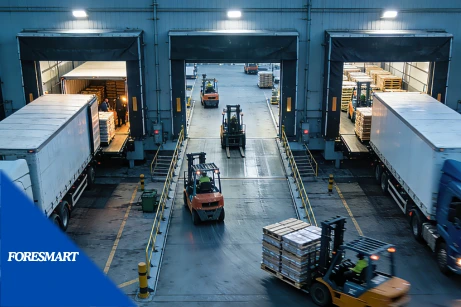
Nowadays, speed is everything in shipping. That’s where cross-docking comes in. Rather than storing goods for weeks or months, cross-docking moves products directly from inbound trucks to outbound shipments with minimal handling.
This approach reduces storage time, cuts warehouse costs, and keeps supply chains flowing efficiently. After reading this blog, you will understand the basics of how cross-docking works and how it can give your logistics strategy a competitive edge.
What Is Cross-Docking in Logistics?
Cross-docking is a simple but efficient logistics strategy to move goods. Instead of storing products for longer periods of time, items are unloaded from incoming trucks, sorted, and sent through outgoing trucks, usually the same day.
The main goal is to speed up deliveries and reduce costs. Traditional warehousing focuses on storing inventory until there is a need for it. On the other hand, cross-docking uses the facility as a transfer point rather than a storage space. As the products keep moving, it helps businesses in cutting down storage fees, handling time and inventory holding costs.
This flow is useful particularly for high-volume shipments with a predictable demand. For instance, retail goods or fast-selling consumer products.
Many companies depend on third-party logistics providers to manage their cross-docking and warehousing operations. These experts handle the coordination, equipment, and timing needed to keep shipments moving smoothly. This allows businesses to focus more on sales, customer service, and overall growth rather than worrying about day-to-day logistics.
Cross-Docking Process
The cross-docking supply chain process is designed to keep products moving with fewer delays and zero unnecessary storage. It heavily depends on coordination, timing, and live data tracking.
Inbound Receipt and Quality Check
The cross-docking services begin when inbound trucks arrive at the cross-docking facility at the receiving dock. Pre-labelled goods are then unloaded immediately and are checked for quantity and condition.
Every pallet or carton is scanned and updated on the warehouse management system (WMS). This step is important, as early accuracy will prevent downstream errors and ensure that damaged products don’t enter the distribution flow.
Sorting and Staging
After the scanning process, the goods are then entered into a central staging area. Here, sorting is done based on the final destination, delivery route, or customer order. This sorting can be done manually or through automated conveyor systems. The WMS directs workers on where each item is to be placed. This stage is the core of cross-docking solutions.
Outbound Loading
Once the goods are sorted, they’re moved to outbound dock doors and loaded onto the right trucks. The final scan confirms that each shipment contains the right item in the right quantity. Multiple trucks are being loaded at the same time, so to avoid bottlenecks, precise coordination is necessary.
Live Data & Visibility
Through the entire process, continuous scanning enters the data into the WMS. This provides full visibility, helps in identifying problems, and allows managers to make any adjustments immediately. This turns the process into a matter of hours, which once took days.
Types of Cross-Docking
Depending on a business’s needs and shipping patterns, there are different types of cross-docking to choose from. Each type has its own way of grouping, sorting, and moving products from inbound to outbound shipments. Below, we have explained the four different types in simple terms.
Consolidation and Continuous
Under this type, goods from different suppliers and locations are brought together and immediately combined into one larger outbound shipment. You can view it as gathering many smaller pieces and putting them together into one big order that is going to the same destination.
Consolidation is for minimising transportation costs, and it also makes shipping more efficient. The process time is usually a few hours to one day.
De-Consolidation
This process is the opposite of consolidation. Here, large shipments arrive at the warehouse, and then they are broken down into smaller shipments to deliver them to different destinations.
For instance, a full truckload arrives at the warehouse and is split into many smaller loads, and then they are headed to different stores. This helps businesses in delivering goods according to client needs and avoids holding the inventory in storage.
Pre-Distribution
This happens when inventory is organised and staged even before it arrives at the cross-dock facility. Products are grouped and prepared prior to arrival based on known demand, so once they arrive at the facility, they are ready to be delivered. Pre-distribution minimises handling time and speeds up the shipping process even more.
Post-Distribution
Post distribution happens when the goods arrive, sorted and then sent for short-term storage before being delivered to the final destination. This type is useful when the items can’t go straight to the outbound trucks.
For instance, maybe because delivery vehicles aren’t ready to move, or the delivery time isn’t confirmed yet. The main goal is still to minimise longer storage time, but this type of cross-docking allows a brief holding period to organise final deliveries.
Each of these types is for different operational goals, from cutting transportation costs to speeding up delivery time. However, all these are to make the supply chain smoother and more flexible.
Benefits & Drawbacks of Cross-Docking
Although cross-docking warehouse operations provide certain benefits, they also present some major operational challenges. Understanding this trade-off between speed and complexity will help you in managing your inventory.
Benefits of Cross-Docking
Faster Delivery Times
One of the major benefits is speed. The products are moved from inbound trucks to outbound trucks for delivery with little to no storage in between. This smooth and fast flow helps businesses in meeting tighter deadlines and improves customer satisfaction.
Reduced Storage Costs
As products aren’t stored for longer time periods, businesses can save on warehouse expenses. There is no need for a bigger storage space, less labour is required to move items, and reduced cost to manage inventory.
Lower Handling Damage Risks
Storage isn’t required most of the time, which results in much less touching between unloading and departures. This minimises the risk of damaging goods during transit and is particularly best for items that are fragile and require extra handling.
Better Inventory Turnover
Cross-docking appreciates a leaner inventory system. Rather than holding large stock levels, goods are moved quickly in the supply chain. The best part of this is that it improves cash flow and minimises the risk of excess or outdated inventory.
Drawbacks of Cross-Docking
High Setup and Coordination Needs
Cross-docking only works best when incoming and outgoing shipments are scheduled closely together. This requires strong planning and reliable transport partners on board.
For small businesses, this complexity can be challenging at times as it requires extra effort.
Limited Use Cases
Cross-docking is not suitable for all products. Goods needing long-term storage, fragile items that require careful handling, or products needing assembly or customization do not benefit from this model.
Dependency on Stable Processes
Cross-docking processes require stable and predictable supply chains. If your shipments are arriving at inconsistent times or delivery is delayed, the entire system can slow down, which will cause bottlenecks rather than speeding up the delivery process.
Frequently Asked Questions (FAQs)
What are the main types of cross-docking?
The four main types of cross-docking include consolidation and continuous, de-consolidation, pre-distribution and post-distribution. Each of these types serves different needs and operational goals.
What skills are needed for cross-docking?
For cross-docking, one needs to be familiar with warehouse equipment, such as forklifts and pallet jacks. Also, the staff must be a self-starter and have excellent organisational skills to be able to manage multiple activities, have problem-solving skills, and display a willingness to learn and improve.
The four main types of cross-docking include consolidation and continuous, de-consolidation, pre-distribution and post-distribution. Each of these types serves different needs and operational goals.
For cross-docking, one needs to be familiar with warehouse equipment, such as forklifts and pallet jacks. Also, the staff must be a self-starter and have excellent organisational skills to be able to manage multiple activities, have problem-solving skills, and display a willingness to learn and improve.