
If you sell online, ship packages regularly, or want to send a care package to someone serving overseas, you may come across an unfamiliar address type: APO address.
It looks like a normal U.S. address, but it follows special routing rules, comes with shipping limits, and can cause surprises if handled incorrectly. If the format is wrong, your package may be delayed, returned, or held up. There are also FPO and DPO addresses, similar to APO addresses.
So what is an APO address? And what about FPO and DPO? Below is a plain, practical breakdown of what you need to know.
What Do APO/FPO/DPO Addresses Stand For?
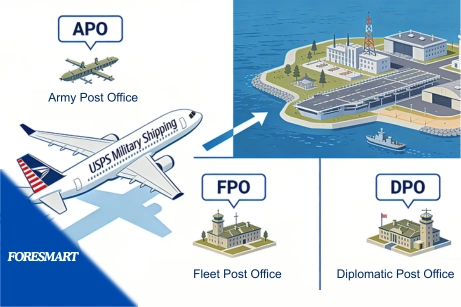
APO means Army Post Office or Air Force Post Office.
FPO means Fleet Post Office, used by Navy and Marine Corps addresses.
DPO means Diplomatic Post Office, which serves the U.S. embassy and diplomatic personnel overseas.
Think of these labels as a map; they tell the mail system which special military or diplomatic “fast lane” to take.
Why These Addresses Exist and How Routing Works?
Military and diplomatic mail requires special handling. When you use APO, FPO, or DPO addresses, USPS treats the package as domestic mail during sorting. After that, the parcel is handed over to military or diplomatic logistics for overseas delivery.
Because of this special process, you must NOT include the foreign city or country name. Adding them can cause the mail to be sent through the regular international postal system, leading to delays or customs issues.
In practice, an APO/FPO/DPO address looks like a normal U.S. address, but after USPS processing, it follows a separate, secure route through military or diplomatic channels.
The Correct Address Format
A valid APO/FPO/DPO address usually has these parts in order: full recipient name, rank or unit if applicable, the box or PSC/Unit line, the APO/FPO/DPO written in the city field, the two-letter military state (AA, AE, AP), and the 5 or 9-digit ZIP code.
Example:
Sergeant Jane Doe
PSC 3 BOX 4120
APO AE 09021
Do not include a foreign country or city name.
Always include a return address.
Mail must be addressed to a specific person or unit; “Any Service Member” or “Soldier” is no longer allowed. This format is enforced to keep automated sorting working and to prevent mail from entering foreign systems by mistake.
The Three Military “States” and What They Mean
The USPS maps overseas regions into three pseudo-states:
-
AA covers the Americas, excluding Canada.
-
AE covers Europe, the Middle East, Africa, and Canada.
-
AP covers the Pacific region.
Those two-letter codes replace a state name in the address so the USPS machines and military dispatch centers can correctly funnel mail. If you pick the wrong code, routing slows down.
Special Rules and Common Restrictions
There are a few critical constraints:
Do not add city or country. That is the rule, always.
Mail must be to a named recipient or a unit, not generically addressed.
Certain size limits apply, especially for DPO addresses. Because of how diplomatic pouches are handled, some DPO locations restrict package dimensions. Oversized items may be refused or returned. Always check the receiving post office’s rules before sending large parcels.
There are content restrictions and national security inspections. Packages can be opened for inspection and some items are disallowed by either USPS or the receiving military or diplomatic authority.
Customs, Fees, and Who Pays What
Here is one nice thing: As USPS treats most APO/FPO/DPO mail as domestic, rates for Priority Mail to APO addresses are often the same as U.S. domestic Priority Mail. But customs rules still matter for large parcels and for carriers other than USPS.
If you use a private carrier, check whether they will accept APO/FPO/DPO addresses; many do not, or they convert to USPS handoff.
Also, some items that would be duty-free for a resident in country X might still be inspected. Pay attention to the proper customs forms for packages over carrier thresholds. Be clear with the recipient about expected timing and potential customs hold-ups.
Practical Shipping Tips for Sellers and Individuals
-
Format exactly as USPS examples show. No country, no city. Use AA/AE/AP. Include return address.
-
Use the right carrier service. USPS is the simplest route for APO/FPO/DPO. Private carriers may accept the label but frequently hand off to USPS. Check before you buy postage.
-
Measure and weigh accurately. Weight mistakes cost you and slow things down.
-
Think about content. Food, batteries, and hazardous items often require special labeling or are prohibited. If in doubt, check the USPS military mail restrictions page.
-
Track and insure. Use services that offer end-to-end tracking and insurance designed for military mail when sending valuable items.
Closing Notes
You can treat the APO address, FPO address, or DPO address as domestic in format and postage when using USPS. But do not assume the parcel will move like a typical domestic ground package.
Routing, inspections and local military/diplomatic constraints add variables. If you follow the format and rules above, you avoid most delivery problems.
For commercial sellers, build an FAQ, show format examples at checkout, and automate validation to keep returns down. The small extra care up front saves time and avoids angry customers.
FAQS
Can I include the foreign city or country on the label?
No. Do not add a foreign city or country. That can route mail into civilian international streams and cause delays or rejection.
Can I ship to APO/FPO/DPO with UPS, FedEx, or DHL?
Usually no. USPS is the primary carrier for direct delivery to APO/FPO/DPO. Private carriers often hand packages off to USPS or will not deliver directly. Confirm with the carrier first.
Are APO/FPO/DPO shipments treated as domestic for postage and customs?
USPS prices many APO/FPO/DPO services like domestic mail, but military/diplomatic shipments follow special rules and customs requirements. Check USPS guidance for the service you choose.
What items are commonly restricted or prohibited?
Hazardous goods, certain foods, and items restricted by the receiving command or country may be barred. Packages may be inspected. Always review USPS military or diplomatic restrictions before shipping.
No. Do not add a foreign city or country. That can route mail into civilian international streams and cause delays or rejection.
Usually no. USPS is the primary carrier for direct delivery to APO/FPO/DPO. Private carriers often hand packages off to USPS or will not deliver directly. Confirm with the carrier first.
USPS prices many APO/FPO/DPO services like domestic mail, but military/diplomatic shipments follow special rules and customs requirements. Check USPS guidance for the service you choose.
Hazardous goods, certain foods, and items restricted by the receiving command or country may be barred. Packages may be inspected. Always review USPS military or diplomatic restrictions before shipping.