
As there is an expansion in the global trade networks nowadays, the challenges of managing these goods have also increased. Provided the diversity of goods that pass through customs daily, it is extremely important to handle them efficiently. That’s where HS codes are employed.
What is an HS code? The Harmonized System code (HS code) refers to a six-digit value used to classify shipments that are being traded internationally and assemble useful information in terms of codes.
If your trade involves the U.S., you will also use relevant customs codes such as the HTS codes or Schedule B codes. This blog will help you understand their functions and differences.
How Do HS Codes Work?
In 1983, the World Customs Organization (WCO) introduced the concept of HS codes in international trading and shipping of goods. HS codes are reviewed every 5 years, considering the fluctuations in technologies and patterns.
The HS Code system categorizes goods on the basis of a 6-digit number that is recognized internationally. This ensures hassle-free international trade as it eliminates the need for lengthy descriptions or complicated term interpretations. It helps quickly determine the correct tariffs, duties, or taxes for imported or exported goods, preventing costly errors.
Some benefits include:
-
Standardization Across Borders
-
Faster Customs Processing
-
Accurate Duties and Taxes
-
Compliance and Legal Protection
-
Simplified Documentation
The HS code classifies goods into “chapters”, “headings”, and “subheadings”. Countries that follow the HS agreement usually classify the same product under the same section, chapter, heading, and subheading. But each country adds 2 to 4 extra digits to track its imports and exports better. For example, in the U.S., people use the HTS code and Schedule B number in customs filings.
Related Reading: How to Find My HS Tariff Code?
HTS Codes vs. HS Codes
People often confuse the HS code and HTS code. While both terms sound similar, there is a huge difference between them.
HS codes are universal 6-digit codes used for importing and exporting, while the HTS (Harmonized Tariff Schedule) code is generally 8 to 10 digits, containing the HS codes.
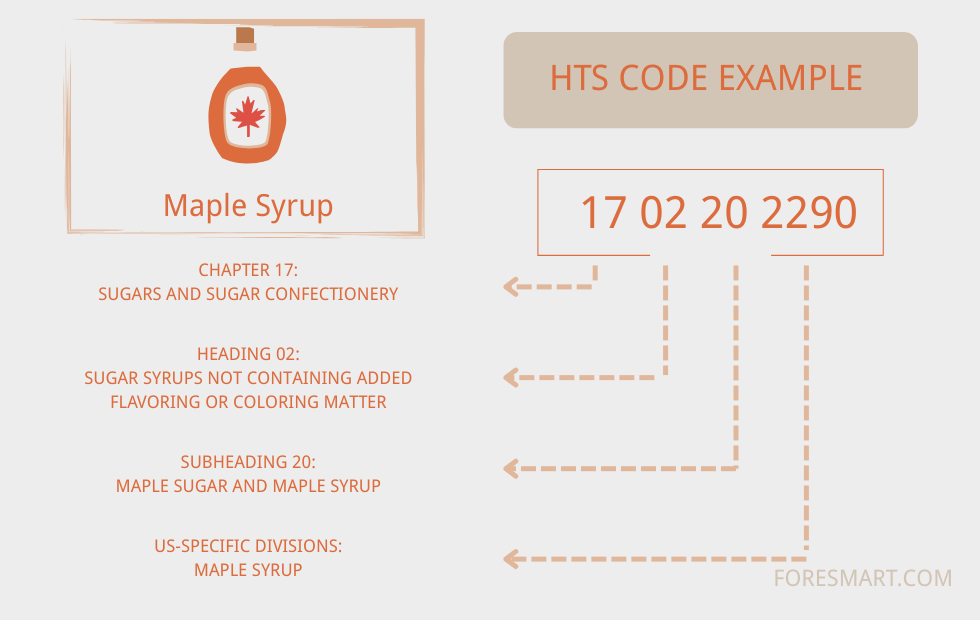
For instance, the HTS code for maple syrup is 1702.20.2290, and the former 6-digit number is the HS code, universally meaning the maple sugar products.
HTS codes are required when importing goods to the U.S. They help determine duties or tariffs you owe, import restrictions, and whether a special trade agreement applies.
Schedule B vs. HTS Codes
The Schedule B code is a 10-digit code with the first 6 digits also reserved for the HS code, while the last 4 digits indicate statistical information about the exports.
These codes are used by the U.S. government for tracking trade data and can sometimes be the same as the HTS number.
However, even though both Schedule B codes and HTS codes are based on the same HS codes, they serve different purposes. HTS codes deal with importing cargo into the U.S., while Schedule B codes mainly manage the exporting goods from the U.S.
The Schedule B code is mandatory when the shipment is valued over $2,500 or the export requires a license. These codes will be required when you’re filing Electronic Export Information (EEI) via the Automated Export System (AES).
HTS Codes & Schedule B Codes Lookup
So, how to find HTS codes and Schedule B codes?
In case you don’t know the HTS code of your product, check the general rules of interpretation (GRI’s) or directly go to the HTS lookup website, looking for the HTS that best fits your product.
For the Schedule B code lookup, the U.S. Census Bureau offers free tools on its Schedule B website to help you classify products, access training, and get support. The most commonly used tool is the “Schedule B search tool” for the classification of your products.
How Does CROSS Help with Product Classification?
When a product is hard to classify, importers and exporters can use the Customs Rulings Online Search System (CROSS) to find U.S. Customs and Border Protection (CBP) rulings on similar items. These rulings offer guidance on assigning the correct HTS (Harmonized Tariff Schedule) code and estimating duties.
While CROSS doesn’t directly provide a Schedule B code, it can still help by clarifying how goods are classified under HTS. If no relevant ruling is available, you may request a binding ruling from CBP for an official classification.
Why Should You Classify a Product Properly?
To understand why proper classification is important, consider that you are exporting parts for umbrellas. In the U.S., the HTS code for umbrella parts is 6603.20.3000. However, if you have to export the same product to Germany and use the full U.S. HTS code by mistake on the commercial invoice, the German importer’s paperwork will be rejected. This is because Germany classifies umbrella parts under 6603.20.0000.
Although the 6-digit HS subheading is the same, the additional digits in the U.S. HTS codes have led to a misclassification in Germany’s import system. Such minor mistakes can have a bigger impact in international trading, as this can lead to delays and even fines. Use of correct classification on the basis of the destination country’s tariff schedule is something you should keep in mind.
To check the customs codes when importing goods into Germany or other EU countries, visit the Taxation and Customs Union.
Final Thoughts
Getting HS, HTS, and Schedule B codes right contributes to your hassle-free international trade. A small mistake can mean delays, fines, or rejected shipments.
To avoid these headaches, businesses should use reliable databases, online tools, or consult trade experts. Proper classification keeps things moving smoothly and helps avoid costly disruptions.
FAQs
How do you differentiate between HS codes and HTS codes?
The Harmonized System (HS) Code is used internationally, and it has a six-digit number. Nevertheless, the Harmonized Tariff Schedule (HTS) Code has a ten-digit code and is specific to U.S. import filing.
What is a Schedule B Code, and how is it classified?
A Schedule B Code is used to classify U.S. exports. It is based on the HS Code but is specifically maintained by the U.S. Census Bureau for tracking export statistics and trade compliance.
How do I classify products properly in international trade?
-
You should use the online customs code lookup tool of the target country.
-
Check the Product Description. Ensure it matches the code’s definition.
-
Verify with Customs Rules.
-
Consider Consulting an Expert. A customs broker or freight forwarder like Foresmart can help.