

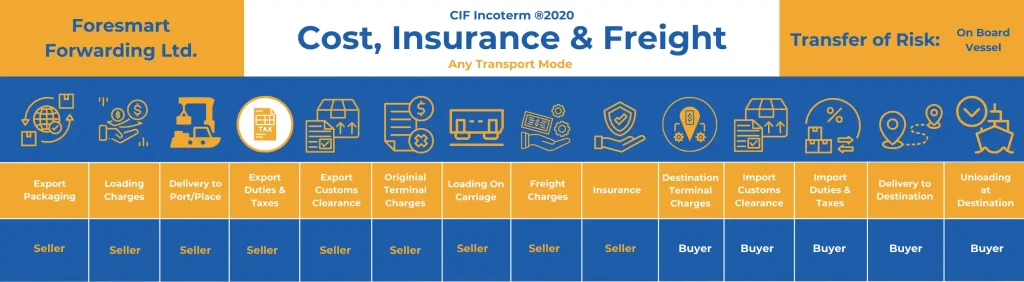
Having worked on many CIF shipping projects, we often get asked numerous questions about what CIF Incoterms stand for, how they work, and when to use them. This can be confusing, even for people who regularly import and export goods!
In this article, we’ll explain the ins and outs of CIF shipping terms, helping you understand the importance of sending goods between countries. Let’s dive in!
What is the meaning of CIF shipping terms?
CIF stands for “Cost, Insurance, and Freight.” It is one of 11 shipping rules called Incoterms, which split costs and risks between buyers and sellers when goods cross borders.
According to the International Chamber of Commerce (ICC), which draws up Incoterms, with CIF shipping, the seller pays the costs of transporting the goods over the ocean to a port in the buyer’s designed country. But once the ship reaches that destination port, things change. Now, the buyer starts being responsible for the costs.
So, it seems like under terms, the seller needs to assume more responsibility than the buyer. The seller should oversee things until the ship docks at the other port. Indeed, CIF Incoterms removes the buyer’s hassles to some degree. Yet, It is worth mentioning that the risk transfers to the buyer as long as the exported goods are loaded on the board.
What are the responsibilities of CIF Incoterms?
As we said, CIF Incoterms split up duties between the buyer and seller. Let us discover what exactly these duties are:
Seller’s Responsibilities
- Send goods to the ship
- Deal with export documents and customs clearance
- Sort out ocean freight (including export tax) and insurance
- Pay freight and insurance fees
- Send shipping paperwork to the buyer
Buyer’s Responsibilities
- Pick up goods at the destination port
- Handle import customs clearance
- Pay fees to import goods
- Arrange transport from the port to the facility
The seller arranges and pays for the goods to be put on a ship and for marine insurance, which covers any damage before they reach the destination port. They must pack the order correctly and put it on a ship sailing to the correct port.
Sellers will usually sign a contract with a shipping firm and pay the shipping bill. When the goods arrive at the destination port, the buyer starts paying. Buyers should cover the fees to import the goods and transport them from the port to the final destination.
As you can see, CIF Incoterms assign more work to the seller, which, on the other hand, also gives them more oversight of goods moving across the ocean.
Advantages and disadvantages of buyers
When using CIF Shipping, buyers should consider some pros and cons of it.
Advantages
- Predictable – Buyers only need to deal with import customs costs and local delivery fees regardless of the international shipping costs which can vary a lot.
- Less responsibility – The seller is the one who organizes shipping and insurance.
Disadvantages
- Higher starting cost – The CIF shipping cost the seller provides to the buyer includes freight and insurance fees.
- Less control – Buyers can’t impact shipping mode or timing, etc.
CIF terms work well for buyers who are happy to let the seller they trust handle logistics. They just need to pay more upfront and can then enjoy simplicity and peace of mind.
But buyers who require tight cost control or to track goods effectively may want Incoterms like FOB instead.
When to use CIF Incoterms?
Here’s when Incoterm CIF is handy:
Countries with tricky import rules
Navigating customs paperwork in some markets means steep learning curves. The buyer should be more familiar with local customs or agents compared to the seller thousands of miles away.
Sellers with rich exporting experience
If sellers have their own local carrier partner, they may get a more competitive shipping rate than buyers unless buyers can find a suitable sea freight forwarder to transport the goods. Sellers with exporting experience are also more skilled in handling customs documents.
What Is Sea Freight Forwarding?
Testing orders with a new supplier
CIF shipping saves buyers’ efforts for small test orders from a fresh seller, sparing the buyer’s international shipping hassles.
Incoterms CIP vs. CIF
People learning Incoterms often mix up CIF and CIP:
CIF means the seller pays freight and insurance before the cargo reaches the destination port.
CIP takes it further – the seller should pay the destination terminal charges. The fees occur when goods are unloaded from the ship and stored at places near the dock.
Picking CIF vs CIP depends on the buyer’s business needs and shipping abilities. CIF Incoterms suits buyers with port connections who can grab goods fast.
Conclusion
CIF Incoterms removes much of the complications and effort from buyers while still giving sellers oversight until goods reach the destination country port. For many global trade scenarios, paying a higher purchase price for simplicity and predictability is worthwhile to buyers who want to focus on their core business.
Armed with a deep understanding of CIF shipping, you’re now in a position to make informed commercial decisions and arrangements for your international orders.
FAQs about CIF Incoterms
What’s the difference between CIF and FOB?
FOB means the seller is only liable for cots before the goods are loaded onto the vessel. CIF makes the seller accountable for all costs until the goods reach the destination port.
What is the difference between CIF and DDP shipping?
DDP is another Incoterms rule that means “delivered duty paid”. The seller is responsible for international shipping, customs clearance duties and taxes, and delivery to the buyer’s final address. Under CIF, the seller only covers costs to the destination country port.
How prevalent are CIF Incoterms?
CIF is one of the most widely used Incoterms globally and suits many trading situations. According to shipping associations, over 65% of ocean freight shipments move under CIF contracts.
Do CIF Incoterms change?
Yes, CIF and other Incoterms have undergone minor updates. Recently, in 2020, environmental/sustainability best practices were formally added to CIF and other Incoterm guidelines.