
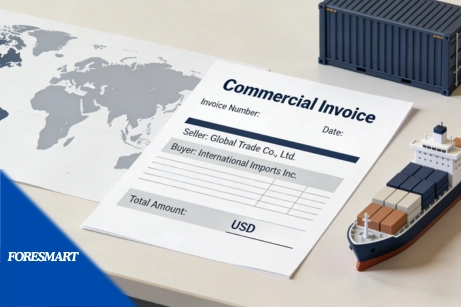
When it comes to international shipping, a commercial invoice or an international invoice is a critical document. It details the sale of the goods between an exporter and an importer. However, it’s different from a standard invoice that’s used for domestic transactions. This international invoice drives customs clearance, duty or tax calculation, and legal compliance in both the export and import countries. Let’s look at what the commercial invoice and invoice are in detail.
Define Commercial Invoice
A commercial invoice is a legally recognized document that is issued by the exporter, the one who is selling, to the importer. The document itself details the goods being sold and shipped across international borders. It also serves as a bill of payment. Officials working in customs use this document to assess duties, taxes, and other compliance metrics that align with import regulations. It’s different from a simple sales invoice since it’s designed for cross-border trade and for a regulatory review.
The international invoice is usually prepared by the exporter, who submits it along with other international shipping documents to ensure that a shipment can move through customs. It is received by the importer and customs in the destination country.
Why Is a Commercial/International Invoice Important? When It Is Needed?
This international invoice is an important document in international trade. It’s mandatory in the customs clearance process. Customs professionals in different countries rely on this document to get the official shipment details and ensure compliance with the laws. Without such documents, goods can get delayed or rejected at the border.
In addition, the valuation stated in the documents is used to determine taxes, customs duties, or import tariffs. For example, for goods imported to the U.S., the export invoice should reflect the true transaction value, including any assists, royalties, or proceeds. If there are errors in the custom invoice, or it’s just missing altogether, customs charges can be inaccurate.
It also supports foreign exchange, payment, and insurance: banks, insurers, and tax authorities rely on its data as the official record of the transaction.
Apart from that, the document is a legal proof of a transaction between a buyer and a seller and protects them both if there is a dispute.
Creating a commercial invoice with accuracy and submitting it on time helps businesses prevent shipment delays and allows them to avoid fines.
Commercial Invoice vs. Invoice vs. Shipping Invoice
A normal invoice is used for domestic trade only and records a sale for payment and accounting purposes. It does not include HS codes, Incoterms, country of origin, or shipping details, which are required on a commercial/international invoice. However, it supports local taxation, such as VAT or sales tax, depending on the country.
In contrast, a commercial invoice is mandatory for cross-border trade and is used for customs clearance and letters of credit.
Sometimes, exporters call the commercial invoice a shipping invoice, which causes confusion. A shipping invoice is proof of shipment that shows goods have been sent by the seller. It is used by the shipper, freight forwarder, and recipient to confirm what was shipped. For domestic shipments, it’s almost the same as a normal invoice, yet it doesn’t replace a commercial invoice for customs purposes in international trade.
How to Create a Commercial Invoice and Common Mistakes to Avoid
Now you know what customs commercial invoices are, how they’re used, and their importance.
To understand it further, we’ve provided a table below that details commercial invoice requirements (mainly four sections) and mistakes you should avoid.
|
Section |
Add |
Avoid |
|
Seller and Buyer Details |
Full legal names Complete addresses Contact information Tax ID, EIN, or VAT number |
Using abbreviated or trade names instead of full legal names Missing suite numbers or postal codes Incorrect or outdated contact details Omitting required tax identification numbers |
|
Product Information |
Accurate product description Quantity and packaging details Correct HS code Country of origin |
Vague descriptions like “parts” or “samples” Quantity mismatches with the packing list Incorrect or missing HS codes Failing to specify the packaging type |
|
Pricing and Payment Terms |
Unit price Total shipment value Currency used Payment terms |
Currency not clearly stated Mathematical errors in totals Missing Incoterms Inconsistent values across export documentation Unclear or omitted payment terms |
|
Shipping Information |
Port of loading Destination port Carrier details |
Listing an incorrect destination Missing carrier name Inconsistent shipment details compared to the bill of lading Failing to update changes before submission |
Commercial Invoice vs. Other Export Documentation
When preparing goods for international shipping, businesses must collect multiple forms of documentation pertaining to the shipment. Each document serves a different purpose.
Details on how commercial invoices compare to other shipping documents are provided below:
|
Document |
Purpose |
Issuance |
Legality |
Role |
|
Commercial Invoice |
Official record of sale and declaration of goods’ value |
After goods are sold and are ready for shipment |
Legally binding financial document |
Mandatory for customs clearance; used to calculate duties and taxes |
|
Proforma Invoice |
Preliminary quote or estimate provided before the sale |
Before the final sale agreement |
Not legally binding as a demand for payment |
Used for negotiation, securing financing, or obtaining import permits |
|
Packing List |
Details the physical contents of the shipment |
When goods are packed |
Not a financial document |
Helps customs and carriers verify shipment contents and quantities |
|
Bill of Lading |
Contract between shipper and carrier for transport |
When goods are handed to the carrier |
Legally binding transport contract |
Serves as proof of shipment and title of goods in transit |
Conclusion
To sum it all up, a commercial invoice is a shipping document that’s used in international trade. It’s possible for more people to think that this document serves the purpose of a billing receipt, but that’s not entirely the case. This international invoice serves as a foundation for customs processing and other legal compliance protocols. Given this, businesses need to understand what this document is and how to prepare it to avoid fines or costly shipping delays.
Frequently Asked Questions (FAQs)
Is a commercial/export invoice required for all international shipments?
Yes, it is necessary for all international shipments as it aids with verification and the calculation of customs duties, taxes, and more.
Can I use a standard invoice instead of a customs invoice?
No, standard invoices are only applicable when you have a local shipment. For international shipping, a commercial or customs invoice is necessary.
What happens if there are errors on the commercial invoices?
If this international invoice contains errors, it can cause customs delays, incorrect duties, or fines. The best course of action is to contact the exporter immediately to issue a corrected invoice and provide it to your customs broker. If the shipment has already been sent, you may need to submit an amended invoice to customs to avoid penalties.
Yes, it is necessary for all international shipments as it aids with verification and the calculation of customs duties, taxes, and more.
No, standard invoices are only applicable when you have a local shipment. For international shipping, a commercial or customs invoice is necessary.
If this international invoice contains errors, it can cause customs delays, incorrect duties, or fines. The best course of action is to contact the exporter immediately to issue a corrected invoice and provide it to your customs broker. If the shipment has already been sent, you may need to submit an amended invoice to customs to avoid penalties.