
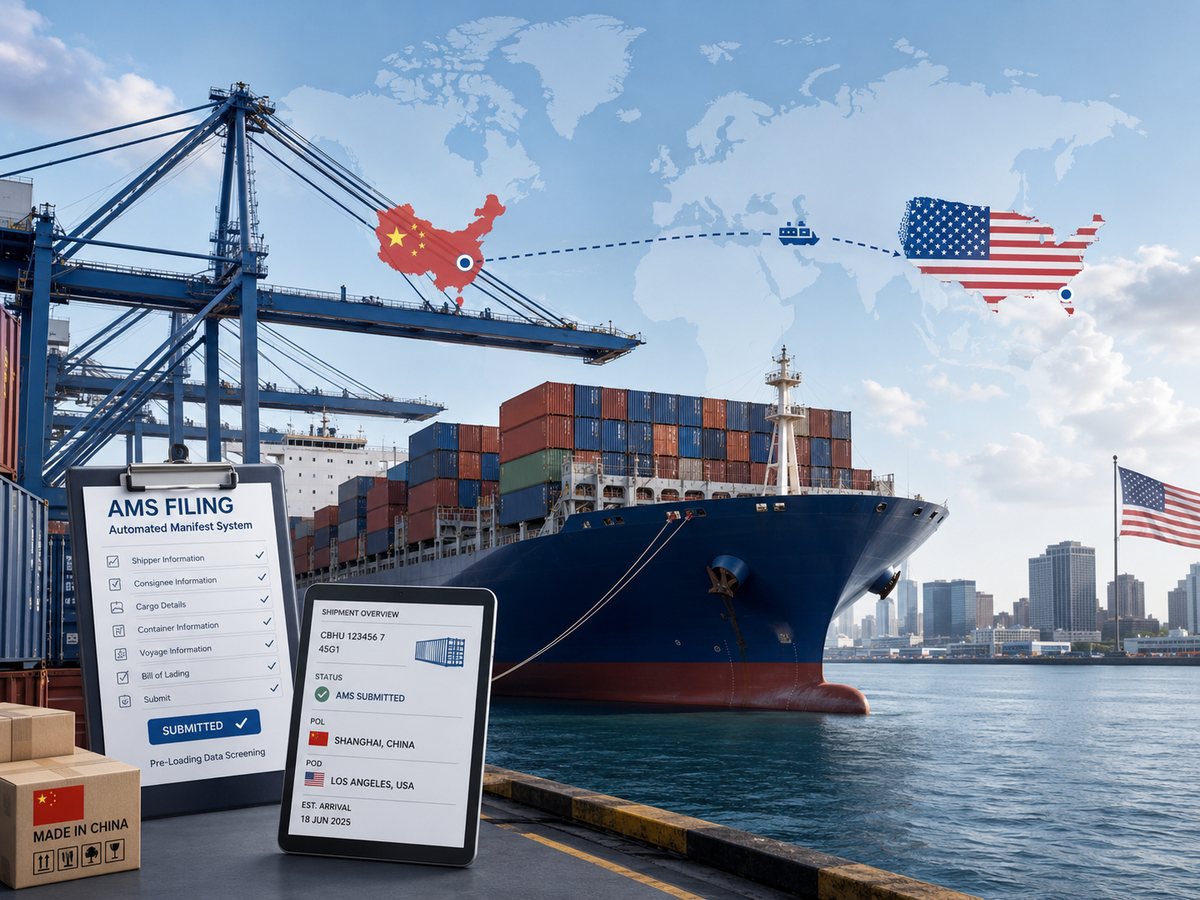
AMS is the advance ocean cargo filing US Customs and Border Protection (CBP) uses before vessel loading. CBP uses AMS to screen US-bound ocean freight before the container leaves the foreign port. Under 19 CFR 4.7, CBP must receive most containerized cargo declarations at least 24 hours before foreign-port loading. For China to USA importers, wrong AMS data can cause loading delays, filing corrections, CBP questions, and pre-arrival shipment holds.
Before the carrier cutoff, importers need four answers. Who files AMS? What data does AMS need? How is AMS different from ISF? Which supplier documents need checking?
What Is AMS in Shipping?
AMS is electronic manifest data sent to CBP before US-bound ocean cargo loads. The filing gives CBP party, bill of lading, cargo, container, vessel, voyage, and port data. CBP uses that data to screen freight before departure from China.
Automated Manifest System Meaning
The Automated Manifest System, or AMS, is CBP’s system for receiving electronic vessel cargo declaration data. In China to USA ocean shipping, “AMS filing” usually means the pre-loading manifest record. This record ties to the master bill of lading or house bill of lading.
AMS is not the customs entry, duty payment, or final cargo release. AMS filing is a pre-loading security and manifest step. The AMS record must match the shipping documents before the container reaches the terminal cutoff.
AMS Role in US-Bound Ocean Freight
AMS moves cargo screening before vessel departure. CBP reviews core manifest data before a container arrives at Los Angeles, Long Beach, New York, Savannah, or another US port.
AMS timing for China to US freight sits before sailing. A clean AMS filing helps cargo keep the booked vessel plan. One wrong field can interrupt the shipment plan. Common triggers include a wrong consignee, vague cargo description, missing container number, or unmatched bill of lading number. These issues can trigger a correction before loading or a hold later in the trip.
Who Submits AMS?
The vessel carrier normally files carrier-level AMS data. An eligible NVOCC may file house-level AMS data or send required data to the vessel carrier. The importer usually does not submit AMS directly. The importer still controls the source documents behind the AMS record.
Vessel Carrier Responsibility
The vessel operating carrier transmits vessel cargo declaration data to CBP unless another approved filing path applies. 19 CFR 4.7 requires CBP to receive the electronic cargo declaration through AMS or a CBP-approved replacement system. The deadline is 24 hours before loading at the foreign port.
The carrier’s AMS record usually follows the master bill of lading. Carrier data problems often start with booking instructions, supplier paperwork, and container details that arrive late or change after the carrier cutoff.
NVOCC Filing Role
An NVOCC may transmit required cargo declaration data directly to CBP. The NVOCC must hold Federal Maritime Commission licensing or registration and the required international carrier bond. Without that filing setup, the NVOCC sends required cargo information to the vessel carrier for AMS filing.
This filing path matters when an importer books through a forwarder that issues a house bill. The carrier’s master bill and the forwarder’s house bill shape the AMS data trail. Importers should keep the master bill of lading vs. house bill of lading structure clear before the sailing cutoff.
Importer Document Support
The importer supports AMS by checking source documents before cutoff. The main checks are:
- commercial invoice and packing list
- shipper, consignee, and supplier names
- cargo description, carton count, and gross weight
- container number, seal number, and final delivery contact
The importer may not click “submit.” Importer-side document errors can still delay the filing.
This check is urgent for China shipments with multiple suppliers. If one supplier sends a vague cargo line, the house bill may need an amendment. A carton-count change after pickup can cause the same problem before the vessel cutoff.
What Information Does AMS Need?
AMS needs enough manifest data to identify the parties, cargo, packing, container, and sailing. 19 CFR 4.7a lists cargo declaration data, including bill numbers, cargo descriptions, party details, containers, seals, vessel name, voyage number, and ports.
|
AMS data area |
What to check before cutoff |
Importer risk if data is wrong |
|---|---|---|
|
Party details |
Shipper, consignee, notify party, NVOCC or forwarder identity |
CBP questions, amendment work, mismatched delivery party |
|
Bill of lading |
Master bill, house bill, SCAC, bill number |
Filing mismatch between carrier, NVOCC, and broker |
|
Cargo details |
Precise cargo description, package count, weight, container, seal |
Vague cargo data, holds, correction fees |
|
Vessel and ports |
Vessel name, voyage, port of loading, last foreign port, first US port |
Wrong sailing record, cutoff miss, rolled booking |
Shipper and Consignee Details
AMS needs complete shipper and consignee information from the bill of lading. In consolidated shipments, the master bill may show the NVOCC or forwarder. Each house bill should reflect the real vendor, supplier, manufacturer, consignee, or delivery party where required.
Party data often fails through copying. The invoice may show one factory name. The packing list may show a trading company. The booking may show a different shipper. That mismatch can force extra document review.
Bill of Lading Information
AMS data ties directly to the bill of lading structure. The filing record may include the carrier SCAC, master bill number, house bill number, and bill-level package quantity. CBP rules also require unique bill of lading identifiers and treat bill-level data as part of the cargo declaration trail.
Importers should confirm which party issues each bill before shipment. Cargo reconciliation gets harder when the broker, carrier, and NVOCC see different shipment descriptions. The master bill, house bill, and commercial documents should describe the same cargo.
Cargo Description and Container Details
AMS cargo descriptions must be precise enough for CBP screening. 19 CFR 4.7a says generic descriptions such as “FAK,” “general cargo,” and “STC” are not acceptable for this cargo declaration data.
Containerized shipments also need container numbers and seal numbers. The lowest outside package count matters, so a container with 200 cartons on 10 pallets should list 200 cartons, not 10 pallets.
Vessel, Voyage, and Port Information
AMS includes vessel name, voyage number, loading port, last foreign port, scheduled first US port, and departure data. These fields connect the cargo record to the actual sailing.
Late booking changes create risk in this data set. If the carrier rolls the container to a later vessel, the manifest data may need updating before the new sailing moves forward.
When Do China to USA Ocean Shipments Need AMS?
AMS applies before loading on most containerized sea freight from China to the United States. CBP must receive the electronic cargo declaration at least 24 hours before foreign-port loading. Carrier document cutoffs usually come earlier. The carrier needs time to check and transmit the data.
The 24-Hour Rule Before Vessel Loading
The 24-hour rule is the core AMS deadline for containerized ocean freight. CBP must receive the electronic cargo declaration 24 hours before the carrier loads cargo aboard the vessel at the foreign port.
For a shipment leaving Yantian, Ningbo, Shanghai, Qingdao, or Xiamen, the AMS clock runs before loading in China. The deadline is not based on US arrival, customs clearance, or final delivery.
Carrier Documentation Cutoff
The carrier documentation cutoff is the practical deadline importers feel. A carrier may require bill of lading instructions and AMS data before the legal 24-hour filing point. The earlier cutoff gives carrier staff or EDI systems time to validate the record.
Missing a carrier cutoff can roll the container to the next sailing even when the cargo is physically ready. Importers should treat the carrier cutoff as the working deadline, not the last legal minute.
LCL and Consolidated Cargo Timing
LCL and consolidated cargo need earlier document discipline because multiple suppliers feed one container plan. One late supplier document can slow the house bill data for the whole consolidation lot.
Freight consolidation needs document control before warehouse receiving closes. The consolidator must check supplier names, carton counts, descriptions, marks, and weights before the NVOCC or carrier pushes the AMS data.
What Is the Difference Between AMS and ISF?
AMS is the carrier or NVOCC manifest filing. ISF is the importer security filing for ocean cargo arriving in the United States. AMS tells CBP what cargo is on the vessel. ISF gives CBP importer-side supply chain data. ISF data includes buyer, seller, manufacturer, ship-to party, country of origin, and HTSUS number.
|
Filing |
Main purpose |
Responsible party |
Core timing |
|---|---|---|---|
|
AMS |
Vessel cargo manifest screening |
Vessel carrier or eligible NVOCC |
24 hours before foreign-port loading for most containerized cargo |
|
ISF |
Importer-side security data |
ISF Importer or authorized agent |
Most core elements 24 hours before foreign-port loading |
Filing Purpose
AMS and ISF both support pre-arrival security screening, but the data sources differ. AMS follows the ocean manifest and bill of lading trail. ISF follows importer, seller, buyer, manufacturer, ship-to, origin, HTSUS, stuffing, and consolidator data.
A clean AMS filing does not mean the ISF is complete. Importers still need a separate Importer Security Filing (ISF) workflow for US-bound ocean cargo.
Responsible Party
AMS responsibility sits with the vessel carrier or eligible NVOCC filing path. ISF responsibility sits with the ISF Importer or the importer’s authorized agent.
The importer should not assume the freight quote includes both filings. The booking confirmation should state who handles AMS and who handles ISF. The booking should also show what data the importer must provide and when each party needs final documents.
Filing Timing
AMS and ISF often share the same 24-hour-before-loading pressure, but the rules are not identical. 19 CFR 149.2 requires most ISF data no later than 24 hours before foreign-port loading. Importers or authorized agents submit those elements. Container stuffing location and consolidator data can follow later in defined cases.
AMS and ISF mistakes often appear together because both filings rely on supplier and shipment data before loading. If the supplier changes the cargo description, carton count, or manufacturer after pickup, both filings may need review.
What Happens If AMS Information Is Wrong?
Wrong AMS information can cause a loading delay, carrier amendment, CBP hold, exam, correction cost, or penalty exposure. The risk depends on four questions. What data is wrong? Who found the mistake? Has cargo loaded? Can the carrier or NVOCC correct the record before CBP or terminal action?
Loading Delays
Loading delay is the most immediate AMS risk. If the filing is incomplete, late, or rejected before loading, the carrier may hold the container from the planned vessel.
A loading delay can break the importer’s delivery schedule before the vessel leaves China. The container may sit at the terminal or CFS while the carrier, NVOCC, forwarder, and supplier fix the data trail.
CBP Holds or Exams
CBP can hold or examine cargo when manifest data raises questions or conflicts with other import records. The AMS record is one of the early data layers CBP reviews before a shipment reaches a US port.
A hold is not the same as a penalty. A hold can create storage, demurrage, detention, trucker standby, and missed delivery appointment risk. Importers should connect AMS checks with the broader customs clearance process instead of treating AMS as a carrier-only formality.
Correction Costs and Penalty Risk
AMS correction costs may come from carrier amendment fees, NVOCC service charges, broker time, and delayed delivery. Penalty risk can also appear when required manifest data is missing, late, false, forged, or altered.
Under 19 CFR 4.7 and 4.7a, manifest failures can expose carriers or NVOCCs to civil penalties or liquidated damages. Importers should still care, because the commercial fallout often lands as delay cost, amendment cost, or shipment friction.
How Foresmart Helps Reduce Manifest Errors and Clearance Delays
Foresmart helps China to USA importers reduce AMS friction before loading. Foresmart checks documents before loading and keeps carrier, NVOCC, and customs-clearance data in one working file. This support is most useful when importers buy from multiple Chinese suppliers, use LCL or consolidation, or need door-to-door handling.
Pre-Loading Document Review
Foresmart reviews supplier documents before the carrier cutoff. The review covers shipper details, consignee details, product descriptions, package counts, gross weights, container data, and bill of lading instructions. This review helps catch small document conflicts before they become AMS amendments.
For importers sourcing from Alibaba, trading companies, or multiple factories, this step helps stop supplier paperwork from reaching the carrier in separate versions.
Carrier and NVOCC Coordination
Foresmart is an NVOCC and FMC-licensed freight provider, with FMC code 031352 and WCA ID 130815. These credentials support coordination with carriers, overseas agents, and customs-side partners when a China to USA shipment needs document control before sailing.
A China freight forwarder can keep the booking, house bill, supplier documents, and consignee instructions in one working file before carrier or NVOCC transmission.
China to USA Shipment Checks
Foresmart checks China to USA ocean cargo against the sailing plan, carrier cutoff, port pair, cargo description, container details, and consignee information. This process matters more when a shipment moves through LCL, FCL, FBA delivery, or multi-supplier consolidation.
Foresmart’s China-origin network covers warehouse and consolidation support in 10 Chinese cities. The cities are Shenzhen, Guangzhou, Yiwu, Xiamen, Shanghai, Dalian, Qingdao, Tianjin, Ningbo, and Foshan. This coverage helps importers collect supplier cargo before the final manifest data cutoff.
Customs Clearance Support
Foresmart supports customs clearance planning through document matching. AMS data, bill of lading data, commercial invoice data, packing list data, and delivery instructions should tell the same story. This document check does not prevent every CBP hold. The check helps reduce avoidable mismatches.
Importers should still confirm the party handling ISF, customs bond, entry filing, duties, taxes, and final delivery. AMS is only one early filing in the US import chain.
FAQ
Is AMS the Same as Customs Clearance?
AMS is not the same as customs clearance. AMS is pre-loading ocean manifest data sent to CBP before cargo leaves the foreign port. Customs clearance covers entry review, duties, taxes, admissibility checks, and cargo release.
Can a Carrier or NVOCC Correct AMS After Submission?
Carriers or NVOCCs can often correct AMS information after submission. The correction depends on timing, carrier rules, NVOCC process, and CBP status. A pre-loading correction is usually cleaner than a correction after cargo loads. Later changes can create amendment fees, document conflicts, or CBP questions.
Does Air Freight Use the Same AMS Filing as Ocean Freight?
Air freight does not use the same ocean AMS filing process described in 19 CFR 4.7. Air cargo has separate manifest and advance electronic information rules under 19 CFR Part 122. Importers should not reuse ocean AMS timing for air shipments.
Who Should Fix AMS Data If Supplier Documents Are Wrong?
The party that controls the filing should correct AMS data. The supplier and importer must provide the clean source documents. In practice, the importer should ask four questions: Which field is wrong? Which source document must change? Who will transmit the correction? Does ISF also need review?
Do LCL Shipments Need Separate AMS Handling?
LCL shipments need careful AMS handling because one container may contain cargo from multiple shippers. The carrier, NVOCC, or consolidator must keep master and house bill data matched. The importer must provide precise supplier, consignee, cargo, package, and weight details before the consolidation cutoff.
AMS is not the same as customs clearance. AMS is pre-loading ocean manifest data sent to CBP before cargo leaves the foreign port. Customs clearance covers entry review, duties, taxes, admissibility checks, and cargo release.
Carriers or NVOCCs can often correct AMS information after submission. The correction depends on timing, carrier rules, NVOCC process, and CBP status. A pre-loading correction is usually cleaner than a correction after cargo loads. Later changes can create amendment fees, document conflicts, or CBP questions.
Air freight does not use the same ocean AMS filing process described in 19 CFR 4.7. Air cargo has separate manifest and advance electronic information rules under 19 CFR Part 122. Importers should not reuse ocean AMS timing for air shipments.
The party that controls the filing should correct AMS data. The supplier and importer must provide the clean source documents. In practice, the importer should ask four questions: Which field is wrong? Which source document must change? Who will transmit the correction? Does ISF also need review?
LCL shipments need careful AMS handling because one container may contain cargo from multiple shippers. The carrier, NVOCC, or consolidator must keep master and house bill data matched. The importer must provide precise supplier, consignee, cargo, package, and weight details before the consolidation cutoff.