Both wholesale and retail are essential components of the entire supply chain, and they work together to ensure efficiency in product distribution.
Wholesalers sell in bulk to other businesses, while retailers sell individual units to the end consumer. For an importer, understanding this distinction is the foundation of your pricing strategy, logistics, and legal compliance.
In this article, we’ll look at what each one does in depth, what the difference between wholesale and retail is, the wholesale strategy for retail, the focus of retail, and more. Let’s get started!
What Is Wholesale?
Wholesale is a business or process where goods are purchased in large quantities directly from manufacturers or large distributors at low per-unit prices. Goods might be shipped in pallets or containers.
Then, they resell goods to retailers, usually business-to-business (B2B), and in some cases, even institutional buyers, but not to individual customers. The primary role of a wholesaler is to simply act as an intermediary, the middleman, between the producers and the market.
Wholesalers focus on volume, inventory turnover, logistics management, and long-term contracts rather than on store displays or consumer marketing. Their customers could be retail stores, restaurants, hospitals, and even organizations. Namely, any customer who requires large volumes of products.
An example of a wholesaler: a company that buys 50,000 pairs of jeans from a factory in Vietnam and sells 500 pairs to 100 different clothing stores.
By buying in bulk, the wholesaler benefits from lower margins per unit but high quantities. This is what allows them to offer competitive pricing to their buyers as well.
In addition, having entities like wholesalers and distributors is essential for manufacturers, as products can be sent to the market faster.
What Is Retail?
Retail refers to the business of selling goods or services directly to the end customer who will actually use the product. Unlike a wholesaler, retailers operate at the final stage of the entire distribution process, and they strive to meet the needs of the individual customer. The primary role of a retailer is to purchase products in smaller quantities, from wholesalers and even manufacturers and make them available to the end customer.
They profit from high markups per unit to cover the costs of marketing and branding, storefronts (physical or online), and customer service. The focus of a retailer is have a store layout and merchandising in a way that optimizes the shopping experience for greater purchase intent.
Some common types of retailers are supermarkets, department stores, online shops, and boutiques. For example, an Amazon seller buys 500 pairs of jeans from the wholesaler and sells 1 pair to an individual customer.
Wholesaler vs Retailer
While the wholesaler and retailer are both essential links in the product distribution chain, their roles become different in how they operate, who they sell to, and how their profit is generated.
As an importer, you are situated at the top of the supply chain, often acting as the bridge between a foreign factory and the domestic market. Knowing the difference between a wholesaler and a retailer helps clarify how you should position yourself in the market.
The fundamental difference is that the former focuses on large-scale distribution, whereas the latter focuses on direct customer sales.
The table provided below shows how each model serves a different purpose within the supply chain and why both are necessary for smooth market operations.
|
Aspect |
Wholesaler |
Retailer |
|
Target Customers |
Sells to retailers, businesses, and institutions |
Sells directly to end consumers |
|
Quantity of Goods Sold |
Deals in bulk and large-volume orders |
Sells small quantities |
|
Pricing and Profit Margins |
Lower margins per unit, higher volume sales |
Higher margins per unit, lower volume |
|
Location and Operations |
Operates from warehouses or distribution centers |
Operates through physical stores or online platforms |
|
Marketing and Customer Interaction |
Minimal marketing, B2B-focused relationships |
Heavy focus on branding, promotions, and customer service |
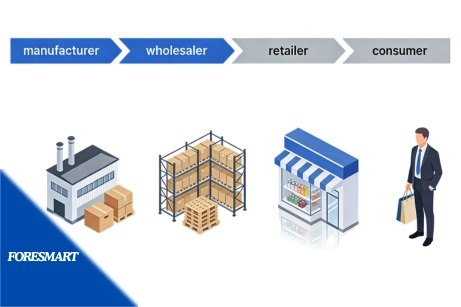
The flow of goods in a supply chain follows a clear path that goes from manufacturers to wholesalers, then to retailers, and then to the end customer.
What Importers Should Know?
Now you know the difference between wholesale and retail. And understanding your role in the supply chain is crucial for your pricing and strategy. The following are some aspects you should consider when deciding between wholesale trade and retail trade, in other words, sell to stores or direct to consumers:
Pricing Strategy
As an importer, if you sell directly to the customer (DTC), you keep the entire margin, but you will have to cover the costs of marketing, shipping, returns, and customer service.
In contrast, selling to retailers means lower per-unit prices and more accounts to manage. Your price must allow for their markup, or they won’t buy from you.
Minimum Order Quantities (MOQs)
If you sell to retailers as a wholesaler, you’ll likely need to buy larger quantities to meet minimum order requirements. This is necessary to maintain stock levels that retailers can sell through efficiently. However, this also means you need to manage your stock carefully to avoid holding excess inventory.
If you’re selling DTC, the risk of holding dead stock is higher, especially when you import large quantities but don’t sell them fast enough. You must carefully assess consumer demand and market trends to avoid costly inventory build-up. Both require efficient inventory planning.
Sales Tax
In many regions (like the U.S.), if you sell to a retailer and they provide a Resale Certificate, you are tax-exempt. The retailer will be responsible for collecting and remitting sales tax to the government when they sell the goods to the final consumer.
If you sell directly to consumers, you are responsible for collecting and remitting sales tax in the areas where you have a taxable presence.
To sum up, selling to end retailers if you prefer high-volume sales, are prepared to manage large shipments, and want a steady flow of orders. If you have a knack for marketing, want to earn higher profit margins, and have the infrastructure to pick, pack, and ship products individually to consumers, sell to end customers.
Wholesaler vs Distributor
Wholesalers and distributors both operate between manufacturers and retailers, but their roles are not the same.
As mentioned above, wholesalers focus on bulk purchasing and resale. Like a company buying pallets of consumer goods and selling cartons to local retail stores. Wholesalers often work with multiple brands and have little control over pricing and promotion.
On the other hand, a distributor acts as an official partner of a manufacturer and represents the brand in a specific market. They have a stronger influence over pricing, promotion, and market strategy.
Normally, wholesalers buy directly from manufacturers. However, when a distributor has exclusive rights to certain products or operates in a specific market, wholesalers may sometimes buy from them.
Since wholesalers usually deal with high-volume orders, they often rely on container shipping, like ocean freight, for cost-efficiency, and full-container loads (FCL) to minimize transportation costs. While distributors, being more involved in brand building, may need faster or specialized transport, like air freight or express courier services for time-sensitive goods.
Conclusion
Knowing the difference between wholesale and retail is essential for proper supply chain management, business positioning, and product sourcing.
To keep it simple, a wholesaler handles the bulk buying, storage, and distribution. The retailer, however, focuses on selling directly to the customer with strong branding and merchandising.
Frequently Asked Questions (FAQs)
What is the main difference between wholesalers and retailers?
A wholesaler is someone who sells products to other businesses and sellers, whereas a retailer is someone who sells products directly to the customer.
How do importers function as wholesalers?
They source products directly from overseas manufacturers, negotiate prices, and handle contracts, shipping, insurance, and customs clearance. Once the goods clear customs, they own the inventory and store it in domestic warehouses. From that stock, they sell in bulk to retailers, ecommerce sellers, or other B2B customers at wholesale prices.
Can a business be both a wholesaler and a retailer?
Yes, there are some businesses that sell in bulk to companies and sell individual products to individual customers.
Why are wholesalers important in the supply chain?
Wholesalers basically help manufacturers as they allow them to reach broader markets. This also reduces shipping costs for product makers and ensures item availability in the market.
A wholesaler is someone who sells products to other businesses and sellers, whereas a retailer is someone who sells products directly to the customer.
They source products directly from overseas manufacturers, negotiate prices, and handle contracts, shipping, insurance, and customs clearance. Once the goods clear customs, they own the inventory and store it in domestic warehouses. From that stock, they sell in bulk to retailers, ecommerce sellers, or other B2B customers at wholesale prices.
Yes, there are some businesses that sell in bulk to companies and sell individual products to individual customers.
Wholesalers basically help manufacturers as they allow them to reach broader markets. This also reduces shipping costs for product makers and ensures item availability in the market.