
Shipping is, no doubt, the backbone of international commerce. Every day, thousands of ships travel across the world, carrying everything that ranges from raw materials to manufactured goods. We know of this in the back of our minds, but have you ever actively thought about how much a cargo ship costs?
These massive ships represent some of the most significant investments in the transportation industry. Understanding the costs is essential for businesses that run shipping operations or investors looking to start a venture.
In this article, we’ll walk through some of the various factors that determine the cargo ship cost, look at the operating expenses, compare the container ship price with cruise liners’, and more. Let’s get started…
Cargo Ship Categories in Marine Transportation
When it comes to cargo ship cost, one of the most important factors is the Deadweight Tonnage (DWT). The DWT in shipping measures the total weight a ship can carry. This weight includes the cargo, fuel, and supplies.
Another key factor is the Twenty-foot Equivalent Unit (TEU). The unit measures the total container capacity of the vessel.
Besides DWT and TEU, other factors such as cargo handling equipment, advanced navigation technology, and fuel-efficient propulsion systems influence the price as well.
The cargo ship price, apart from depending on the size and capacity, also depends on which category it falls under. Knowing what the different categories are can help individuals better comprehend the price difference among them. These categories include:
Small Coastal Vessels
These small cargo ships are generally under 10,000 DWT and are designed for short-sea and regional trade. Such cargo shipping vessels operate on shorter routes and are commonly used for coastal transport and feeder services connecting regional ports.
Handysize Bulk Carriers
These vessels can range from 15,000 to 35,000 DWT and offer greater capacity than the smaller coastal vessels. Their relatively moderate size allows them to call at a wide range of ports, including those with limited infrastructure. As a result, their price often falls in the mid-range.
Panamax Container Ships
These cargo ships have a DWT that’s between 65,000 and 80,000 and are made to fit through the original Panama Canal locks. Given this strategic size and substantially larger capacity than the previous ones we have mentioned, these vessels come with higher construction, operating, and charter costs than smaller cargo ships.
Post-Panamax and New Panamax Vessels
These shipping vessels exceed the original Panama Canal dimensions. The New Panamax (also known as Neo-Panamax) vessels are designed to transit the expanded canal. Although construction and operating costs for these larger ships are higher, they benefit from economies of scale, allowing carriers to transport more cargo per voyage at a lower cost per container.
Ultra Large Container Vessels (ULCVs)
Ultra Large Container Vessels represent the largest class of container ships in global shipping, carrying over 18,000 TEUs and, in some cases, exceeding 24,000 TEUs. The cargo ship price for these vessels is among the highest, no matter it is about construction or operating costs. But they provide maximum economies of scale on major global trade routes.
Used Cargo Ship Cost: New vs. Pre-Owned Options
Used vessels can offer cost advantages as opposed to ordering new ones, since pre-owned ships tend to come at lower costs. The second-hand cargo ship is a useful option for many companies.
But, before considering used ships, you need to know why used vessels have lower prices, and their operational life is also lower than that of their new counterparts.
Beyond age, a ship’s maintenance history and the remaining time before major overhauls also affect its price.
Some of the pros and cons you need to be aware of when buying used ships include:
|
Pros of Buying Used |
Cons of Buying Used |
|
Lower initial capital investment |
Higher maintenance and repair costs |
|
Immediate availability for operation |
Reduced fuel efficiency |
|
Established performance and reliability record |
Shorter remaining operational lifespan |
|
Avoid new-build delivery delays |
May lack the latest technology and safety features |
|
Good option for testing routes or markets |
Potential for unexpected mechanical issues |
Operating Costs of Cargo Ships
Operating costs play a major role in a vessel’s profitability.
Improvements in fuel efficiency alone can lead to significant savings over time, especially across decades of operation.
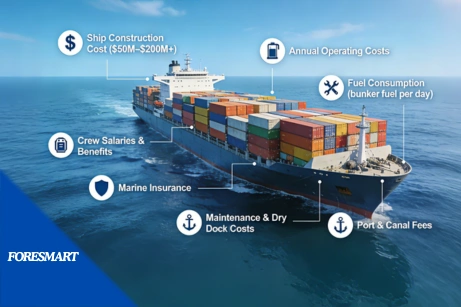
When assessing the total cost of a cargo ship, account for ongoing operating expenses. These can make up a large portion of the overall cost, and in some cases, even exceed the ship’s purchase price over its lifetime. Key contributors to cargo ship operating costs include:
Crew Salaries
It represents a substantial portion of operating expenses and covers wages for officers, engineers, support staff, and other personnel who are essential to keep the ship running.
Fuel Costs
The fuel cost is the single largest operating expense and varies based on the size, speed, and route of the cargo ship.
Maintenance and Repair
These are ongoing expenses that cover things like servicing, inspections, engine overhauls, and repairs, which tend to increase as the cargo ship ages.
Insurance
Insurance costs help protect operators in the event of hull damage, cargo loss, liability claims, etc.
Additional Expenses
There are also expenses like port fees and tolls, which vary based on vessel size and the applicable maritime regulations.
Do I Have to Buy a Cargo Ship?
In many cases, you don’t have to buy a cargo ship to move goods by sea. That’s where cargo charter services come into play.
A cargo charter means you rent cargo space or an entire vessel for a specific shipment or period, instead of owning the ship.
Buying a cargo ship only makes sense if you’re a shipping company or investment group, operating at massive, consistent volume, and want full operational control.
For everyone else, chartering is the standard approach.
Cargo Ships vs. Cruise Ships: How Much Does It Cost to Build a Cruise Liner?
To compare cargo ship cost and cruise ship cost, it’s important to understand that cruise liners and cargo ships are completely different types of investments. Costs for some cruise liners can even be higher than those of some biggest cargo ships.
Cargo ships cost anywhere from tens of millions to a few hundred million USD, depending on vessel type, size, and specialization. Cruise liners often cost $700 million to over $1.5 billion USD for a single ship.
One of the main reasons for the price difference between these two vessels is that they are built with fundamentally different design priorities. Cruise ships are known for being complete resorts on water and require a lot of luxury amenities that include restaurants, theaters, spas, and more. Cargo ships, on the other hand, prioritize capacity and efficient loading systems.
As passenger-focused vessels, cruise liners require extensive safety systems, amenities, and interior finishes that cargo ships do not. Combined with higher staffing requirements, these factors contribute to the significantly higher cost of building a cruise liner.
Conclusion
When it comes to investing in a cargo ship, you must carefully consider both the initial cost of the purchase and the operational expenses.
Meanwhile, the cargo ship cost can vary dramatically based on the size, capacity, and technology involved. Understanding these factors helps you make an informed decision when you consider buying a cargo vessel at a sustainable price.
Frequently Asked Questions (FAQs)
How long does a cargo ship last?
The exact duration a cargo ship can last depends on proper maintenance and how it’s used. With proper maintenance, these vessels tend to last for up to 20 to 30 years.
Can individuals buy cargo ships?
It is possible for individuals to purchase cargo ships, smaller vessels in particular. However, due to the level of capital required and the vessel’s intended use, most buyers are shipping companies or investment groups.
What is the most expensive part of owning a cargo ship?
As far as the expense associated with owning and operating a cargo ship is concerned, things like purchasing the hull or the propulsion system are seen as large expenses, but the fuel costs tend to be the largest ongoing expense.
The exact duration a cargo ship can last depends on proper maintenance and how it’s used. With proper maintenance, these vessels tend to last for up to 20 to 30 years.
It is possible for individuals to purchase cargo ships, smaller vessels in particular. However, due to the level of capital required and the vessel’s intended use, most buyers are shipping companies or investment groups.
As far as the expense associated with owning and operating a cargo ship is concerned, things like purchasing the hull or the propulsion system are seen as large expenses, but the fuel costs tend to be the largest ongoing expense.