
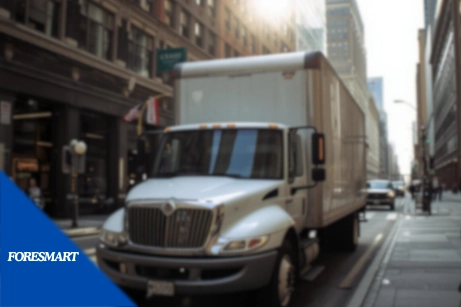
A straight truck is a vehicle where the cab and the cargo box sit on the same rigid frame. Think of the cab and the cargo area as one unit, not two pieces hooked together. That single-frame layout is the main thing that separates a straight truck from an articulated rig.
Types of Straight Trucks
There are lots of flavors when it comes to straight trucks. Straight box trucks or cube trucks are common for local delivery and moving. Refrigerated straight trucks move temperature-sensitive goods. Flatbeds and stake beds are used in construction and landscaping. Smaller step vans and parcel vans are used by couriers and last-mile carriers.
The basic point here is flexibility. If the job is regional or final-mile, a straight truck is often the practical choice. Industry write-ups and fleet guides break these down more fully.
Size, Weight Classes, and the Qualification
In general, straight trucks range from small 10-foot cube bodies up to 26-foot or so. Since there are different types of it, straight truck specifications, such as their gross vehicle weight rating (GVWR), can vary widely, and that rating drives both payload and driver licensing rules.
In the U.S., many straight trucks with GVWRs under 26,000 pounds mean a commercial driver’s license (CDL) is not necessary in some jurisdictions. But once certain GVWR thresholds are crossed or hazardous materials are loaded, the rules change, and a CDL is typically required. Always check the vehicle plate and local rules before hiring someone to drive. Or leaving the task of arranging shipment to your freight forwarder, like Foresmart.
Why Fleets Pick Straight Trucks: Advantages
They are simpler to operate. One rigid frame reduces the number of couplings and moving parts. This often results in lower maintenance, easier training for drivers, and better maneuverability in tight urban streets.
For many businesses, the economics line up: lower capital cost, lower operating cost, and good suitability for short or medium hauls.
Straight trucks also make loading and unloading straightforward because the cargo box height can match docks or be fitted with liftgates.
Limitations to Keep in Mind
However, they are less flexible than a tractor-trailer when it comes to scaling capacity. You can’t detach the cargo box or switch to another type of trailer whenever you need more space or a different setup.
Also, for very heavy, long-haul, or high-volume moves, a tractor-trailer will carry much more payload. If you need long-distance economy of scale, the straight truck will, in many cases, cost more per ton-mile.
Again, those tradeoffs are why carriers often mix both vehicle types in a fleet.
Choosing the Right Size
Pick a truck by thinking about volume and weight separately. A 10-foot box gives you room for small moves. A 26-foot box gives more cubic feet and can handle more palletized freight.
But cargo volume is not the same as payload. The truck’s empty weight reduces the amount of cargo you can legally add.
So do this: check the GVWR, subtract the truck’s curb weight and the weight of fuel and passengers, and what remains is the actual maximum payload. If you are hauling dense freight, payload matters more than cubic feet. Many rental companies and fleet operators list the typical payload capacities for each truck size.
Real World Uses and Sectors
Final mile delivery, furniture moving, event logistics, food and beverage distribution, and municipal services like small waste hauling often rely on straight trucks. Straight trucks are also common at construction zones for moving supplies. Think of them as a giant pickup truck with a flat, easy-to-load bed.
Delivery services and rental companies use them as they offer the power of a big truck without the hassle. Straight trucks are easy to drive and fit better in cities than those long semi-trucks.
Practical Tips for Loading
-
Load heavy items low and near the front axle. That controls weight distribution.
-
Use straps and load bars to prevent movement. A shifting load can cause loss of control.
-
Check axle weights, not just total. Being overweight on one axle can lead to fines and safety hazards.
-
Inspect the liftgateand use it safely.
What Managers and Owner-Operators Should Check
-
Confirm GVWR and the required license for drivers.
-
Match truck length to cargo volume and payload needs.
-
Inspect axle loads when loading.
-
Plan for daily checks of tires, lights, and brakes.
-
Choose body type to fit the cargo: reefer, dry, flatbed, or parcel van.
Final Thoughts
Straight trucks are the workhorses of short and regional freight. They are plain, effective, and often the most economical choice for many businesses. But plain does not mean simple. You still need the right size, proper loading practices, and an eye on weight and regulatory rules. Get those right and the straight truck freight will be smooth as far as possible.
FAQs
Straight Truck vs. Box Truck
As we mentioned above, a box truck is a type of straight truck. All box trucks are straight trucks. But not all straight trucks are box trucks. When we talk about straight trucks, we mean a truck where all axles, the cab, and the cargo area are built on one single frame. When we speak of box trucks, we are emphasizing that the truck has an enclosed, box-shaped cargo area.
Should I buy or lease a straight truck?
If you are the shipper deciding whether to buy or lease a straight truck, make sure you gather the right information:
-
Fuel economy. Calculate how efficiently the truck runs in your typical operations, like the common delivery routes.
-
Warranty coverage. Find out what the warranty includes for both the drivetrain and the truck body.
-
Maintenance costs. Request estimated maintenance expenses and a list of common replacement parts (like tires, brakes, or reefer units).
-
Resale value. Some truck brands hold their value better than others, which affects long-term cost.
As we mentioned above, a box truck is a type of straight truck. All box trucks are straight trucks. But not all straight trucks are box trucks. When we talk about straight trucks, we mean a truck where all axles, the cab, and the cargo area are built on one single frame. When we speak of box trucks, we are emphasizing that the truck has an enclosed, box-shaped cargo area.
If you are the shipper deciding whether to buy or lease a straight truck, make sure you gather the right information:
-
Fuel economy. Calculate how efficiently the truck runs in your typical operations, like the common delivery routes.
-
Warranty coverage. Find out what the warranty includes for both the drivetrain and the truck body.
-
Maintenance costs. Request estimated maintenance expenses and a list of common replacement parts (like tires, brakes, or reefer units).
-
Resale value. Some truck brands hold their value better than others, which affects long-term cost.