
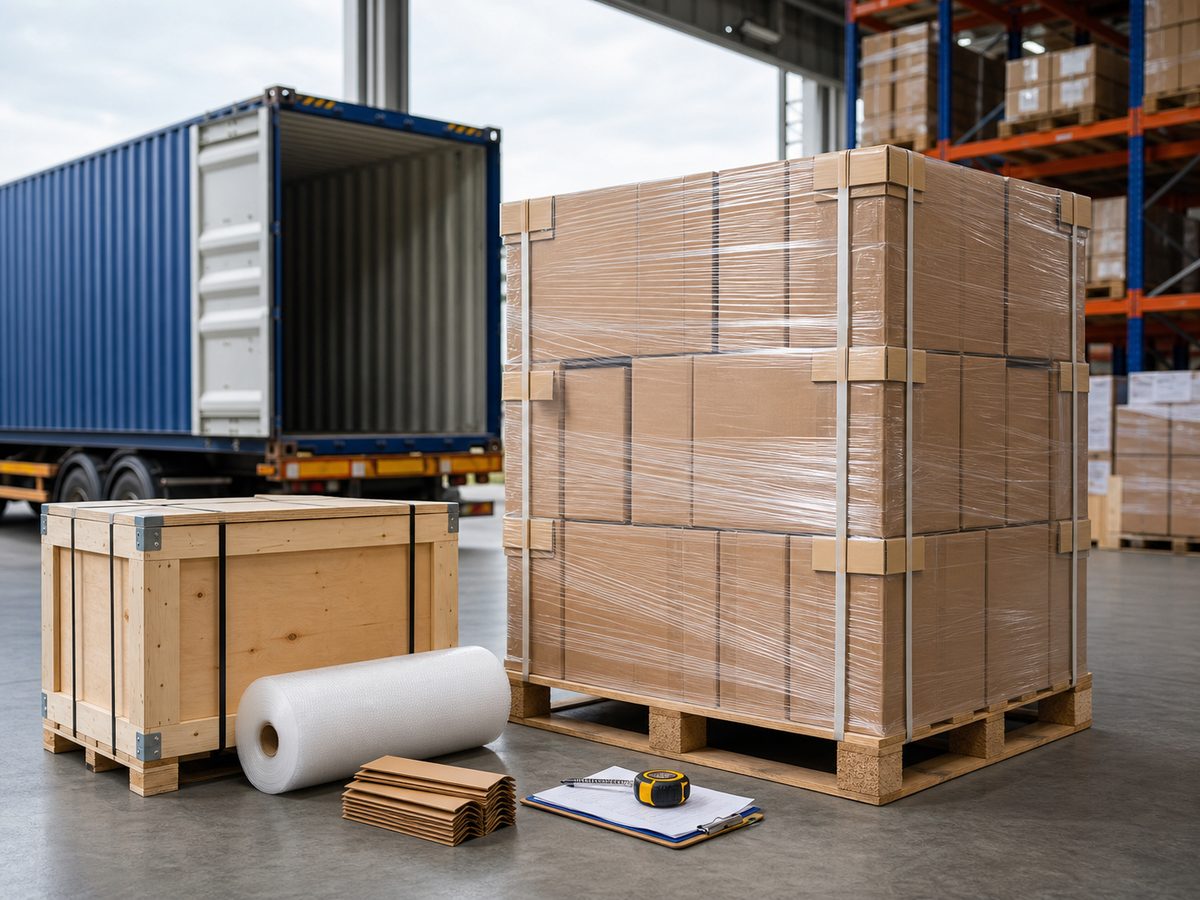
Freight packaging should protect cargo, keep shipment data accurate, and match carrier, customs, and receiving rules before pickup in China.
Weak cartons, loose pallets, missing marks, and wrong dimensions can turn a normal export shipment into extra repacking cost, warehouse delay, or arrival damage. Before booking, the buyer should confirm final carton size, gross weight, labels, pallet plan, and pickup photos.
What Should Freight Packaging Cover Before Cargo Leaves China?
Freight packaging should cover retail packaging, export cartons, pallets or crates, cushioning, handling marks, and shipment labels. Retail packaging protects the saleable unit. Freight packaging protects that unit through pickup, warehouse handling, container loading, customs checks, and final delivery.
Retail Packaging and Export Freight Packaging
Retail packaging is the box, bag, or insert the final buyer sees. Export freight packaging is the outer protection that keeps that retail pack usable after repeated handoffs.
Do not treat retail packaging as the shipping carton unless the item can move safely through parcel networks. A glossy product box may crush under stacked cartons, rub against pallet edges, or absorb moisture in a container. Damaged retail packaging can hurt resale value even when the product itself still works.
Outer Cartons and Inner Cushioning
Outer cartons should match the product weight, route, and handling method. Heavy goods need stronger cartons, tighter tape, and less empty air inside the box.
Inner cushioning should stop the item from moving inside the carton. Foam, molded pulp, paper fill, partitions, and corner guards work only when the product cannot shift during forklift movement or container vibration. Empty carton space raises damage risk and can increase chargeable volume.
Pallets, Crates, and Dunnage
Pallets make cartons easier to move by forklift and reduce direct floor contact. Crates protect heavy, fragile, or irregular cargo when cartons cannot hold the load.
Dunnage fills gaps, blocks movement, or separates cargo from hard surfaces. This protection matters when mixed cartons, crates, or loose items leave empty space inside a pallet or container.
Handling Marks and Package Labels
Handling marks tell warehouse teams how to move the cargo. Common marks include fragile, keep dry, this side up, stack limit, carton number, gross weight, net weight, and destination mark.
Package labels should match the packing list and commercial invoice. A wrong SKU, carton count, or consignee can slow warehouse receiving. The forwarder must confirm which cargo belongs to which shipment before release.
How Should You Pack Export Cargo for Freight Shipping?
Pack export cargo so each carton, pallet, or crate can handle lifting, stacking, vibration, and moisture exposure. Then match labels and dimensions with the packing list, because wrong package data can delay receiving even when the cargo is physically safe.
The packaging plan should follow the cargo type, not a thin carton chosen to save factory packing cost.
Sealing Cartons for Long-Distance Handling
Seal cartons with freight-grade tape across the center seam and carton edges. Heavy cartons may need reinforced tape, strapping, or corner protectors.
Weak tape can open during warehouse transfer or container loading. Open cartons create inventory mismatch, missing accessories, and repacking work before the shipment can move.
Protecting Fragile Goods Inside the Carton
Fragile goods need cushioning that separates each item from the carton wall and from other items. Glass, ceramics, electronics, lighting, and display parts usually need dividers, foam, molded inserts, or double boxing.
The carton should pass a simple shake check before pickup. If the product moves inside the box, the inner pack is too loose for freight handling.
Palletizing Cartons for Forklift Movement
Palletized cartons should sit inside the pallet footprint, with no overhang. Stack cartons in stable layers, wrap the pallet tightly, and add straps when the load is tall or heavy.
Shipping pallets affect container loading, truck space, and warehouse handling. The pallet size should match the carton footprint, cargo weight, and receiving rules.
Crating Heavy or Irregular Cargo
Heavy or irregular cargo may need a wooden crate, steel frame, or custom base. The crate should let forklifts lift the cargo without pressing on the product.
Machinery, furniture, stone, trade show displays, and oversized parts often fail in normal cartons. A crate adds cost, but weak packaging can lead to breakage, rework, or denied carrier pickup.
Which Packaging Details Can Raise Cost or Delay Shipping?
Packaging affects freight cost when dimensions, weight, labels, wood marks, or receiving rules change after the quote. These details matter because carriers charge by space, handling risk, compliance work, and shipment data accuracy.
|
Packaging detail |
Cost or delay trigger |
Buyer action before pickup |
|---|---|---|
|
CBM and dimensional weight |
Larger cartons can raise chargeable volume |
Confirm carton size and gross weight by SKU |
|
Wasted carton and pallet space |
Empty air uses container or air cargo space |
Ask the supplier for packed photos and measurements |
|
Wood packaging |
Missing ISPM 15 marks can trigger inspection or rejection |
Use treated and marked wood when solid wood packaging applies |
|
Battery or DG labels |
Wrong labels can block air or ocean acceptance |
Confirm battery type, Wh rating, SDS, and required marks |
|
FBA labels |
Missing carton or pallet labels can delay Amazon receiving |
Match labels to the Send to Amazon shipment plan |
CBM and Dimensional Weight
CBM is the shipment volume, usually calculated from carton length, width, and height. A small weight change may matter less than a larger carton size when carriers charge by volume.
Air freight also uses dimensional weight when cargo is light but bulky. The CBM figure should come from final carton or pallet dimensions, not the product size alone.
Wasted Carton and Pallet Space
Wasted space inside cartons raises freight cost because the buyer pays to move air. Wasted pallet space also reduces carton capacity inside a truck or container.
This space problem often appears after a supplier uses oversized cartons for convenience. The buyer should request final packed dimensions, not product dimensions, because freight quotes use the packed cargo size.
ISPM 15 Marks for Wood Packaging
Solid wood pallets, crates, and dunnage may need ISPM 15 treatment and marks for international movement. The IPPC ISPM 15 standard covers raw wood packaging, including dunnage. The standard excludes processed wood such as plywood when processing removes pest risk.
Missing or unreadable marks can slow customs or destination inspection. Buyers should ask for clear photos of the pallet or crate mark before cargo leaves the supplier.
Battery and Dangerous Goods Labels
Battery cargo may need hazard labels, marks, declarations, and carrier approval. The IATA battery guidance says lithium battery air transport depends on configuration and rating. For rechargeable batteries, Watt-hour rating matters. For non-rechargeable batteries, lithium content matters.
Battery packaging errors can block pickup, delay booking, or force a mode change from air to sea. Buyers should confirm battery type, test summary, SDS, carton marks, and packing method before the forwarder quotes the shipment.
FBA Carton Labels and Receiving Rules
Amazon FBA shipments need packaging and labels that match the shipment plan. Amazon’s FBA workflow directs sellers to Send to Amazon. The workflow covers shipment creation, preparation, packing, and labeling before goods go to a fulfillment center.
Wrong carton counts, mixed SKUs, missing pallet labels, or loose cartons can delay FBA receiving. Amazon sellers should confirm carton labels, pallet labels, and box content data before cargo leaves China.
How Can a China Freight Forwarder Check Packaging Before Shipment?
A China freight forwarder can check packaging before shipment while cargo is still in China. This check can include supplier photos, warehouse inspection, carton reinforcement, and updated dimensions when packaging changes.
Supplier Pickup and Warehouse Inspection
Before pickup, the supplier should send photos that show the cargo is ready for export handling:
- Product inside the carton
- Sealed outer carton
- Carton label
- Pallet base and wrapping
- Wood mark, if solid wood packaging applies
The forwarder should compare those photos with the packing list and quote data.
At the warehouse, a China freight forwarder can check carton condition, count received pieces, note visible damage, and flag mismatches. This inspection is not a full product QC check, but this warehouse check can catch visible packaging problems before export booking.
Repacking Weak or Mixed-Supplier Cargo
Replace or reinforce weak cartons before cargo joins a larger shipment. Mixed-supplier cargo may also need new labels, stronger cartons, or separated SKU groups.
Foresmart’s consolidation workflow can receive cargo from multiple suppliers, then repack, palletize, and consolidate the shipment when the original packaging is not freight-ready. This workflow fits buyers who source from multiple Chinese factories and need one export-ready shipment.
Palletizing Consolidated Freight in China
Palletize consolidated cargo by destination, SKU, carton strength, and handling risk. Heavy cartons should sit lower, fragile cartons should not carry weight, and mixed supplier marks should stay readable.
Foresmart’s cargo consolidation service covers pickup, repacking, palletizing, and consolidation through 10 major Chinese cities. This nationwide receiving setup helps buyers reduce loose-carton handling before export.
Matching Packaging Details With the Freight Quote
The freight quote should use final packed data:
- Packed size
- Gross weight
- Carton count
- Pallet count
- Cargo type
- Receiving rules
If the supplier changes cartons or pallets after the first quote, the forwarder should update the freight cost before booking.
Packaging data should also match the commercial invoice, packing list, and warehouse labels. Foresmart’s freight glossary gives quick definitions for CBM, chargeable weight, dunnage, and other international shipping terms.
FAQs
Who Is Responsible for Freight Packaging When Buying from Chinese Suppliers?
The supplier usually packs the goods first, but the buyer should define export packaging requirements before production ends. A freight forwarder can check, repack, or palletize cargo in China, but the forwarder needs clear instructions and cost approval.
What Packaging Photos Should I Request Before Cargo Leaves the Supplier?
Request photos of the product inside the carton, sealed outer carton, carton label, pallet base, pallet wrapping, wood mark, and final packed dimensions. These photos help the buyer catch weak cartons, wrong marks, and size changes before pickup.
Can Carton Counts or Pallet Dimensions Change After the Supplier Makes the Packing List?
Carton counts and pallet dimensions can change if the supplier repacks, combines cartons, changes pallet height, or replaces weak boxes. The buyer should update the packing list and freight quote whenever the final packed data changes.
Can Poor Freight Packaging Affect a Cargo Insurance Claim?
Poor freight packaging can affect a cargo insurance claim because insurers may review whether the packaging fit normal transit handling. Photos, packing records, and warehouse notes help show the cargo condition before export.
Who Pays for Repacking if Cargo Reaches the China Warehouse in Weak Cartons?
The buyer, supplier, or forwarder can pay for repacking depending on the purchase terms and the cause of the problem. The buyer should confirm the cost before the warehouse repacks weak cartons, because repacking can change shipment dimensions and freight cost.
The supplier usually packs the goods first, but the buyer should define export packaging requirements before production ends. A freight forwarder can check, repack, or palletize cargo in China, but the forwarder needs clear instructions and cost approval.
Request photos of the product inside the carton, sealed outer carton, carton label, pallet base, pallet wrapping, wood mark, and final packed dimensions. These photos help the buyer catch weak cartons, wrong marks, and size changes before pickup.
Carton counts and pallet dimensions can change if the supplier repacks, combines cartons, changes pallet height, or replaces weak boxes. The buyer should update the packing list and freight quote whenever the final packed data changes.
Poor freight packaging can affect a cargo insurance claim because insurers may review whether the packaging fit normal transit handling. Photos, packing records, and warehouse notes help show the cargo condition before export.
The buyer, supplier, or forwarder can pay for repacking depending on the purchase terms and the cause of the problem. The buyer should confirm the cost before the warehouse repacks weak cartons, because repacking can change shipment dimensions and freight cost.