
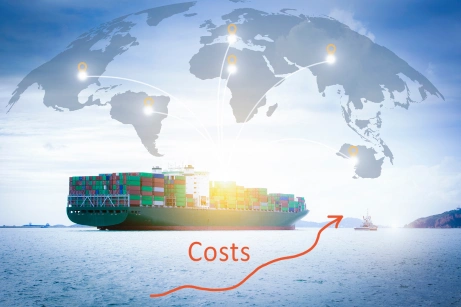
Unexpected Surge in Ocean Freight Prices
In the second half of 2023, freight demand is expected to remain stable in 2024 due to sluggish international trade and a large number of new ships coming into service. As a result, capacity supply is expected to increase in 2024 and overall freight rates to decline.
Surprisingly, sea freight prices rose in the first half of 2024. This period is generally considered to be the off-season. The ocean freight prices are even higher than they were in the second half of 2023.
In addition, sea freight prices have been on an upward trend since early May. Ocean freight costs from Asia to Europe and the Americas have risen significantly. Instead of going up in the range of $50-$100, the price increase for a 40HQ container reached $100-$300-$500. From the end of May to the beginning of June, the cost of shipping increased at an alarming rate. Freight costs increased by as much as $500-$1,000.
What are the Current Freight Rates?
Currently, the shipping cost from major China ports like Shenzhen, Ningbo, and Shanghai to Los Angeles has doubled. The same applies to the shipping cost to New York on the East Coast. The price from China to Los Angeles is about $5,500-6,500/40HQ, while the price to New York is about $7,000-8,500/40HQ.
Freight costs to major European ports (Felixstowe, Hamburg, Rotterdam, Antwerp) have also more than doubled. Many B2B buyers, Amazon sellers, and some freight forwarders are asking why sea freight rates increased so much in May and June 2024.
Factors Contributing to the Increase in Sea Freight Costs
According to Brian, the founder of our company, he believes that the following factors have contributed to the increase in sea freight costs in May and June 2024:
Red Sea Crisis
Shipping routes between Asia and Europe have been affected by the Red Sea crisis. As one of the world’s major trade routes, the Asia-Europe route carries a large amount of cargo every day. Due to the impact of the Red Sea crisis, this route has suffered a significant loss of capacity. In the past, it took about 26-35 days to ship from Asian departure ports (such as Japan, Korea, China, Vietnam, etc.) to European destination ports (such as the United Kingdom, Germany, the Netherlands, France, etc.).
However, the route now requires a detour to the Cape of Good Hope in Africa, increasing the shipping time by more than 15%. The shipping time has been extended by 7 days or more, and the round-trip time has been increased by about half a month. This has created a 10-15% capacity gap on the Asia-Europe route and has had a major impact on the entire shipping industry.
Water Shortage in the Panama Canal
The route between Asia and North America is also one of the world’s major shipping routes. However, due to insufficient water levels in the Panama Canal, the speed of ship traffic has been reduced. Ships are also limited in the amount of cargo they can carry each time they pass through the Panama Canal, measured by weight.
Shipments from China to the East Coast of the United States are often delayed by more than 7-10 days because of problems in the Panama Canal. This leads to a drain on capacity, which pushes up freight rates.
Impact of Customs Duties
During April and May, many countries issued notices of tariff increases. Brazil and Mexico, in particular, have imposed tariffs on many Chinese goods. This has led to a concentration of goods exported, especially large and space-consuming products like China’s electric cars. These large cargoes occupy a large number of containers in a short time.
At the same time, electric vehicle manufacturers tend to be large enterprises. So shipping companies prioritize allocating cargo compartments to them. As a result, the capacity of traditional trade goods has been further compressed. This eventually led to an increase in transport prices.
Congestion at the Port of Singapore
As the world’s second-largest port, Singapore handles many ships entering and leaving every day. Usually, the docking and transit time for ships in the ports of Singapore is 1-2 days. However, according to the latest information collected, many ships have now extended their stay in ports by several days.
However, according to the information gathered, many ships have extended their stay in port by several days. This has led to slower shipping times and a further strain on transport capacity. Due to the shortage of transportation capacity, freight will also rise.
Reselling Cargo Space
When prices are rising fast, some speculators will control shipping space in advance. They create tension and then sell these cargo capacities at a higher price. Although the proportion of such behavior is relatively small, it still has an impact on price hikes.
The Risk of Rising Prices
For Buyers
The rapid rise in prices is harmful to international trade. For example, some buyers expect shipping costs of around $2000 when placing an order. However, when it comes time to ship, the shipping fee may increase to $4000 or more. This increase in freight rates can raise costs for buyers. If the buyer’s procurement volume is large or their funds are limited, this can easily lead to a disruption in the capital chain. The break of the capital chain may lead to a series of problems such as abandonment and bankruptcy.
For Sellers
Sellers who have accepted many CNF (Cost and Freight) orders, may face higher costs when shipping the goods compared to before. As a result, the profits on these orders will be reduced. In some cases, these orders can even result in sellers losing money. In the case of FOB (Free On Board) orders, the buyer pays for the freight, which may appear unrelated to the seller.
However, if the buyer observes a rise in freight rates, they might choose to delay shipping. This may result in the seller being unable to receive the balance payment in time, causing a tight cash flow situation. Whether it’s CNF or FOB, due to the increase in freight rates, the overall product flow speed will decrease. For regular products, the turnover rate may slow down, leading to relatively low sales.
For End Customers
The end customer may pay a higher price for a certain product than before. Additionally, to avoid price increases, some products may have a reduced quality compared to previous standards.
Advice on Coping with Rising Shipping Costs
For Buyers
If the goods are not seasonal or there are no other urgent needs, buyers can consider waiting for a while. But this is just a personal suggestion. The specific decision requires the buyer to consider its actual business situation. Meanwhile, maintaining communication with freight forwarders is also important. Update yourself on changes in freight rates and cargo availability at all times.
For Sellers
Sellers need to pay attention to cash flow management and be prepared for a drop in turnover.
For freight forwarders
Freight forwarders should keep close communication with both buyers and sellers. At the same time, it is necessary to ensure timely payment to control risks. In the case of crowded ports or rapid changes in freight rates, freight forwarders should inform customers on time to prevent goods from being abandoned at the destination.
Conclusion
Faced with the challenge of rising freight rates, buyers, sellers, and freight forwarders need to work closely together and constantly adjust strategies to adapt to changing market conditions.
As a freight forwarding company, we provide comprehensive sea freight services, maintain close communication with our clients, and promptly provide information on changes in freight rates and shipping space for our clients. If you have any questions, we welcome detailed discussions with you.
Contact foresmart