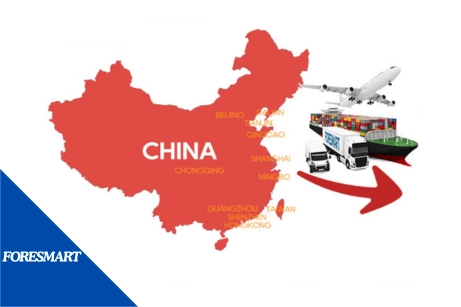
China stands as the world’s largest exporter of goods. According to customs statistics, in 2024, China’s total foreign trade volume reached $5.98 trillion, with exports accounting for 25.45 trillion yuan.
The mature industry chains, extensive transportation systems, a vast number of suppliers, diverse product options, and competitive pricing have attracted numerous overseas buyers to import from China for many years.So how to import from China?
When considering importing wholesale products from China, you may have several questions. What products should I purchase? Is there a market for the products I want to import from China? Can I ensure the quality of the products? Is my supplier reliable and easy to communicate with? How should I arrange transportation? Will my products safely arrive on time?
Don’t worry, even if you’re feeling overwhelmed. This blog introduces a step-by-step guide on how to safely and efficiently import from China, ultimately facilitating the growth of your business.
Step 1: Choosing Goods to Import From China
Before choosing the imported goods from China, make ensure you have the necessary import qualifications.
Supposing the cargo is imported to the United States, American companies importing under their corporate name need an Employer Identification Number (EIN).
For individual importers, a personal taxpayer identification number (ITIN) or Social Security Number (SSN) is necessary.
For foreign importers not based in the United States, known as Importer of Record (IOR), a Customs Assigned Importer Number (CAIN) is required.
Requirements of the Importing Country
The importing country may have specific regulations regarding the types, quantities, or packaging of imported goods. Understand the import policies of the destination country. The goods you are procuring should comply with national requirements.
Taking the United States as an example:
-
- You will need to obtain an Importer Number, which will appear on import documents.
-
- Most goods do not entail importing permission, but certain goods necessitate permits from relevant agencies or departments for importation. Examples include:
Some agricultural products such as milk, dairy products, fruits, vegetables, nuts, tobacco, or animals;
Arms and ammunition;
Medical devices;
…
Visit the official website of the CBP (https://www.cbp.gov/) to learn about the specific requirements for different goods imported from China to the USA.
There is also a detailed article on shipping from China to the USA.
Requirements of China
Consideration should also be given to exporting countries’ policies. Check China’s export policies to ensure your goods can be exported smoothly.
Market Prospects for Goods Imported From China
Consider the profit margin and market viability of the products you import from China.
What is the potential profit—can it reach 30%?
What are the transportation and storage costs?
Is there a market for this product in your country, and what is the potential demand?
Can you sell it in your state?
Step 2: Finding Suitable Suppliers to Import From China
Once you’ve identified the general category of your imported goods, the next step is finding a supplier.
Online Sourcing
A convenient way is to use B2B e-commerce platforms for procurement, like Alibaba, China’s most renowned platform, boasting 5900+ product categories and over 200,000 suppliers worldwide.
However, Alibaba may lack a strict vetting mechanism for suppliers, resulting in a mixed quality of suppliers. It’s challenging to ensure credibility and product quality at first sight. Investigation and careful discernment in Alibaba suppliers are necessary.
On-Site Visit
Sometimes, many importers will visit China in person to secure the right suppliers. They attend trade shows or tour factories to find suitable products and suppliers.
Every year, Guangzhou, China hosts two sessions of the China Import and Export Fair (also known as the Canton Fair). The 136th session, which concluded on November 4, 2024, saw participation from over 30,000 companies.
The fair is organized into three phases:
- The first phase primarily focuses on industrial themes, including electronics and appliances, machinery, building materials, and hardware tools;
- The second phase highlights daily consumer goods, gifts, and decorative items;
- The third phase features textiles, clothing, and food products.
The Canton Fair is China’s largest trade exhibition and one of the most significant globally, attracting numerous domestic and international companies.
The time for the Canton Fair in 2025:
- Phase 1: April15 – 19
- Phase 2: April23 – 27
- Phase 3: May 1 –5
The online platform service lasts six months (from March 16, 2025, to September 15, 2025).
Types of Suppliers
China has specialized regions for manufacturing and wholesaling specific products. You can start by researching online to understand the distribution of relevant industry clusters. Then, compare and select suppliers from those areas. You’ll typically find two types of suppliers: trading companies (acting as sourcing agents) and factories.
Trading companies usually don’t produce but specialize in sourcing products from factories. Known for offering a wide range of products and excellent customer service, they often have lower MOQ (Minimum Order Quantity) but higher fees.
On the other hand, factories offer cheaper prices and personalized services. Nevertheless, the MOQ will be higher. Cultural and language differences may impact their customer service.
If you’re importing from China for the first time, choosing a local sourcing agent can be more secure. Generally, sourcing agents charge around 3%-15% commission.
Evaluate Suppliers
Assess your suppliers thoroughly.
What is their reputation like? Have they exported to your country before? Do they have extensive experience in producing this type of product? Do they possess relevant certifications? Can they provide the necessary export documents? Are their prices competitive? Do they offer after-sales service? Can they offer samples? Do they support reasonable payment terms?
If you have a large order but are unsure about choosing this supplier, you can start with a trial order. Place a small initial order to test the waters.
If your factory doesn’t accept transactions in US dollars, Foresmart’s purchasing service can also provide currency support for you. Using the Chinese yuan (RMB) as the payment currency might be more cost-effective whenever possible.
Understand Trade Terms
Before negotiating prices with your supplier, you need to have a basic understanding of international trade terms.
Taking the commonly used Incoterms, FOB and EXW, as examples: if the trade adopts EXW terms, the buyer is responsible for local tasks, including booking cargo space, picking up goods from the factory, customs declaration, and transporting the goods to the shipping vessel.
With FOB terms, however, the seller is responsible for transporting the goods from the factory or warehouse to the port. All local costs and responsibilities until the goods are on the shipping vessel deck are covered by the seller. It’s crucial to note that the price provided by the seller includes these local costs.
Once you’ve confirmed the suppliers and trade terms, you can proceed with preparations for cross-border transportation to import from China.
After your goods are ready in the factory, inspect them comprehensively to prevent potential disputes related to quality issues later on.
Step 3: Selecting Transportation Methods to Import From China
Next, what shipping method should you choose for your goods? Here’s a rough table for your reference.
|
Weight & Volume |
Suggested Transport Mode |
Transit Time |
|
≥500KG |
Ocean Freight |
14-42 |
|
≥45KG |
Air Freight |
5-10 |
|
≤200KG |
Express |
3-7 |
Transportation Modes
Common international transportation modes include sea freight, air freight, rail freight, trucking, and express freight.
Sea freight typically takes longer but is more cost-effective compared to air, truck, and rail transport, making it suitable for transporting large volumes of goods.
Air freight is suitable for transporting perishable goods and high-value products, and it is one of the fastest transportation methods.
Rail freight is more economical than air freight, less affected by weather compared to ocean shipping, and offers faster delivery. If you are shipping goods from China to Europe, railway transport could be a good option.
Trucking is suitable for medium to short-distance transportation. It is more flexible compared to other modes, allowing goods to be delivered wherever trucks can reach.
If the shipment volume is extremely low and doesn’t meet the requirements for air freight, express freight is also a viable choice. Often, express shipments can bypass customs procedures (depending on each courier company’s policies) and deliver goods more rapidly.
Different transport companies have varying requirements for the weight and size of received goods, and the speed of transportation also differs.
Certain transport modes have specific requirements for goods received. For instance, explosives, gases, and flammable liquids cannot be shipped by air. Therefore, the table above is for reference purposes only. If you have more questions, feel free to contact us.
Transportation Process
In the context of sea freight, a comprehensive transport process encompasses booking, collecting goods from the factory to the port in the importing country, customs declaration, loading onto the ship, ocean transport, unloading upon arrival at the destination port, customs clearance, pickup, transportation to the local warehouse, and finally delivering to the customer.
A skilled freight forwarder can oversee each of these stages, offering support for any issues and presenting competitive prices with bulk discounts.
Transportation Service
If you are dealing with smaller shipments imported from China and aiming to save on freight costs, consider finding a freight forwarder, and asking for a consolidation service, like LCL (Less-than-Container Load) sea shipping.
In ocean freight, goods are loaded into containers and shipped. A 20-foot container, for instance, can accommodate approximately 28 cubic meters or 27 tons of cargo. Since many buyers may not purchase such large quantities at once, and the cost-effectiveness of an entire container might be low when not fully filled, sharing container space with other buyers for smaller shipments can be a better option. Learn more about container specifications.
Transportation services can also be divided into to-door and to-port. To-door services include door-to-door and port-to-door, and to-port services encompass port-to-port and door-to-port.
Door-to-door service means your freight forwarder helps pick up your cargo at your designated place and is responsible for all the international shipping and local delivery to your final destination.
While port-to-port service only covers shipping between ports.
Step 4: Customs Declaration
After settling on the shipping method, it’s imperative to assemble some essential documents for the customs. In most cases, customs declaration is a prerequisite for international shipping.
Documents required for export customs declaration typically include an export declaration form, commercial invoice, packing list, and so on. If your trade terms delegate customs clearance responsibilities to the buyer, which is you, we recommend collaborating with a seasoned customs broker to mitigate the risk of fines due to inaccurate declarations.
When arranging sea shipments to the United States, it’s important to submit AMS and ISF information to CBP 24 hours before the vessel departs from the origin port. AMS and ISF systems aim to heighten cargo security and simplify customs processes. Non-compliance with AMS or ISF regulations may result in penalties and delays in customs clearance.
Step 5: Waiting for Shipment
When your goods reach the port and undergo customs clearance, it’s time to wait for cross-border transportation. The required transit time varies significantly based on the chosen transportation mode.
Infrastructure variations at different ports, seasonal fluctuations, extreme weather conditions, unforeseen events, and so on can all influence transit times.
Keep these factors in mind when calculating the estimated transportation time.
Step 6: Customs Clearance
After the commencement of goods transportation, you can start preparing the customs clearance documents.
Documents
Taking the United States as an example for the import destination, the essential customs clearance documents may include the following:
-
- Packing lists
-
- Certificate of origin
-
- Customs bond
-
- Commercial invoice
Some products require import licenses, and items like food, pharmaceuticals, or cosmetics must adhere to specific quality and specification criteria enforced by CBP or relevant regulatory bodies. This may entail presenting inspection certificates or undergoing sampling inspections.
Foresmart provides support for pre-arranged sea freight customs clearance, facilitating prompt pickup of goods upon port arrival to minimize any potential delays.
Tariffs
During the customs clearance process, tariffs are handed over to customs.
The United States and many countries have established trade agreements to decrease tariffs and incentivize imports. You can check the specific tariff details for your goods by entering the HTS code (corresponding to each unique product) on the HTS official website. If your goods qualify for tax advantages, accurately submit relevant supporting documents and apply to customs for preferential treatment.
Despite being duty-free, goods imported into the United States with a value exceeding $2500 must obtain a customs bond. Customs bonds are categorized into two types: single-entry bonds and continuous bonds. Single-entry bonds are applicable for one-time imports valued under $50,000, starting at a minimum of $100. Continuous bonds are valid for the entire year, with a higher cost starting at a minimum of $600.
Step 7: Pick-Up and Delivery
The stage of pickup and delivery comes after customs clearance.
With to-port service, you can get ready for pickup once the goods arrive at the port. The consignee might need to provide the arrival notice or bill of lading at the port to collect the goods, and the freight forwarder will inform you about the precise time, location, and required documents.
With to-door service, it’s a simple process – someone will manage the pickup, and you only need to wait for the transport company to bring your goods from the port to the designated location.
Conclusion
Importing from China involves much more than just transportation. It includes several steps that are crucial to the process. From selecting the right products and finding reliable suppliers to handling import/export paperwork, negotiating costs, and arranging transportation, every step demands careful consideration and preparation.
While this beginner’s guide to importing from China may not encompass every detail, we hope it will be a valuable resource, offering inspiration for your importing business.
Frequently Asked Questions (FAQs)
What are China’s top exports?
China’s Top Ten Exports in December 2023 (Source from Ministry of Commerce):
Electrical machinery, apparatus, and equipment – ¥51.49M
Telecommunication and sound recording equipment – ¥28.54M
Office machinery and automatic data processing equipment– ¥17.65M
Land vehicles (including hovercraft)– ¥17.13M
General industrial machinery and parts– ¥15.38M
Apparel and clothing accessories– ¥14.59M
Metal products– ¥13.50M
Spinning, weaving, finished products, and related products– ¥11.20M
Specialized industrial machinery– ¥7.34M
Food and live animals– ¥6.84M
How can I ensure the quality of products that I import from China?
We recommend you assess and choose reputable suppliers, inspect products when they are ready before shipping, and work closely with freight forwarders to learn the newest status of your cargo.
Do I need to pay taxes when I import from China?
Yes, taxes are typically applicable when importing goods from China. The specific taxes can include customs duties, value-added tax (VAT), and potentially other taxes or fees depending on the nature of the goods and the importing country’s regulations.
Contact foresmart