
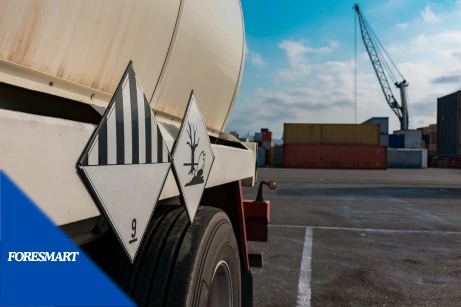
On August 9, 2024, an explosion occurred at a container terminal in Ningbo Port, China. The container was carrying Class 5 hazardous materials (oxidizers and organic peroxides), which pose a significant risk during transportation.
We often hear about explosions at ports or on ships around the world. Most of these incidents happen because of hazardous materials. Such incidents are a reminder that dangerous materials must always be handled properly, with trained personnel, with proper documentation, and with the use of specialized containers.
In this article, we will talk about how shipping Class 9 hazardous materials comes with different challenges and transportation tips for Class 9 goods.
What Are Class 9 Hazardous Materials?
Class 9 hazardous materials are those materials that can impact the health, property, or environment negatively without proper handling. This is why it is important to ship them with care. Hazardous materials can be gases, liquids, or solids. Corrosive materials and some daily-use items also come under the category of hazardous materials.
Most such materials are normally shipped in tank containers in line with the regulations for shipping Class 9 materials. Since tank containers can be stacked over one another, this method of shipping hazardous materials is safer compared to other methods.
Where Do Class 9 Hazardous Materials Get Their Name From?
You must be wondering why are these materials called Class 9 hazardous materials. This term comes from the UN Committee of Experts on the Transport of Dangerous Goods which has categorized dangerous materials into 9 different classes depending on how dangerous they are.
Overview of the 9 Classes of Hazardous Materials
Let’s look at an overview of the 9 classes!
Class 1: Explosives
All the materials that can rapidly catch fire or detonate as a result of a chemical reaction are known as explosives. There are six sub-classes of Class 1 materials, which include the following:
Division 1.1: Materials containing mass explosion hazard.
Division 1.2: Materials that do not have an explosion hazard, but rather have a projection hazard.
Division 1.3: Materials with a fire hazard and either a minor projection hazard, a minor blast hazard, or both hazards.
Division 1.4: Materials that only pose a minor hazard in case of ignition.
Division 1.5: Materials that can result in a mass explosion.
Division 1.6: Extremely sensitive material with no mass explosion hazard.
Class 2: Gases
All those gases, regardless of whether they are compressed, dissolved, refrigerated, liquified, or a mixture of two or more gases, that are hazardous for humans or the environment fall under Class 2. This class has further 3 sub-classes to make the categorization easy.
Division 2.1: Flammable Gases come in this sub-section.
Division 2.2: Non-toxic and non-flammable gases are part of this division.
Division 2.3: This sub-class includes toxic gases.
Class 3: Flammable Liquids
A liquid, a mixture of two or more liquids, or a liquid with solids in it that can be ignited easily is known as a flammable liquid. They are dangerous in shipping because flammable liquids are volatile and can quickly catch fire. Some of the examples of this class of hazardous materials include gas, oil, and acetone.
Class 4: Flammable Solids
Sometimes, solids can also be ignited quickly. They are called flammable solids: sodium batteries, metal powders, and activated carbon, etc. There are three sub-classes of flammable solids:
Division 4.1: Flammable solids.
Division 4.2: Substances that are spontaneously combustible.
Division 4.3: Solids that are dangerous in a wet state.
Class 5: Oxidizing Substances
All the oxidizing agents and organic peroxides come under this category. These materials are extremely reactive and catch fire quite easily, thanks to the high amount of oxygen present in them. Hydrogen peroxide and lead nitrate are two of the examples of oxidizing substances.
Class 6: Toxic and Infectious Substances
Toxic materials can threaten humans’ lives if they are inhaled, swallowed, or come in contact with skin. As for infectious substances, these are the materials that cause diseases in animals or humans. Dyes, medical waste, and biological cultures are some examples of toxic and infectious substances.
Class 7: Radioactive Materials
Materials that emit radiation due to unstable atomic nuclei are called radioactive materials. These materials need no introduction when it comes to determining how dangerous they can be because they pose a serious threat to the environment and humans when they are unstable.
Class 8: Corrosives
All those substances that disintegrate or degrade the materials they come in contact with are called corrosives. Chlorides, paints, and batteries are some of the examples. They are highly reactive to produce a positive chemical effect.
Class 9: Miscellaneous Materials
The last of the nine classes is that of miscellaneous goods that are hazardous but do not fall in any of the other eight categories. Some examples of miscellaneous goods include lithium batteries, dry ice, asbestos, magnetized materials, motor engines, and airbags.
Related Reading: How to Ship Lithium Batteries?
Packaging Requirements for Class 9 Hazmat
The Class 9 hazardous materials are rather safe to ship compared to other classes of hazardous materials, but they still need proper packaging to be safely transported from one place to another. When shipping Class 9 hazardous materials, keep the following packaging requirements in mind to avoid any inconvenience:
UN Number
A UN number is a four-digit code that is preceded by the letter “UN”. Each hazardous material is given a specific number and the UN number highlights which Class 9 hazardous material is being shipped. For example, acetone has UN 1090 as its UN number.
PSN
Proper shipping name, or PSN, is a term used to accurately describe the cargo being transported. For lighters, have the PSN “LIGHTERS”.
Packing Group
There are a total of three packing groups defined by the UN: I, II, and III. By knowing the packing group of a hazardous material, you can determine the degree of packing required for it.
Safely Shipping Class 9 Hazardous Materials
There are a number of different things to keep in mind while shipping Class 9 hazardous materials, including knowing regulations, proper classification, and correct labeling. Let’s discuss these points one by one!
Complete Knowledge of Regulations
If you are shipping hazardous materials, you should have a clear idea of all the regulations. These regulations include a range of things, including packing, documents, marking, and labeling of materials.
Proper Training to Handle Dangerous Materials
Ensuring your freight agent has proper training to handle Class 9 hazardous materials is also important because shipping them requires extra care which only a trained personnel can ensure. This also comes with a higher shipping fee.
Correct Classification of Hazardous Cargo
Another point to consider while shipping Class 9 hazardous materials is properly classifying the cargo containing dangerous materials. The shipper is responsible for making the classification and marking the materials correctly. Classification makes sure that everyone who handles your cargo knows what exactly is inside it and handles it with the required attention and care.
Pack Your Cargo Correctly
Correctly packing and labeling hazardous materials matters as well. When packing hazardous substances, it is important to avoid container overstuffing and to remove old labels from reused boxes to prevent confusion or mishandling.
Choose the Right Container
Lastly, always ship Class 9 hazardous materials in a suitable and specialized container, instead of a regular one.
Documents Required for Shipping Class 9 Hazardous Materials
You need several documents to ship hazardous substances, including a materials safety data sheet, transport emergency card, and container packing certificate. Let’s get to know them one by one!
-
Material Safety Data Sheet (MSDS): This sheet contains all the details about potential hazards of the substance being transported and how to safely handle them. This document is essential for both sea freight and air freight shipments.
-
Dangerous Goods Declaration (DGD): It tells about the category a hazardous material belongs to, and includes labels, identification marks, and special packaging.
-
Dangerous Goods Manifest (DGM): A DGM contains all the important information of hazardous materials.
-
Transport Emergency (TREM) Card: This card is carried by workers dealing with hazardous materials and has instructions about how to safely transport such substances.
-
Container Packing Certificate: This certificate is proof that the hazardous material has been packed as per the regulations.
No need to worry if you feel at a loss. A reliable freight forwarder like Foresmart can handle your Class 9 Hazardous Materials across borders effectively. We work with your supplier and our shipping partners closely to ensure a seamless shipping process.
Conclusion
Shipping Class 9 hazardous materials is different from transporting other common types of cargo. These substances are dangerous compared to normal shipping materials.
One also needs to properly follow the regulations of shipping such materials to avoid confiscation or heavy fines. By working with an experienced freight forwarder, and following the best shipping practices, you can ensure safe and quick transportation of your hazardous materials without any worry.
FAQs
What are hazardous materials?
All those substances that pose a risk to human health, property, or the environment are called hazardous materials, such as explosives, toxic substances, flammable solids, and corrosives.
Why are dangerous substances called Class 9 Hazardous Materials?
The “Class 9” in hazardous materials comes from the UN Committee of Experts on the Transport of Dangerous Goods, which has divided all hazardous materials into 9 different classes.
Do Class 9 hazardous materials that are to be domestically transported need shipping labels?
A placard is a large, diamond-shaped sign affixed to the outside of a vehicle, container, or bulk packaging. Class 9 hazardous material placards are not required for non-bulk transport within the U.S. However, bulk packaging containing Class 9 hazardous material must display a placard.