
Warehouse logistics refers to all the activities from receiving products, storing them properly, tracking where they are, picking and packing them for orders, and handling returned goods inside a warehouse.
In simple terms, it’s how a warehouse works day to day and runs smoothly.
It is of great importance in the speedy world of supply chain today, to keep products moving from suppliers to customers. However, managing warehouse and logistics is not always easy, as issues such as inventory mismanagement, outdated systems, and labor inefficiency can often arise. That’s where a reliable warehouse logistics system becomes essential.
This article will go into the functioning of warehouse logistics and walk you through the best practices in inventory management. Not forgetting, we will also give you a warehouse set checklist so you can go about it the right way.
Warehouse Logistics Functions: More Than Storage
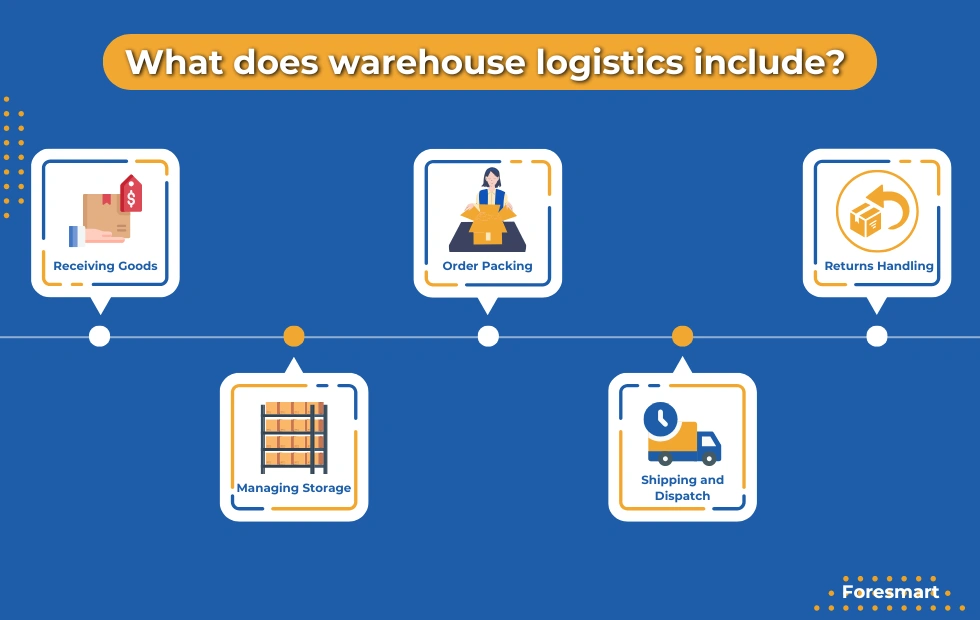
Warehouse logistics extends across the full flow of goods inside the facility and into the wider supply chain, connecting suppliers, transport, and customers.
To be more specific, it includes:
Receiving and Putaway
Checking incoming goods and placing goods in the right locations.
Inventory Control
Tracking stock levels, lot numbers, and expiry dates; performing cycle counts to keep records accurate.
Value-Added Services
Grouping parts into kits, labeling, or doing simple assembly.
Order Picking and Packing
Selecting the correct items, packing, and preparing them for shipment or production.
Cross-docking and Consolidation
Moving goods directly from inbound to outbound without storage, or combining shipments to reduce costs.
Reverse Logistics
Handling returned goods, inspecting them, and deciding whether to restock, repair, or dispose of them.
Compliance Management
Managing quarantined stock, rejected materials, and documentation for customs, safety, or industry rules.
Data Management
Using warehouse systems (WMS) to track orders in real-time and coordinate with ERP and transport systems.
Managing the Warehouse Itself
Warehouse logistics is also about running the building and people, not just handling boxes.
Importance of Warehouse Logistics
Good inventory logistics helps reduce labor waste, prevent overstocking, and cut shipping errors, directly improving margins and customer satisfaction.
With real-time inventory tracking and basic automation, importers can keep stock levels healthy and respond quickly to changes in demand. This prevents delays and missed sales.
A well-organized warehouse also speeds up order processing. Clear layouts and efficient picking reduce handling time, enabling faster deliveries.
Beyond storage, strong warehouse logistics support growth. Warehouse management systems (WMS) provide visibility and data that make it easier to scale operations as volumes increase.
In short, warehouse logistics is the backbone of distribution, ensuring products are available when and where customers need them.
Common Warehouse Logistics Challenges
Managing warehousing and logistics is not an easy thing. One of the biggest problems is having an insufficient workforce, especially during peak times.
Moreover, inadequately trained workers can commit expensive errors in picking or packing, as well as in inventory tracking.
Mismatched stocks, over-ordering, and deliveries missed due to manual practices or outdated WMS are common problems. This is where a dependable storage logistics system is crucial.
Slow operations and inefficient goods handling often happen as well. Time spent wandering aisles, unclear picking paths, and bottlenecks in receiving or shipping docks all add up to time and lost output.
Many businesses also have to deal with technological gaps, such as using spreadsheets or disjointed systems as opposed to integrated logistics platforms, which leads to the logistics operation becoming harder to manage.
Get Foresmart’s Logistics and Warehousing Service
Inventory Strategy in Warehouse Logistics
Good inventory management is essential to warehousing logistics. Poor tracking leads to stockouts, excess inventory, and higher costs. Here are some proven inventory practices helps goods move smoothly and meet demand.
-
One key method is ABC analysis, which groups inventory by value and importance. High-value or critical items (like A items) receive the most attention, while lower-value items (like C items) require less control.
-
Another practice is stock rotation, using FIFO (first in, first out) or LIFO (last in, first out), depending on the product, to prevent spoilage and obsolescence of inventory.
-
Using barcodes, QR codes, or RFID to improve tracking accuracy and instant visibility across locations.
-
Another useful method is cycle counting. Try to check small portions of inventory regularly instead of doing large annual counts.
-
Pick the perfect inventory logistics system, and it will massively impact the overall efficiency of your warehousing and logistics. A good WMS features real-time inventory updates, order prioritization, and instant analytics. Its cloud-based systems are beneficial for businesses in hyper-growth mode. They are also easily integrated with other platforms such as e-commerce systems, providing a cohesive supply chain ecosystem.
Together, these practices can reduce risk and improve storage logistics operations.
Warehouse Setup Checklist
The key to effective warehouse logistics management is a proper behind-the-scenes structure. If you own a warehouse that needs to be organized, then there are a few things that you should do.
-
Starting off with floor markings to enforce designated areas. For example, you should decide how the floor is taped off into receiving, storage, picking, packing, and shipping zones. This involves understanding how much space you have to work with, ceiling height, dock doors, columns, and aisles, which need consideration for forklifts and jacks.
-
Then, you will need pallet racks, shelving units, bins, and other storage devices to keep your inventory organized.
-
You need to decide which WMS to use and how it will integrate with your warehousing workflows.
-
Safety must come before everything else, which is why you need fire extinguishers, signposts, eye wash stations, protective gear, and emergency exits.
-
Finally, walk through the mockup, run a pretend workflow through it, and modify for feedback before you put it into effect for real.
Even though you decide to use third-party warehouses, check these steps to see if they are well-equipped and qualified.
Conclusion
Warehouse logistics is an important part of your supply chain management. Companies that adopt smarter systems and automate workflows will remain at a competitive advantage, achieving a more adaptable, productive, and scalable operation.
Frequently Asked Questions (FAQs)
What do warehouse management systems do?
A WMS is a software solution that can deliver real-time insight into inventory, drive better labor and space optimization, and manage the fulfillment of tasks from receiving to shipping. It optimizes warehouse workflows and enhances order accuracy.
What are common warehousing challenges?
Warehouse operations challenges include things like labor shortages, inventory inaccuracies, poorly designed layouts, and outdated technology that slows down performance and scalability.
What should be included in a warehouse setup checklist?
A good checklist needs to include the following: a clear layout plan, appropriately chosen racking and equipment, barcode or labelling tools, and a thorough test of workflows before final installation.
A WMS is a software solution that can deliver real-time insight into inventory, drive better labor and space optimization, and manage the fulfillment of tasks from receiving to shipping. It optimizes warehouse workflows and enhances order accuracy.
Warehouse operations challenges include things like labor shortages, inventory inaccuracies, poorly designed layouts, and outdated technology that slows down performance and scalability.
A good checklist needs to include the following: a clear layout plan, appropriately chosen racking and equipment, barcode or labelling tools, and a thorough test of workflows before final installation.