The Suez Canal is recognized as a key transport route all over the globe. The trade route links the Mediterranean Sea with the Red Sea, making it easy for shipping between Europe and Asia. In this age of globalization, canal helps lower international shipping costs and reduce both transit time and fuel use.
This blog will look at the Suez Canal’s role in the shipping industry today.
Where Is the Suez Canal Located?
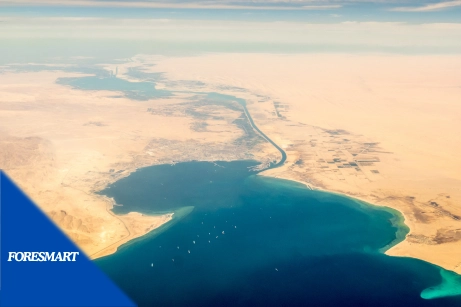
So, how long is the Suez Canal, and where is it? Look at the Suez Canal on the world map, you will find it links the Mediterranean Sea Port to the Red Sea at Suez, and it is located within Egypt.
The length of the Suez Canal reaches a distance of 193 kilometers ( around 120 miles). Most other large canals need locks to raise or lower ships, but not the Suez Canal since it is at sea level. Vessels can pass through without stopping and this continuous flow makes transporting goods faster and more efficient.
About 12% of the world’s trade volume comes from vessels traveling through this route every year. These vessels may carry oil, natural gas, goods like electronics or food in containers, and other products. More than 50 ships go through the canal every day, making it extremely busy for ships around the world.
With the canal positioned between two important oceans, it is vital for water trade as it reduces the distance to Asia from Europe by up to 7,000 kilometers, compared to using the route around Africa. Shipping important manufacturing equipment or perishable goods can be made quicker with this benefit.
Suez Canal Expansion: Enhancing Capacity and Efficiency
In response to international trade and today’s larger ships, Egypt undertook building a 35-kilometer parallel channel alongside part of the original canal, allowing two-way traffic in several sections.
The whole expansion took little time to finish, and immediately cut down on waiting times and made this canal manage more ships from around 49 ships per day to over 90.
An important part of the project is to make the canal deeper and wider, which makes navigation much safer for huge ships and tankers.
Egyptian authorities not only increase how well the canal works but also confirm that it can handle the latest demands in shipping.
As a result of these expansions, goods are transported at a higher speed and with fewer setbacks, which lowers costs for shipping companies and makes global supply chains more dependable.
Suez Canal vs. Panama Canal
Another important canal for shipping is the Panama Canal, which is an artificial waterway. Let us learn about the difference between the Suez Canal and the Panama Canal.
Design and Functionality
Since the Suez Canal is built at sea level and does not have locks, navigation is made easier and journeys are completed faster. On the other hand, the Isthmus of Panama is mountainous, so the Panama Canal uses locks to help ships travel between the Atlantic and Pacific Oceans. Furthermore, the canal relies on freshwater from reservoirs, and drought conditions can lower daily vessel capacity and significantly extend ship waiting times during dry periods.
Capacity and Vessel Accommodation
Because of the Panama Canal’s 2016 expansion, it can accept Neo-Panamax vessels measuring up to 366 meters and 49 meters across. So, how many ships go through the Panama Canal per day? The number depends on various factors like the traffic or seasonal changes. It can usually pass through 30 to 40 ships each day.
While the Suez Canal can accommodate more ships. It is able to take ships that are up to 400 meters long and 77 meters wide, which are known as Suezmax vessels. This size allows it to handle some of the largest container ships in the world.
Geographic and Trade Significance
The canal in Suez is mostly used for Europe-Asia trade, and the Panama Canal links trade between Asia and North America.
Challenges in the Shipping Industry
The world’s shipping industry is vital to overseas commerce, and it is facing many tough problems. These include:
Environmental Impact and Climate Change
There are changes to the climate that are impacting the weather and access to water in major areas. For example, because of droughts in Central America, the Panama Canal needs to shrink ships and reduce daily crossings, which affects global shipping systems. For another example, higher sea levels and stronger storms are adding more risks to steps that are usually taken on main routes.
Geopolitical Instability
Political crises in places including the Middle East, Africa, and parts of Asia can result in problems on important corridors. Traffic can be delayed in this Canal if blockades, embargoes, or sabotage occur, causing significant financial issues.
Operational Incidents
When a ship collides or there are technical problems, some strategic routes may have to close for a time. When something happens, such as a stuck ship in the canal, global cargo transportation can be stopped for days, and millions of dollars of goods are left stranded.
Emission Standards and Fuel Regulations
Pressure is mounting on the maritime industry to cut its greenhouse gas emissions. To comply with new global rules, people must start using clean fuels and more environmentally friendly technologies. Although investing in LNG, methanol, and hydrogen-based engines is already underway by some shipping companies, it takes a lot of money and changes to existing infrastructure.
Alternative Shipping Routes
Nowadays, besides the Suez Canal and Panama Canal, the shipping industry is trying out and assessing several other routes.
Northern Sea Route (NSR)
Because polar ice is melting, ships can now use the Northern Sea Route along Russia’s Arctic coast for longer intervals. This route cuts the time it takes to travel from northern Europe to northeast Asia. But limited availability during certain times, missing infrastructure, and risks from the environment all make it hard to use widely.
Cape of Good Hope
If the Egyptian waterway is blocked or crowded, there are ships that pass through the southern tip of Africa instead. Even though it is longer, this route doesn’t require paying canal tolls.
Overland Transport Corridors
Improved rail networks, including those through the Belt and Road Initiative in China, create good alternatives to shipping. It takes trains moving goods between China and Europe about 15–20 days, which is faster than taking them by sea. However, it is more costly than sea transport.
Smart Logistics and Digital Solutions
Besides building new roads or airways, logistics software, digital ports, and real-time tracking are helping to cut waste and improve current transportation systems.
Conclusion
The Suez Canal is an important part of the world’s maritime network because of its location between the east and the west.
Even though the Panama Canal faces challenges from the environment, the Egyptian waterway also needs to handle politics and continuous operations to preserve its value.
Rather than deciding which is superior, the point is to see how well the canals can respond to changes in the world of trade. With new factors affecting the environment, trading patterns, and ways to move goods, these canals should keep upgrading to become more digital and able to handle more challenges.
Frequently Asked Questions (FAQs)
What is the main difference between the Panama Canal and the Suez Canal?
The Panama Canal uses a lock system to adjust for elevation changes, while the Suez Canal is a sea-level waterway requiring no locks. This makes the Suez faster and more straightforward for navigation, especially for large vessels.
What two bodies of water does the Suez Canal connect?
It connects the Mediterranean Sea to the Red Sea. It enables the shortest maritime route between Europe and Asia, saving time and fuel. The canal in the Suez handles a significant share of global cargo traffic, making it crucial to international trade and supply chain efficiency.
How long does it take to cross the Panama Canal?
It takes around 8 to 10 hours to pass through the Panama Canal, which is about 82 kilometers (around 51 miles).
Can the Suez Canal be bypassed, and if so, how?
Yes, it can be bypassed using alternative routes such as the Cape of Good Hope, the Northern Sea Route, or overland rail corridors between Asia and Europe. However, these alternatives generally take a longer time, are more expensive, or are seasonally limited, making the Suez Canal the preferred option in most cases.