
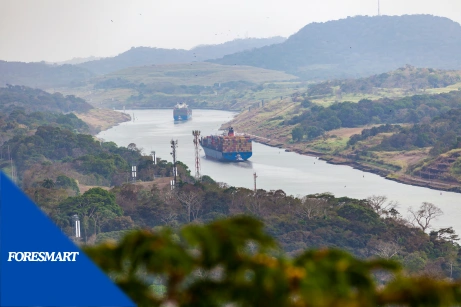
Choosing a maritime route is more than just a matter of preference in the world of global trade. The decision affects numerous aspects, including supply chain reliability, operational costs, delivery times, and environmental impact.
Throughout the history of shipping goods by sea, both the Cape Horn and Panama Canal routes have played a major role in international shipping.
Take, for example, the Panama Canal, hailed as perhaps the most transformative infrastructure project in history, which offers convenience as it’s a shortcut between the Atlantic and the Pacific Ocean. On the other hand, sailing around Cape Horn can be tough, but it remains a significant passage, even in today’s world.
Today, we’ll take a closer look at the Panama Canal and Cape Horn, discussing the economic and environmental implications of each route.
Historical Overview of Maritime Trade Routes
Before the Panama Canal was constructed, global trade had no option but to take on the notoriously tough and rough waters of Cape Horn. This remains the most southern point of the South American continent, making it a perilous adventure because of powerful currents, massive waves, and brutal winds. Notice that the Cape of Good Hope is different from Cape Horn, and the former is located at the southern tip of Africa.
Cape Horn truly tested the limits of early maritime engineering and human will, but continued to serve as a vital link for ships traveling from the Americas to Europe and Asia.
Then came the Panama Canal in 1914, and that genuinely revolutionized global shipping altogether. It was a genius feat, allowing a narrow yet navigable passage through the Isthmus of Panama. Not only did this reduce travel distances by thousands of nautical miles, but it also allowed ships to avoid the dangers of Cape Horn. It’s often considered a monumental engineering marvel and has, since, become the preferred route for commercial cargo.
This shift away from Cape Horn to the Panama Canal led to a dramatic evolution in global logistics. It changed the significance of cities like Panama City and Colón, impacting port development and international shipping patterns around the globe.
At the same time, this reduced the strategic value of the ports along the southern Atlantic and Pacific coasts of South America. But now, with growing challenges, Cape Horn is slowly being reconsidered as an option.
Cape Horn vs. Panama Canal: Distance and Efficiency
A voyage from New York to San Francisco via Cape Horn will take around 13,000 nautical miles. However, the same journey from the Panama Canal takes just over 5,000 nautical miles, saving you half the time and resources.
This is a clear win under normal circumstances for container ships and tankers operating on tight schedules. Instead of taking more than a month to complete a journey through the treacherous waters of Cape Horn, you may get from one destination to another in a fortnight via the Panama Canal. Not to mention, less time spent at sea means a lower chance of piracy, weather-related delays, and mechanical wear.
That said, it isn’t always black and white. A journey through the Panama Canal means you’ll have to pay thousands of dollars in tolls based on the type of vessel and cargo passing through. And you could save money at Cape Horn, but be exposed to greater risk and fuel expenses. It would also require more contingency planning because of the unpredictable nature of the route.
Ultimately, the Panama Canal is usually the preferred option due to economics and time efficiency. Meanwhile, the Cape Horn remains a viable option when the canal is inaccessible.
Cape Horn vs. Panama Canal: Operational Considerations
The decision between choosing the preferred route isn’t only about distance, though. There are many other considerations, like, for instance, the operational trade-offs. These can affect everything from safety, cost-effectiveness, to scheduling, and as a result, a longer-term strategy.
The Panama Canal shortcut is a secure and direct way for cargo ships wanting to go from the Atlantic to the Pacific. It’s ideal for time-sensitive goods, as well as energy shipments. Due to the existence of a streamlined logistics channel, it’s a predictable passage to navigate.
However, there are some restrictions in place, like size requirements, which can be a notable issue for certain carriers. Before 2016, many large ships couldn’t pass through the Panama Canal due to size limits. The opening of the Neopanamax locks that year allowed much bigger vessels to transit. But ultra-large crude carriers and some large LNG tankers are still too big for the canal, so they must take alternate routes. For these ships, the only choice is to sail around Cape Horn.
There are no size restrictions on vessel dimensions or tolls to be paid at Cape Horn. Similarly, port congestion isn’t a concern as everyone else is passing through the Panama Canal, and that makes the journey around Cape Horn “the road less travelled”. As it is with other remote pathways, there are some major dangers, too, like extreme winds, icebergs, and rough sea conditions.
So, for trade logistics teams, it’s not always a default option to pick the Panama Canal as the route to take. They usually consider Cape Horn, too, as an alternative.
Cape Horn vs. Panama Canal: Risk Assessment
The fact is, you need safety in international trade, which is just as important as cost-efficiency and saving time. That’s why the choice between Panama Canal and Cape Horn can’t be decided on any one factor. It is reliant on the risk tolerance of a company and its contingency planning strategy.
Of course, going with the Panama Canal is efficient, but it’s not without limitations. Over 2023 and 2024, the canal was impacted massively due to a drought, which decreased water levels, and authorities had to step in. That led to a reduction of daily transits and the imposition of draft restrictions, causing costly delays and massive bottlenecks. That’s why choosing a route isn’t as straightforward as it may seem.
Add to that the problem of geopolitical stability, and the Cape Horn route looks even more promising. Panama maintains a complex relationship with both the U.S. and China, two of the world’s biggest powers. When tensions rise between them, such as during ongoing trade wars, the Panama Canal often finds itself caught in the middle, adding another layer of difficulty to its operations and strategy.
On the other hand, Cape Horn is politically and logistically independent. It’s extremely unpredictable because of the association with weather and the environmental conditions. But if you have an experienced crew, you can get through with minimal damage. For many organizations, that’s very appealing because there are no queues, no tolls, and definitely no geopolitical strings attached.
As a result, if ships aren’t on time-sensitive journeys and companies are willing to look beyond the greenhouse gas emissions, then Cape Horn offers a great alternative. At the same time, though, even with the shorter journeys, the Panama Canal has its own ecological concerns, like the lack of scarce freshwater due to climate change.
Future Outlook and Final Decisions
With global trade constantly evolving, how to choose between Cape Horn and the Panama Canal? There can be no “right” answer, with several factors influencing each route.
The Panama Canal Authority is working hard to improve the sustainability of the canal and investing big time in its modernization. They’ve introduced water conservation strategies and expanded lock systems to help with the drought issues, but with the demand growing, the challenges will also increase.
Additionally, there’s a renewed interest in the Arctic passage with climate change leading to melting sea ice. This could mean the introduction of a newer passage, but until that happens, Cape Horn will remain an important strategic fallback, at the very least.
There can be no one-size-fits-all solution in international logistics. Climate change, infrastructure upgrades, geopolitical scenarios, and more technological innovation will influence the final decision for businesses in their maritime logistics planning. The smartest players in the trade arena will always be the ones who prepare for tomorrow and find ways to keep goods moving.
FAQs
What is the main difference between Cape Horn and the Panama Canal?
Cape Horn is a longer route, requiring ships to go around South America’s southernmost tip, while the Panama Canal is a manmade shortcut, offering an alternate route to reduce travel time between the Atlantic and the Pacific.
Why would ships choose to go around Cape Horn when they can take the Panama Canal shortcut?
The biggest ships can’t cross the Panama Canal, so they have to go around Cape Horn. Similarly, ships looking to avoid disruptions like congestion or a drought, or simply avoiding tolls, can take the Cape Horn route.
How much distance does the Panama Canal shorten compared to Cape Horn?
The shortcut at the Panama Canal can save ships around 7,000 nautical miles.