
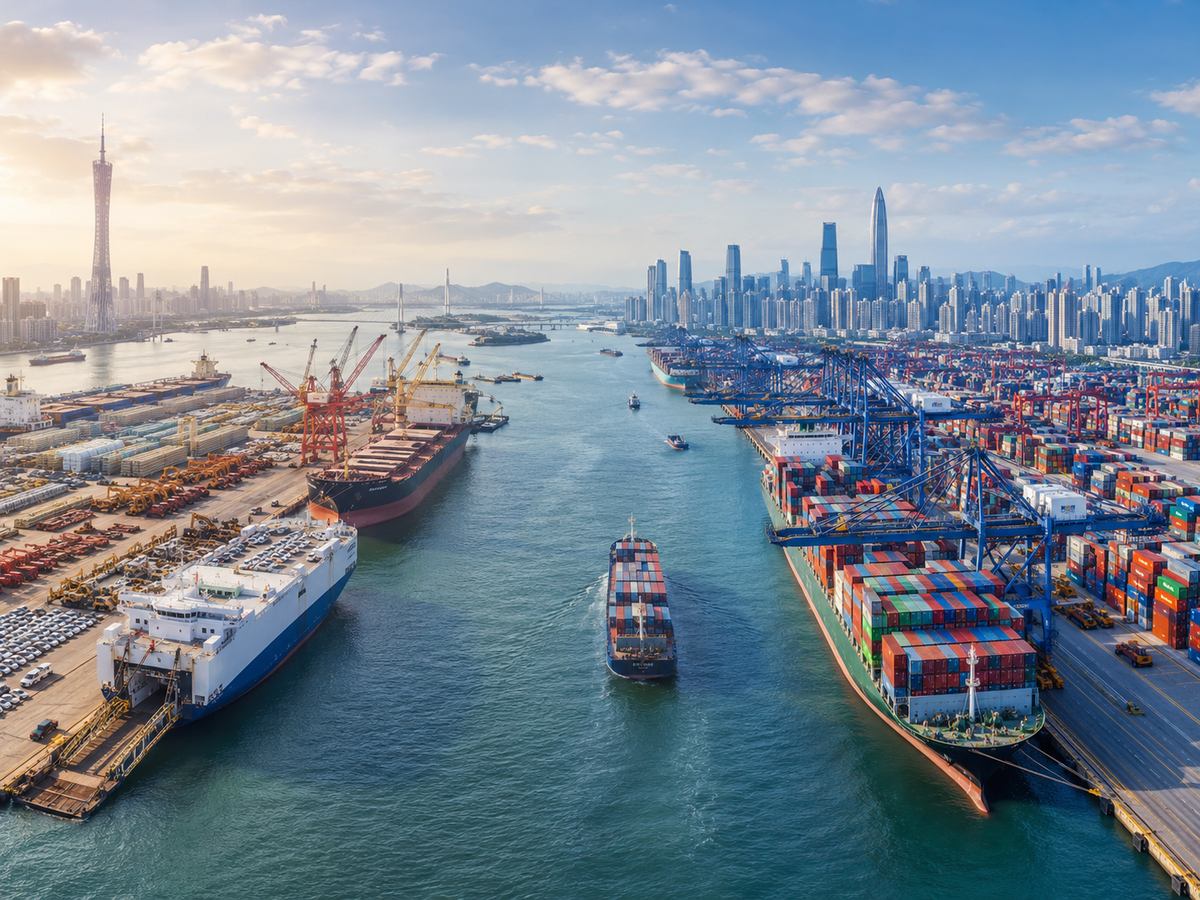
According to Upply’s 2024 ranking of the world’s major ports, Shenzhen handled 33.4 million TEU and Guangzhou 26.1 million. Both rank in the global top ten, and together they handle most of the ocean freight leaving southern China’s Pearl River Delta.
So which is the largest port in southern China? It depends on how you count. Guangzhou moves the most total cargo, while Shenzhen leads on containers. This guide compares the two, shows which one suits your goods, and explains how to ship from each.
Why Is Guangzhou the Largest Port in Southern China?
Guangzhou earns the title on total cargo, not container count. The port moves more than 600 million tons of goods a year, which puts it among China’s top five by total throughput.
Container ports like Shenzhen win on box counts. Guangzhou handles a wider range of freight, and that spread is what makes it the biggest in the region.
A Cargo Mix Beyond Containers Alone
Shenzhen specializes in boxes. Guangzhou takes a broader mix:
- Dry bulk like grain, coal, and ore
- Steel and project machinery
- Cars and vehicles on RoRo ships
- Containers stacked alongside the rest
That spread is why Guangzhou leads on tonnage even when it trails Shenzhen on container count. If your shipment is heavy, oversized, or made up of several cargo types, Guangzhou is usually the port that can take it without special handling.
Deep-Water Terminals at Nansha and Huangpu
Two terminal areas carry the load. Nansha, the deep-water hub near the river mouth, takes the large container ships and most of the ocean exports, since it has the draft for bigger vessels on long-haul routes. Huangpu, closer to the city, leans toward bulk and general cargo. Nansha also runs barge feeders up the river, so cargo from a Foshan or Zhongshan plant can reach the main vessel without a long truck leg.
Shippers moving machinery, furniture, or mixed pallet loads often route through Nansha. We tend to book space there for oversized or multi-supplier consolidations that would be awkward to split across smaller berths.
Deep Inland Reach by River and Rail
The Pearl River and its rail lines pull cargo from factories across Guangdong and reach inland provinces such as Hunan and Guangxi. A plant in Changsha or Nanning can rail its boxes to the quay instead of trucking them hundreds of kilometers, so inland cargo reaches the port cheaply and keeps volumes steady. Many of those factories are the same suppliers buyers meet at the Canton Fair. That reach is part of why the port stays connected to more than 300 ports in over 80 countries.
How Do Guangzhou and Shenzhen Compare?
Guangzhou leads on total cargo, but if you ship containers, Shenzhen is the port to know. The two sit about an hour apart across the Pearl River Delta, yet they play different roles. The table below sets them side by side, with Hong Kong for context.
|
Port |
Containers (2024) |
Role |
Suited to |
|---|---|---|---|
|
Guangzhou |
26.1 million TEU |
comprehensive port, 600M+ tons a year |
bulk, vehicles, mixed and oversized loads |
|
Shenzhen |
33.4 million TEU |
container gateway |
containerized exports, transpacific lanes |
|
Hong Kong |
about 14 million TEU |
separate customs, transshipment hub |
regional consolidation, smaller share |
Rule of thumb: ship boxes through Shenzhen, and ship bulk or oversized cargo through Guangzhou.
Shenzhen’s Container Lead at Yantian
Shenzhen edges ahead on container volume, and most of it moves through Yantian, a deep-water terminal on the eastern side built for the big transpacific ships. Shekou and Chiwan cover more of the western Delta. Sailings from Yantian to the US West Coast and Europe leave often, so boxes spend less time waiting for a vessel, which matters when your stock is running low.
More sailings also bring more carriers competing for your freight, which can help keep rates in check. E-commerce sellers restocking Amazon usually favor Yantian for that frequency. If terms like terminal or transshipment are new, our guide on what a terminal is in freight covers the basics.
Shenzhen’s Electronics Base in Dongguan
Shenzhen and neighboring Dongguan form a dense cluster of electronics and consumer-goods factories that feed the port directly. Phones, accessories, small appliances, and home goods ship in standard containers, which is what Yantian and Shekou are set up to handle.
Should You Ship Through Guangzhou or Shenzhen?
For standard container freight the two ports run close, so factory location, sailing cutoff, and shipment volume usually decide it.
Weighing Factory Location and Drayage Cost
Trucking from the factory to the port, called drayage, adds cost and time before the box is even loaded. A plant in Dongguan or eastern Shenzhen usually ships cheaper and faster through Yantian, while a factory up the Pearl River sits closer to Nansha, where its drayage runs lower.
On a single container the gap can run into a few hundred dollars, so when we plan a client’s first shipment, we weigh factory location against each port’s cutoff and drayage cost before booking.
Matching Cutoffs to Your Deadline
Every sailing has a cargo cutoff, the latest moment your container can arrive and still make that vessel. Miss it and you wait for the next sailing, which can mean several days on a busy lane. On the main transpacific lanes, ocean transit alone runs a few weeks port to port, so a missed cutoff can push your delivery back by a meaningful margin. If your deadline is tight, the port with an earlier or more frequent departure on your route often wins, even when its drayage runs a little higher.
Choosing FCL or LCL by Volume
A full container load, or FCL, makes sense once you can fill most of a 20- or 40-foot box, since you pay for the whole unit either way. Below that, less than container load, or LCL, lets you share a container and pay by the cubic meter. As a rough guide, once a shipment fills more than about half a container, a full box often costs less per unit than shared space. Small or first orders often start as LCL, then shift to FCL as volumes grow.
How Does a Forwarder Ship Your Cargo from Guangdong?
Instead of juggling the factory, the trucker, customs, and the shipping line yourself, you hand the shipment to a China freight forwarder that sequences each step.
Consolidating Cartons into One Container
Buyers rarely source from one supplier. A forwarder collects cartons from several Guangdong factories, checks counts and labels against your order, and loads them into a single container or an LCL slot at a consolidation warehouse. Timing the suppliers so their cartons arrive together matters, since one late factory can hold up the whole container. Your goods then move under one shipment, and you skip paying for half-empty space.
Clearing Customs and Export Paperwork
Export clearance runs on documents. Three of them have to match the cargo, or the box can sit at the terminal and miss its sailing:
- Commercial invoice (declared value and HS codes)
- Packing list (carton counts and weights)
- Bill of lading (consignee and container details)
A forwarder prepares and checks these, files the export declaration with Chinese customs, and keeps the shipment on schedule so you can follow it while it is in transit.
Delivering DDP to Amazon FBA
For Amazon sellers, delivered duty paid, or DDP, is the common setup. The forwarder covers ocean freight, import duties, customs clearance at the destination, and final delivery, so the cartons reach the FBA warehouse ready to receive against your appointment. If you are planning a shipment out of Guangzhou or Shenzhen, our ocean freight services can map the lane and quote door to door.
Frequently Asked Questions
Is Guangzhou or Shenzhen the largest port in southern China?
It depends on the measure. Guangzhou is the largest by total cargo, handling bulk, vehicles, and containers together at more than 600 million tons a year. Shenzhen is the largest by container volume, at 33.4 million TEU in 2024 against Guangzhou’s 26.1 million.
Is Hong Kong one of southern China’s main ports?
Yes, though its role has changed. Hong Kong is a separate customs territory and still a transshipment hub, but its container volume has slipped to around 14 million TEU as more cargo routes through Shenzhen and Guangzhou.
Which southern China port is best for Amazon FBA shipments?
For most FBA sellers, Shenzhen through Yantian is the practical pick. The cargo is usually containerized consumer goods, and the frequent transpacific sailings shorten the wait for a vessel. Factory location can still tip a single shipment toward Guangzhou, so it is worth checking both before you book.
Can a forwarder consolidate cargo from several Guangdong factories?
Yes, and it is standard practice. A forwarder collects cartons from multiple suppliers, combines them into one FCL container or an LCL slot, and ships them under a single booking, which usually lowers cost and simplifies tracking.
It depends on the measure. Guangzhou is the largest by total cargo, handling bulk, vehicles, and containers together at more than 600 million tons a year. Shenzhen is the largest by container volume, at 33.4 million TEU in 2024 against Guangzhou’s 26.1 million.
Yes, though its role has changed. Hong Kong is a separate customs territory and still a transshipment hub, but its container volume has slipped to around 14 million TEU as more cargo routes through Shenzhen and Guangzhou.
For most FBA sellers, Shenzhen through Yantian is the practical pick. The cargo is usually containerized consumer goods, and the frequent transpacific sailings shorten the wait for a vessel. Factory location can still tip a single shipment toward Guangzhou, so it is worth checking both before you book.
Yes, and it is standard practice. A forwarder collects cartons from multiple suppliers, combines them into one FCL container or an LCL slot, and ships them under a single booking, which usually lowers cost and simplifies tracking.