
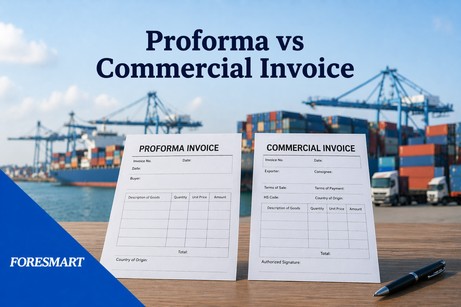
According to CBP regulations, commercial invoices for shipments valued over $2,500 must include the HS code, country of origin, and a detailed product description.
Shippers frequently mix up proforma and commercial invoices — and this document mismatch stalls goods and drives up storage costs. The difference between the two comes down to timing and legal weight, and customs has no tolerance for either being wrong.
What’s the Difference Between Proforma Invoice and Commercial Invoice?
A proforma invoice is a preliminary bill of sale. Sellers issue this document before any goods ship. This proforma document outlines costs and shipping terms.
And a commercial invoice is the final, official bill of sale. Sellers issue this invoice when goods ship. This commercial invoice acts as a formal demand for payment. Most importantly, customs authorities require this document to assess duties and clear cargo.
Primary Purpose
A proforma invoice estimates costs to secure funding. A commercial invoice demands payment and clears customs. Buyers receive the proforma early to review pricing or secure import licenses. Once they confirm the order, sellers issue the commercial invoice. Customs agents then use that document to verify declared values and assess duties.
Issuance Timing
Sellers issue proforma invoices during negotiations and commercial invoices only after goods ship. The proforma circulates while terms are still being finalized. Once buyers confirm the order and cargo leaves the facility, sellers generate the commercial invoice.
Content Flexibility
Proforma invoices are editable; commercial invoices are not. A value or quantity mismatch after cargo ships risks a customs hold. Teams adjust quantities, prices, or freight terms as details settle.
Legal Validity
A commercial invoice acts as a legally binding contract establishing debt. A proforma carries none of that weight — it commits neither party to completing the transaction. The commercial bill proves a completed sale, legally obligating buyers to settle the amount owed.
Accounting Usage
Finance teams record commercial invoices in official company ledgers. A proforma document stays out of accounts payable or receivable. The sale remains theoretical at that early stage. Accountants rely on the commercial invoice to log revenue, track inventory, and file corporate taxes.
Proforma vs Commercial Invoice Comparison Table
Here’s how the two documents stack up across every dimension that matters for customs and accounting.
|
Proforma Invoice |
Commercial Invoice |
|
|
Purpose |
Cost estimate / negotiation tool |
Official demand for payment |
|
Issuance Timing |
Before shipment |
After goods ship |
|
Legal Binding |
No |
Yes |
|
Customs Use |
Samples, gifts, warranty items only |
Required for all standard trade |
|
Content Flexibility |
Editable |
Locked — must match cargo exactly |
|
Accounting Entry |
Excluded from ledgers |
Recorded in AR/AP |
|
HS Code Required |
No |
Yes |
|
Accepted for Duty Calculation |
No |
Yes |
For commercial cargo, customs only accepts the commercial invoice.
Which Invoice Do You Need for Customs Clearance?
Customs requires a commercial invoice for standard international trade. Border agencies use this document to calculate duties and authorize entry. Proforma invoices only work for strictly non-commercial scenarios.
Not sure which one applies? Use this as a quick reference:
- Goods have commercial value : Commercial Invoice
- Sending samples, gifts, or warranty replacements : Proforma Invoice (declare nominal value)
- Still negotiating, nothing has shipped : Proforma Invoice
Commercial Invoices for Official Declarations
You need a commercial invoice to clear any standard trade shipment. Border agents use this exact document to assess import taxes and verify product codes. Missing data stalls goods immediately. Importers use the commercial invoice to prove the declared transaction value matches the physical cargo.
Proforma Invoices for Non-Commercial Exceptions
Customs accepts proforma invoices for non-commercial shipments like product samples, gifts, or warranty replacements.
Shippers use the proforma document to declare a nominal value purely for border processing. If buyers pay for the goods, officers reject the proforma and demand the commercial invoice.
Top Invoice Mistakes to Avoid for Smooth Customs Clearance
Invoice errors freeze cargo at the border. Customs agents reject shipments when paperwork lacks specific details or shows incorrect values.
Vague Product Descriptions
Vague product descriptions force customs to hold shipments for manual inspection. Instead of generic terms like “electronics” or “parts,” border officers require the exact material and intended use. Shippers must provide clear labels, such as “100% cotton men’s t-shirts” or “12-volt car batteries.”
Zero Value Declarations for Samples
Declaring a zero value on samples almost always triggers customs rejection, because every physical item carries a manufacturing cost. Entering ‘$0.00’ flags the shipment as potentially fraudulent. To pass border screening, sellers must declare a nominal production value like “$1.50” even for free gifts.
Incorrect or Missing HS Codes
Missing or wrong Harmonized System (HS) codes lead to incorrect tax bills and border penalties. Since customs uses these codes to calculate duties, leaving the form blank forces border agents to guess the product category. This classification error often causes importers to overpay duties or face compliance fines. If you’re unsure of your code, here’s how to find your HS tariff code.
Mismatched Supporting Documents
Customs cross-checks the commercial invoice, packing list, and bill of lading together. A quantity or description mismatch risks an immediate hold. Foresmart’s door-to-door shipping service coordinates all three documents under one process, reducing the risk of discrepancies.
Conclusion
Proforma invoices facilitate early negotiations, but commercial invoices provide the legal weight required to clear customs. Accurate descriptions, realistic values, and correct HS codes are the only things standing between your cargo and a border hold. Need end-to-end documentation support? Foresmart handles customs procedures and paperwork as part of the full shipping process.
Frequently Asked Questions (FAQs)
Can Customs Reject a Commercial Invoice?
Yes, customs agents reject invoices with vague, inconsistent, or incorrect data. Any discrepancy between the paperwork and physical cargo triggers a hold. Shippers must align the commercial invoice with the packing list and bill of lading to avoid these delays. For a full list of required fields, see what a commercial invoice in shipping requires.
Is a Commercial Invoice the Same as a Tax Invoice?
No, they serve different legal functions. Shippers use a commercial invoice for international trade and duty calculation. A tax invoice is a domestic tool for reclaiming VAT or GST within a single country.
How to Convert a Proforma Invoice to a Commercial Invoice?
Convert a proforma by updating the document title and finalizing shipment data. Sellers must replace the “Proforma” header with “Commercial Invoice” and assign a permanent invoice number. The final version must reflect actual quantities and the ship date to become legally binding.
Yes, customs agents reject invoices with vague, inconsistent, or incorrect data. Any discrepancy between the paperwork and physical cargo triggers a hold. Shippers must align the commercial invoice with the packing list and bill of lading to avoid these delays. For a full list of required fields, see what a commercial invoice in shipping requires.
No, they serve different legal functions. Shippers use a commercial invoice for international trade and duty calculation. A tax invoice is a domestic tool for reclaiming VAT or GST within a single country.
Convert a proforma by updating the document title and finalizing shipment data. Sellers must replace the “Proforma” header with “Commercial Invoice” and assign a permanent invoice number. The final version must reflect actual quantities and the ship date to become legally binding.