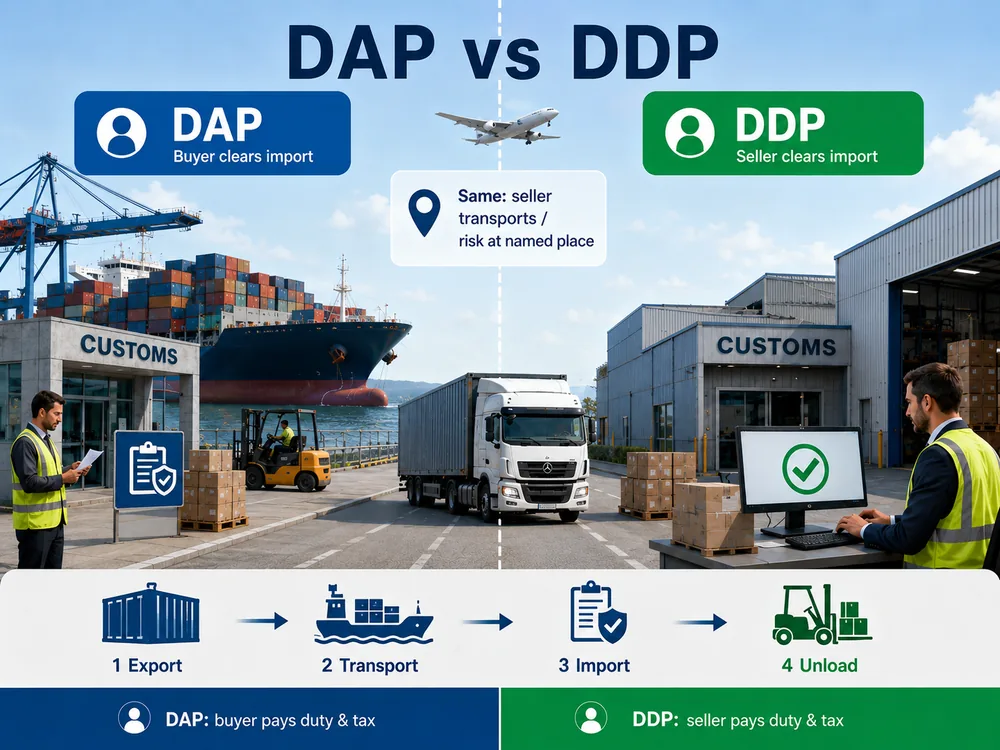
Use DAP when the buyer can handle import clearance and wants control over the customs entry. DDP fits only when the seller can legally manage import formalities in the destination country. Both terms require the seller to arrange transport to the named place and carry transit risk until delivery. The difference is who clears the goods for import and pays the related duties and taxes.
What Are the Main Differences Between DAP and DDP?
DAP leaves import clearance and import charges with the buyer, while DDP assigns them to the seller. Under Incoterms 2020, both terms otherwise place transport to the named destination and transit risk on the seller.
|
Decision point |
DAP |
DDP |
|---|---|---|
|
Import clearance |
Buyer manages and pays |
Seller manages and pays |
|
Import duties and taxes |
Buyer pays |
Seller pays |
|
Customs broker control |
Buyer usually appoints or directs the broker |
Seller usually appoints or directs the broker |
|
Risk transfer |
At the named place, ready for unloading |
At the named place, ready for unloading |
|
Unloading |
Buyer usually bears the risk and cost |
Buyer usually bears the risk and cost |
|
Best fit |
Buyer has local import capability |
Seller can legally and operationally manage destination import formalities |
Import Clearance Responsibility
The buyer completes any required import clearance under DAP shipping terms. That work can include appointing a customs broker, supplying importer information, filing the entry, and obtaining required import permits.
Under DDP, the seller must complete and pay for any required import clearance. DDP does not automatically make the overseas seller the legal importer of record. Destination law still determines the legal importer and any required registrations or representatives.
Import Duty and Tax Responsibility
The DAP buyer pays import duty, import VAT or GST, and other import taxes. Under DDP shipping terms, the seller pays those charges and normally includes them in the sale price or DDP quote. DDP does not remove tax. It changes which party must account for it. Buyers should compare total landed cost, not the headline freight amount.
Customs Control and Buyer Involvement
DAP gives the buyer more control over tariff classification, customs valuation, broker instructions, and the import record. This control helps an experienced importer protect its compliance history and tax documentation.
DDP reduces the buyer’s operational work, but the buyer may still need to supply permits, product information, or other assistance. Importers that need their own name and tax number on the entry should settle that point before agreeing to DDP. Incoterms explain cost and risk allocation, but local customs law decides who can act as importer.
How Do DAP and DDP Work from Origin to Final Delivery?
Both terms make the seller arrange the shipment to the exact named place. Responsibility changes during import clearance and again when the goods reach that place.
Export Clearance and Origin Handling
The seller handles export clearance and transit customs formalities where required under both terms. The seller also arranges pickup and origin handling required by its transport contract. The quote should identify loading, export documents, terminal handling, and security filings. Any gap in the booking can create an extra charge or delay.
International Transport to the Named Place
The seller contracts and pays for carriage to the named place under both terms. DAP and DDP can cover road, rail, air, sea, or a multimodal route.
The named place must be precise. “DAP Chicago” can refer to a terminal, warehouse, or buyer address, and each point creates a different delivery cost. A complete term identifies the facility or address and states “Incoterms 2020.”
Import Clearance at Destination
Under DAP, the buyer manages customs clearance and tells the seller when delivery can continue. Under DDP, the seller manages the import entry and related customs payments. Because missing documents can stop either shipment, the responsible party should prepare permits, tax numbers, and powers of attorney before arrival.
Risk Transfer at the Named Place
Under Incoterms 2020, risk transfers for DAP and DDP at the named destination. The seller must place the goods at the buyer’s disposal, ready for unloading. Entering the destination country or clearing customs does not trigger risk transfer by itself.
If the DAP buyer fails to complete import clearance, the buyer bears cargo risk during the resulting hold. The sales contract should assign document deadlines, arrival notices, and delay costs because the Incoterm does not cover every breach consequence.
Unloading at Final Delivery
The buyer usually bears unloading risk and cost under both DAP and DDP. If the seller’s transport contract already includes an unloading charge, the seller should disclose that amount so the buyer does not pay twice. The buyer still carries the risk during unloading.
The delivery plan should identify the equipment and labor needed. A dock, forklift, crane, liftgate, appointment, or inside delivery may carry a separate charge. Main transport does not automatically include those services.
When Should an Importer Choose DAP or DDP?
Choose the term that matches each party’s customs capability. DAP often fits an established importer, while DDP can fit a seller with verified destination-country clearance arrangements.
Choosing DAP When the Buyer Wants Customs Control
DAP fits a buyer that has an importer registration, a customs broker, and staff who can answer clearance questions. This setup lets the buyer control classification, valuation, duty relief, and tax records. Because the buyer controls clearance, it must send complete documents and monitor arrival before free time expires. Late clearance can trigger storage or delivery rescheduling costs.
Choosing DDP When the Seller Can Manage Import Formalities
DDP fits when the seller can lawfully complete import clearance, pay the duties and taxes, and deliver to the named place. The buyer usually does not file the customs entry or receive separate duty invoices.
For China-origin cargo, Foresmart can quote door-to-door shipping with customs clearance and duties paid. This option depends on the cargo and destination supporting DDP service. The quote still needs a named importer, tax treatment, delivery scope, and written exclusions.
Checking Destination-Country Restrictions Before Choosing DDP
The seller must confirm that destination law allows the planned DDP structure. Local rules may require a locally established importer, tax registration, licensed representative, product approval, or permit. If the seller cannot meet those requirements, use DAP and place import clearance with the buyer. An experienced China freight forwarder can review the route and documents. The sales contract should still name the party legally responsible for the entry.
What Should You Check in a DAP or DDP Quote?
A usable quote must state the exact destination, customs parties, included charges, and delivery conditions. “DAP price” or “DDP price” alone does not define enough scope for a landed-cost comparison.
Named Place and Incoterms Version
Write the chosen term, exact terminal or delivery address, and Incoterms 2020. Use the same wording on the purchase order, commercial invoice, sales contract, and shipping instructions. A city-only destination can leave final-mile transport and terminal transfer open to dispute.
Importer of Record and Customs Broker
Name the importer of record and customs broker before booking. Confirm the importer’s registration, bond, tax number, licenses, and power of attorney where applicable. Under DDP, do not assume the seller can act as importer merely because the quote uses DDP. Under DAP, confirm that the buyer can satisfy the destination country’s importer of record requirements. These requirements vary by jurisdiction and cargo type.
Included and Excluded Destination Costs
The quote should mark each destination cost as included, excluded, estimated, or conditional. Review these items:
- Customs brokerage and entry fees
- Duties, import VAT, GST, and other import taxes
- Terminal handling, document release, and delivery order fees
- Customs exams, inspections, permits, and product-specific charges
- Storage, demurrage, detention, waiting time, and redelivery
- Final-mile delivery and appointment charges
A standard DDP price assigns import clearance, duties, and import taxes to the seller. If the quote shifts one of those costs to the buyer, it departs from standard DDP allocation. State the change in the contract or use DAP when DAP describes the agreement more accurately. A freight glossary can define an unfamiliar fee, but the quote must still identify who pays it.
Delivery Access and Unloading Requirements
Tell the seller whether the delivery point has a dock, forklift, receiving appointment, or access restrictions. State whether the site needs a liftgate, crane, inside delivery, pallet breakdown, or required permits. Because limited access and waiting time can change the final bill, the quote should name the unloading party and excluded delivery services.
FAQs
Do DAP and DDP Determine When Ownership Transfers?
No. DAP and DDP allocate delivery duties, costs, and risk, but they do not determine title or ownership. The sales contract and applicable law must state when ownership transfers.
Is DAP the Same as the Former DDU Incoterm?
No. DAP is the closest current replacement for DDU, but the terms come from different rule sets. Incoterms 2010 introduced DAP and DAT to replace DAF, DES, DEQ, and DDU. Contracts should state DAP and the applicable version instead of relying on the obsolete DDU label.
Do DAP and DDP Apply to Every Mode of Transport?
Yes. DAP and DDP apply to road, rail, air, sea, inland waterway, and multimodal transport. The exact named place remains necessary because risk transfer occurs there, regardless of mode.
Who Pays Demurrage or Storage if the Buyer Delays DAP Import Clearance?
The buyer generally bears extra cost caused by its failure to complete DAP import clearance or take delivery. This allocation assumes the seller met its notice and delivery obligations. The carrier contract, terminal tariff, and cause of delay may determine which party receives the invoice first. Assign free-time monitoring and delay charges in writing before shipment.
Can a Buyer Reclaim Import VAT Under DDP?
DDP does not automatically give the buyer a right to reclaim import VAT. In the EU, the business generally needs an import document that names it as consignee or importer. The document must also show the VAT amount. If the seller imports under its own name, the buyer may lack the required evidence. Confirm the importer, VAT registration, import document, and local recovery rules with a tax adviser before choosing DDP.