

There are two terms in container shipments that most global shippers are scared of: demurrage and detention. Because these charges can hurt your whole logistics budget. Being an importer or exporter, you must be aware of these fees.
So, how are these seemingly similar terms inherently different? Let’s get to know in this detailed guide.
What Are Demurrage Charges?
Before we tackle the difference between demurrage and detention, let’s discuss the definition of demurrage and detention first.
When your international cargo arrives at the port, the process does not end here. The container in which your goods arrive has to spend some time at the terminal where it is unloaded from the ship or train and is picked up to leave the port.
All this takes time, and fortunately, your carrier or the port operator provides you with a decent amount of time till you send your goods away from the port without any additional charges. This time is called “free days,” which vary from shipment to shipment.
But if, for any reason you fail to take your goods away from the port or terminal before the end of “free days,” demurrage is charged to the shipment.
For instance, if you are shipping electronics from a supplier in Vietnam to a port in Rotterdam. The delivery is expected to arrive on May 10th, and you will collect on May 25th.
If your shipping carrier offers 5 free days of storage (common in carriers), you have until May 15th to pick up the goods before additional charges apply. If you pick up the cargo on May 25th, the total storage time is 15 days, with 5 days free and 10 days subject to demurrage costs. These fees are calculated based on a fixed rate for each day the container stays beyond the free period.
What Are Detention Charges?
Importers face detention fees if they do not return the container.
Just like demurrage charges, carrier companies give shippers free time to take the container out of the port and return the empty container. If they do not return the container at the agreed time, detention charges are incurred.
For example, if you take a container to your factory and keep it for 14 days to unload, but the shipping company only allows 7 days to return the empty container, the buyer will face a “detention” charge for the extra 7 days.
Detention vs. Demurrage: Key Differences in Logistics
In some countries, detection and demurrage are combined, while in others, they are separate terms. If you are expecting delays, will you be charged with demurrage or detention?
Simply put, we would say both charges come into play when containers aren’t moved in time, but detention applies when the container is outside ports, and demurrage applies when it’s still at the port or terminal.
However, the exact definition of demurrage and detention varies among shipping lines. So, it’s important to understand what each carrier meant when they incurred detention or demurrage.
To get a better understanding of how they work, let’s discuss how demurrage and detention will differ during export and import.
For Imports
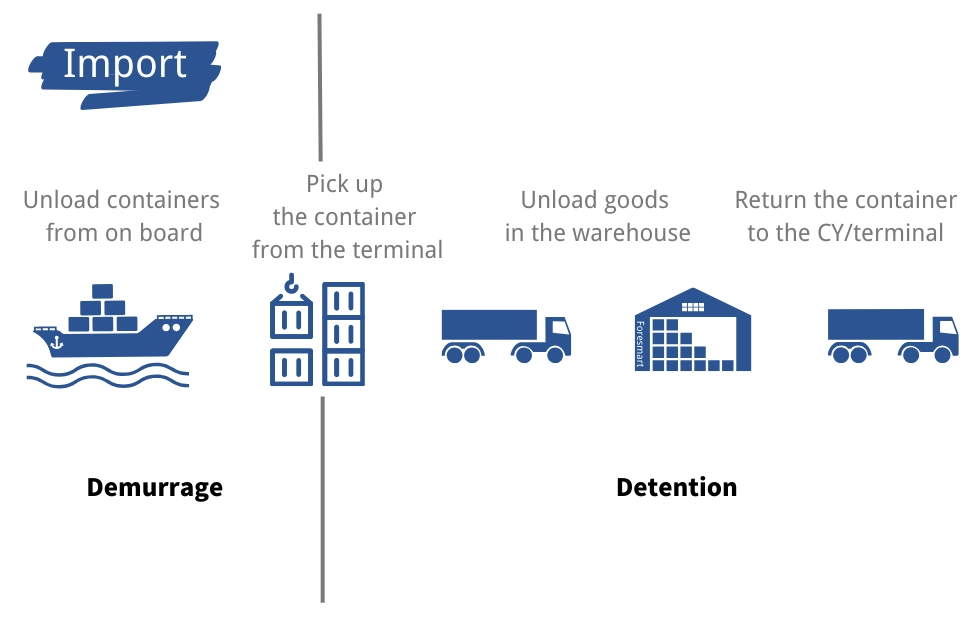
When containers arrive at a terminal for importing, demurrage fees can occur if the containers aren’t picked up in time after they reach the port. Once the free period ends, the port charges the consignee a daily fee.
If the buyer takes the containers away to unload them and delays returning them to the container yard, detention fees will be applied.
It’s not unusual for an importer to face both demurrage and detention charges.
For Exports
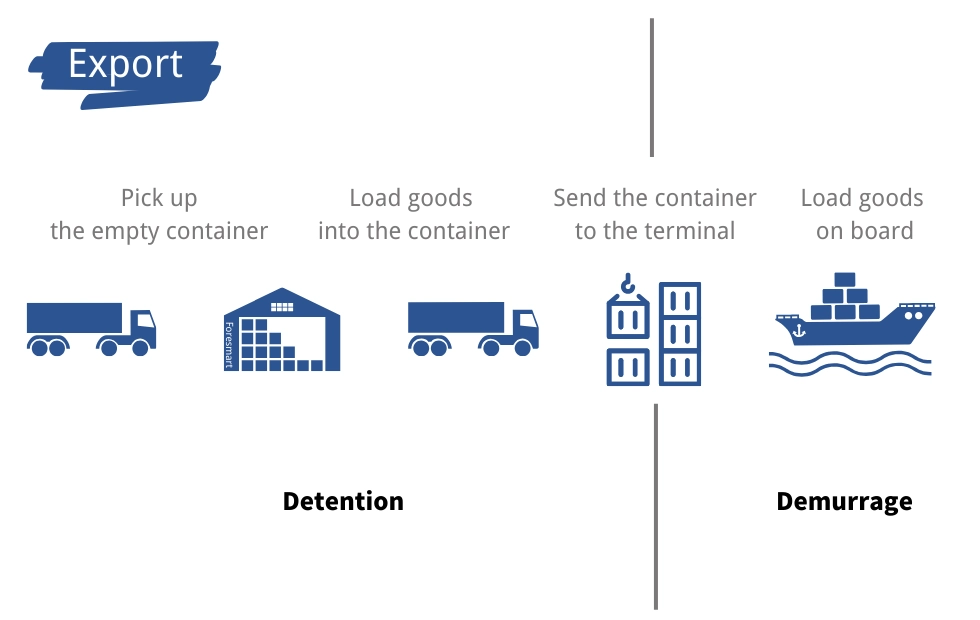
And if you are on the export side, detention and demurrage will apply slightly differently.
When shipping goods out, the port might give you 7 free days so you can collect empty containers, load them with your cargo, and return them to the port to be loaded onto the vessel. If the containers are returned late, detention fees will be charged for each extra day.
On the other hand, demurrage fees can happen if the container stays at the port for too long before the vessel is scheduled to leave. For instance, supposing a ship is set to sail on June 20th, and there are 5 free days before demurrage kicks in. If you send the container to the port on June 10th, it would result in 5 days of demurrage charges from June 15th to June 20th. This fee generally occurs because of a delay in documentation, customs clearance, or vessel schedule changes.
Demurrage Fees vs. Detention Fees
The main purpose of these charges is to avoid disrupting the supply chain of carriers. When a consignee holds onto the equipment longer than the agreed time, it prevents other customers from using it.
Plus, if much equipment stays too long at the port, it causes port congestion.
To manage these problems, carriers charge a per diem fee. This helps cover the cost of bringing in extra equipment and discourages importers from holding onto containers for too long.
How much you’ll pay for detention or demurrage, of course, depends on the number of days you delay picking up and returning the container. Besides, the per-day cost also depends on shipping companies, ports, and carriers.
On average, detention fees of US ports range from $100 to $300 per container per day, while demurrage costs go on the more expensive side, say $400 to $600 per container/per day.
Are Demurrage and Detention Unavoidable?
Wondering why you can experience these delays? Some causes of demurrage and detention delays are unavoidable, such as port congestion and weather like hurricanes.
However, sometimes, you might encounter truck driver delays, contract issues, customs issues, or if your documentation is not complete, which can be avoided beforehand.
How to Avoid Demurrage and Detention? Tips to Save Money
As you can see, these charges can really hurt your bottom line, and of course, this is the last thing you ever want. But don’t worry, detention and demurrage charges are not unavoidable if you follow these smart tips.
Pre-Pull Your Cargo
If your cargo is expected to exceed the free days at the destination port and incur demurrage fees, you can opt to pre-pull it to a nearby container yard. While pre-pull fees apply, this option is more cost-effective than demurrage. This is especially beneficial when your goods arrive on a Friday and staff are unavailable over the weekend, helping you avoid costly demurrage charges.
Create a Clear Pickup Plan
Many people or companies end up paying such fees because their transportation arrangements aren’t properly set up. Your transportation provider should know exactly when your freight will arrive at the port and have their loading appointment scheduled. Also, be sure they have the right credentials to pick up cargo from the port.
In U.S. ports, for example, drivers need a Transportation Worker Identification Credential (TWIC) card and a Uniform Intermodal Interchange and Facilities Access Agreement (UIIA) certification. Without these, they may have trouble accessing the port and hauling your containers. So, you need to plan ahead and ensure everything is in place before your cargo arrives.
Arrange Alternatives
Anything can go wrong, no matter how early or thoroughly you plan. You have booked the trucker to pick up your container. Right! But what if it somehow breaks down in the middle of the road before it can reach your port? So you may need an alternate trucker.
Similarly, do you have a workforce ready to empty your container at your warehouse? Great if you have! But what if any of them fail to unload the goods at the last moment? You may have an alternate team to cover you in unexpected situations.
Keep an Eye on It Closely
Now, the most crucial part! You must have an idea of where your shipment is in real-time. Once you dispatch your goods from the port, you must ensure they arrive at the destination on time. Today, many carrier companies offer real-time monitoring services so you can keep tabs on your shipment. Ask them for tracking details.
Consult a Freight Forwarder
These tips sound effective but overwhelming, right? If you’re short on time or still unsure about how logistics work, you might accidentally overlook important details in the shipment process.
So this time, you need a professional freight forwarder who can guide you at each step of the logistics process. They handle everything, from planning your shipment and choosing the right shipping carriers and trucking companies, to managing storage, paperwork, and customs clearance. This will help you in avoiding demurrage and detention costs.
Related Reading: How to find a freight forwarder in China?
Final Words
Now you know what demurrage and detention are in shipping. What is more important is to understand your carriers’ per-down policies and requirements.
Besides, keep in touch with your freight forwarder and let them help you avoid demurrage and detention charges.
FAQs
What is free time?
Free time, or standard free time, is the amount of time a carrier allows its customers to handle the container without charging any fees. A typical duration of free time ranges from 7 to 14 days.
Are demurrage and port storage charges the same?
Demurrage charges and port storage charges are similar but not the same. Both are levied when your goods exceed the allowable free time. However, demurrage charges are levied by the shipping carrier or the port operator, while a port storage fee is charged by the port operator.
How are demurrage charges calculated?
Demurrage charges depend on your demurrage rate, “Per Day Pro-Rata,” or PDPR, and the number of days the shipment exceeded the free time. For example, if your demurrage fee is $100 per day and your container stays an extra 3 days, you’d be charged $300 in total.