
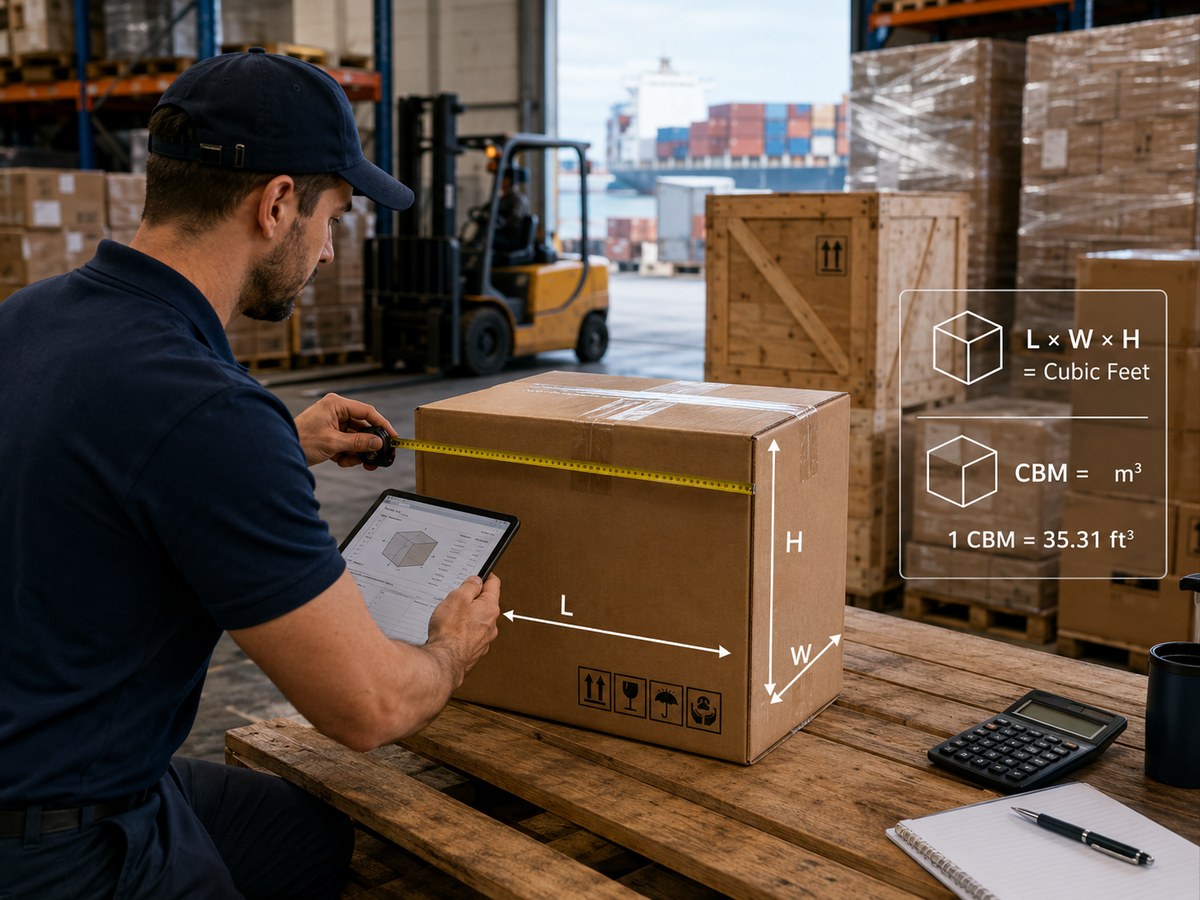
Calculate cubic feet by multiplying the packed length, width, and height, then convert the result to CBM before asking for an international freight quote. Wrong packed volume can make an early quote look cheaper than the final bill.
This guide shows how to calculate cubic feet for boxes, pallets, and crates, then connects packed dimensions to LCL, warehouse space, consolidated shipping, and dimensional weight.
What Is a Cubic Foot?
A cubic foot is the volume inside a space that measures 1 foot long, 1 foot wide, and 1 foot high.
- 1 ft x 1 ft x 1 ft = 1 cubic foot
In shipping, cubic feet means packed cargo volume, not product volume. A small item can still need a large outer box, and a half-empty carton still occupies a full carton slot.
How Do You Calculate Cubic Feet?
You calculate cubic feet by multiplying length, width, and height in the same unit. Use feet directly, or divide by 1,728 when the measurements are in inches.
|
Measurement Type |
Formula |
Example |
|---|---|---|
|
Feet |
Length (ft) x Width (ft) x Height (ft) |
4 ft x 3 ft x 2 ft = 24 cubic feet |
|
Inches |
Length (in) x Width (in) x Height (in) / 1,728 |
24 in x 18 in x 12 in / 1,728 = 3 cubic feet |
|
Multiple boxes |
Cubic feet per box x carton count |
3 cubic feet x 40 boxes = 120 cubic feet |
The number 1,728 comes from one cubic foot: 12 in x 12 in x 12 in = 1,728 cubic inches.
Measure the outside of the packed carton. Product page size often excludes carton walls, foam, and corner guards. For mixed cartons, group cartons by size, calculate each group, then add the totals.
How to Measure Boxes, Pallets, and Crates for Cubic Feet
Measure packed cargo at the farthest outside points. The tape measure should catch bulges, overhang, corner boards, crate bases, and any part that affects loading space.
Box Dimensions
For a carton, measure the longest side as length, the next side as width, and the vertical side as height. Use the packed carton size, not the item size. A 20 inch product may need a 24 inch export carton after inserts and edge protection.
Pallet Dimensions
For a pallet, measure the loaded pallet as one piece. The pallet base, cartons, wrapping, straps, and boards all count. Do not stop at the pallet footprint, because a 48 in x 40 in pallet stacked to 72 inches uses more space than the same pallet stacked to 60 inches.
Crate Dimensions
For a crate, measure from the outer edge of the wood. Skids, feet, braces, side frames, and lid thickness count toward cubic feet. If a pipe, handle, or bracket sticks out, include that point. A photo helps the forwarder check stacking and handling needs.
How Do You Convert Cubic Feet to CBM?
Convert cubic feet to CBM because most international ocean, warehouse, and consolidation quotes use cubic meters. One CBM equals about 35.315 cubic feet.
|
Conversion Need |
Formula |
Example |
|---|---|---|
|
Cubic feet to CBM |
Cubic feet / 35.315 = CBM |
120 cubic feet / 35.315 = 3.40 CBM |
|
CBM to cubic feet |
CBM x 35.315 = cubic feet |
2.5 CBM x 35.315 = 88.29 cubic feet |
This conversion helps when a US buyer measures cartons in inches but the freight quote uses CBM. The guide What Is CBM explains cubic meters in freight terms.
Use two decimal places for quote requests unless the forwarder asks for a different format. Do the math from the original measurements, then round the final CBM. Do not round each carton too aggressively before multiplying, because small errors grow across a full supplier order.
|
Cubic feet |
Approx. CBM |
|---|---|
|
10 cu ft |
0.28 CBM |
|
35.315 cu ft |
1.00 CBM |
|
100 cu ft |
2.83 CBM |
|
500 cu ft |
14.16 CBM |
What Is the Difference Between Cubic Feet and CBM?
Cubic feet and CBM both measure volume. Cubic feet use the imperial system, while CBM uses the metric system.
|
Term |
What It Measures |
Common Use |
Buyer Risk |
|---|---|---|---|
|
Cubic feet |
Volume in feet or inches |
US box, pallet, and storage notes |
Easy to misread as CBM |
|
CBM |
Volume in cubic meters |
LCL, warehouse, and freight quotes |
Quote changes if conversion is wrong |
A supplier may send carton dimensions in centimeters, while the buyer’s warehouse asks for inches. Mixing both systems in one formula can misquote volume.
International freight quotes usually need CBM. Cubic feet still helps US teams that measure cartons, pallets, or storage space in inches. Send both the original dimensions and the calculated volume so the forwarder can check unit errors and stackability.
Shipping Container Dimensions helps buyers compare cargo volume against 20ft, 40ft, and 40ft high cube containers before choosing LCL or FCL.
How Does Cubic Feet Affect Shipping Cost?
Cubic feet affects shipping cost when cargo takes up billable space. Weight still matters, but bulky cargo can cost more because the shipment uses more capacity.
LCL Shipping Charges
LCL cargo shares a container with other shipments. Since shared space has a cost, LCL charges often follow CBM or weight, depending on the quote basis. Low-weight bulky cargo, such as foam goods, plastic display racks, lampshades, and empty cases, can fill space quickly.
Warehouse Space Planning
Warehouses use packed volume to plan receiving, storage, and loading. Wrong cubic feet can force a different staging area. If cartons arrive larger than the booking sheet shows, warehouse staff may need to remeasure, repack, or change the loading plan.
Consolidated Shipping From Multiple Suppliers
Consolidated shipping needs accurate carton volume because multiple supplier orders must fit into one shipment. Foresmart’s freight consolidation service combines cargo from multiple Chinese suppliers across 10 major Chinese cities.
One wrong carton group can distort the consolidation plan.
When Does Dimensional Weight Matter?
Dimensional weight matters when a carrier compares actual weight with space-based weight. Air freight and express shipping use this check often.
Air Freight Billing
Air freight capacity depends on weight and space. A large, light carton can take up aircraft room even when the actual weight is low. Air freight teams often compare actual weight with dimensional weight, then bill the higher figure. Dimensional Weight vs. Actual Weight covers this comparison in more detail.
Express Shipping Checks
Express carriers ask for exact length, width, height, and weight. The carrier system may re-rate the shipment if the package scans larger than the booked size. This risk is common with soft packaging, taped bulges, and cartons that do not hold a square shape.
Dense Cargo and Bulky Cargo
Dense cargo has high weight for its size. Metal parts, tools, and hardware often fit this group. Bulky cargo has high volume for its weight. Foam, plastic shelves, pillows, and assembled displays may bill on volume or dimensional weight.
Common Mistakes When Calculating Cubic Feet
Most cubic feet mistakes come from measuring the wrong object, mixing units, or losing count accuracy.
|
Mistake |
Why This Mistake Hurts the Quote |
Better Action |
|---|---|---|
|
Measuring product size instead of packed size |
Product size excludes export packing. |
Ask for export carton, pallet, or crate dimensions. |
|
Mixing inches and feet |
Wrong units can produce a volume that is 12, 144, or 1,728 times off. |
Convert all sides to one unit before calculating. |
|
Forgetting the carton count |
One carton size is not the full shipment volume. |
Multiply cubic feet per carton by the carton count. |
|
Ignoring pallet height |
Pallet bases, top boards, and corner boards add height. |
Measure the loaded pallet as one piece. |
For mixed cartons, build a table with carton size, quantity, cubic feet per carton, and total cubic feet. If a pallet cannot stack, tell the forwarder, because non-stackable cargo can use more space than cubic feet alone suggests.
What Details Should You Send for a Freight Quote?
Send packed dimensions, weight, and cargo handling details together. Cubic feet alone can miss handling limits and delivery scope.
Include:
- Length, width, and height for each carton, pallet, or crate
- Unit of measure
- Carton count by size group
- Gross weight and net weight
- Cargo name
- Supplier pickup address
- Final delivery address
- Palletized, loose carton, or crated status
- Stackable or non-stackable status
- Photos for irregular, fragile, oversized, or soft-packed cargo
If the shipment starts in China, a China freight forwarder can check supplier dimensions before cargo moves. This check helps catch volume errors while the supplier can still adjust cartons or pallets.
FAQ
Why did my freight quote change after the warehouse remeasured the cargo?
A freight quote can change when the warehouse records a larger packed size than the supplier first reported. Forwarders rate cargo on the space the shipment occupies, so bulges, loose wrapping, pallet overhang, or repacking can raise the final cubic feet and CBM.
Should I round cubic feet before asking for a shipping quote?
Round each package dimension after measuring, then calculate total cubic feet from those rounded dimensions. Do not round too early or shrink a borderline measurement, because carriers and warehouses may remeasure cargo and correct the bill when the booked size is too low.
How do I measure irregular or soft-packed cargo?
Measure irregular cargo at the farthest outside points, as if the cargo sat inside the smallest rectangular box that could hold the shipment. For bags, rolls, or wrapped goods, use the packed shape at rest because the outside shape decides how much truck, warehouse, or container space the shipment uses.
Does empty space inside a box count toward cubic feet?
Yes, empty space inside a shipping box counts because cubic feet uses the outer packed dimensions. A half-filled carton still takes the same external space in a warehouse or container, so oversized packaging can raise volume-based freight, storage, and consolidation costs.
What happens if my booked cubic feet is lower than the actual cargo size?
The shipment may be re-rated, delayed, or moved to a different loading plan when the actual cargo size is higher than the booked cubic feet. This mismatch can affect LCL space, pallet handling, warehouse storage, and dimensional weight checks, especially during tight sailing or flight schedules.
A freight quote can change when the warehouse records a larger packed size than the supplier first reported. Forwarders rate cargo on the space the shipment occupies, so bulges, loose wrapping, pallet overhang, or repacking can raise the final cubic feet and CBM.
Round each package dimension after measuring, then calculate total cubic feet from those rounded dimensions. Do not round too early or shrink a borderline measurement, because carriers and warehouses may remeasure cargo and correct the bill when the booked size is too low.
Measure irregular cargo at the farthest outside points, as if the cargo sat inside the smallest rectangular box that could hold the shipment. For bags, rolls, or wrapped goods, use the packed shape at rest because the outside shape decides how much truck, warehouse, or container space the shipment uses.
Yes, empty space inside a shipping box counts because cubic feet uses the outer packed dimensions. A half-filled carton still takes the same external space in a warehouse or container, so oversized packaging can raise volume-based freight, storage, and consolidation costs.
The shipment may be re-rated, delayed, or moved to a different loading plan when the actual cargo size is higher than the booked cubic feet. This mismatch can affect LCL space, pallet handling, warehouse storage, and dimensional weight checks, especially during tight sailing or flight schedules.