
Seaports are ports, harbors, or inland facilities that allow ships to depart and arrive. International shipping depends on effective coordination ensuring that the goods are transferred smoothly, but it can be tricky sometimes.
Luckily, we have a standard code system. The seaport code is the unique identifier of a seaport, playing an important part in simplifying the complexities of global shipping.
What Is the Seaport Code?
A seaport code is an alphanumeric identifier that helps in identifying seaports across the world. These seaports are part of the UN/LOCODE (United Nations Code for Trade and Transport Locations) system. In 1981, a framework was developed by UNECE (United Nations Economic Commission for Europe) in collaboration with some other trade and transportation companies to promote and simplify international trade. Later, this initiative evolved into what is today known as UN/LOCODE. The database of seaport codes is still managed by UNECE, which currently includes over 103,000 locations in almost 250 countries.
It not only includes seaports but also airport codes. Other inland terminals and logistics hubs are also included in its database.
With the help of the seaport code system, we can simplify shipping, customs clearance, and freight logistics. The seaport codes are present on invoices, bills of lading, and contracts so that every party in the supply chain remains connected and informed.
What Are the Different Types of Seaports?
“Seaport” is a general term that is used for a facility center where your cargo is sent, received, and handled. There are a few other types of seaports that you need to understand for a better insight.
Warm Water Port
It is a type of port where water doesn’t freeze even during winter, which means that it is available for year-round use.
Inland Port
An inland port is located on lakes, rivers, and canals with easy access to the ocean. This way the vessel is allowed to load and unload closer to the cargo’s final destination.
Dry Port
A dry port is an inland facility that is connected directly to a seaport via road or railway.
Cruise Ports
Cruise ports are typically for commercial passengers.
Cargo Ports
Cargo ports are of two types:
Container ports, which handle goods that need to be shipped through containers.
Bulk ports, which handle goods that need to be transported in bulk, like grains, coal, iron ore, etc.
Usually, the majority of cargo ports handle all kinds of goods but for the safer side, always make sure that you are not working with any port that has certain regulations about what can be sent or received as it may affect your shipment process.
Importance of the Seaport Code
Seaport identification codes help maintain clear and concise communication among all the parties connected with the shipping process. For example, they’ve simplified the process of cargo tracking. The seaport code also reduces confusion and frustration that can be caused by ambiguities regarding your freight’s current location to ensure the safe and efficient delivery of your goods.
Seaport codes also eliminate the chances of error that can be caused by lengthy and similar-looking seaport names. These codes enable faster processing of documents, important for customs clearance of your shipment as well.
Structure of the Seaport Code
A seaport code or UN/LOCODE has a certain standardized structure to represent specific locations, it consists of five characters:
Country code, the first two letters of the code denote the country, based on ISO 3166-1 alpha-2 country codes. For example, CN denotes China and TH denotes Thailand.
Location code, the last three letters of the code denote the specific port within a designated country or terminal. For Example HKG for Hong Kong, HAM for Hamburg. In countries where the possible three-letter combination exceeds, numbers are used. For example 0101 for Portland, Maine.
How Are Seaport Codes Used?
The seaport code plays an important role in smooth operations as it prevents any chance of ambiguity and error. It is utilized at different stages of the shipping journey.
Tracking of Your Cargo
All the logistics platforms are dependent on seaport codes to identify and track the location of their sea freight cargo.
Freight Bookings
These seaport codes are used by freight forwarders to schedule their cargo movements.
Shipping Documentations
Seaport codes are present on bills of lading, manifests, contracts, and packing lists so that loading and unloading locations can be identified correctly.
What Is the Difference Between Major Ports and Minor Ports?
Being aware of the locations of the world’s largest ports allows you to more efficient and economical shipping of your goods. For instance, certain types of goods might require access to highways or railroads, customs facilities, and specific types of cargo-handling machinery that aren’t available at smaller ports. Moreover, freight companies usually opt for larger vessels as they can carry more goods at lower prices. These larger vessels require larger space to accommodate, and to avoid congestion and delays, larger ports are selected.
While larger ports have their own advantages, at times small and medium-sized ports have their own pros. Many smaller ports have catered to certain market challenges and focused on their infrastructure and facilities, which provide them a competitive edge. Small seaports usually have close connections with their local city, which means easier access to their destination and departure. This may significantly impact the overall cost of your freight.
Getting insights about the difference between major and minor ports can help you make decisions according to your requirements.
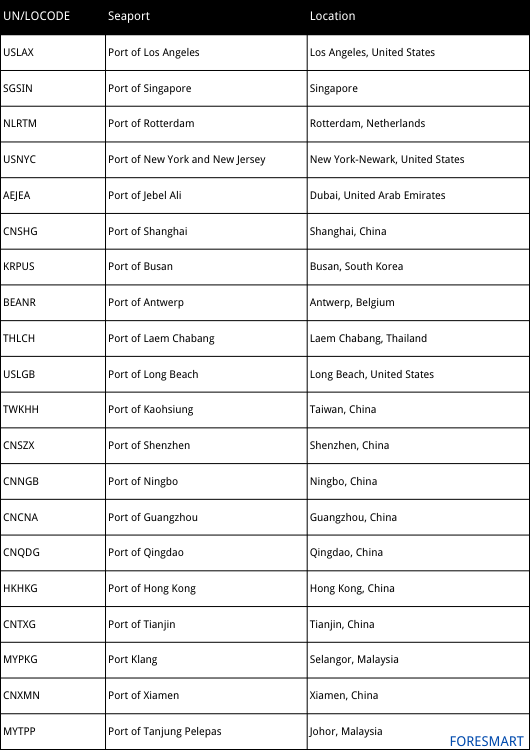
The Seaport Code List of Top 20 seaports
Here is the list of the top 20 seaports and their codes. These seaports are very important in global trade.
Check this page for a more complete list of seaports around the world.
Conclusion
Each seaport has unique features and facilities. This guide covers important information regarding the shipping seaport code system and the top 20 seaports worldwide. When planning your deliveries, refer to this list for a hassle-free process. Alternatively, you can contact Foresmart. We will create the most suitable shipping plan for your cargo.
Frequently Asked Questions (FAQs)
What is a seaport code?
A seaport code is an identifier for seaports. It helps with shipping logistics and global trade. Seaport codes are also called UN/LOCODE.
Where can I find port codes?
You can find port codes through online resources, port code finders, and by searching for a specific port.
When will I need a seaport & when will I need an airport?
Airport and seaport both have their pros and cons, but exploring both of these can be worth it.
Air freight can be a faster and reliable option, but it is expensive for cargo weighing more than 200kg. This also provides you with less capacity than cargo ships.
Sea freight takes a long time but is cheap and more environmentally friendly. Container ships can carry almost all types of goods, whereas many goods are marked hazardous to be transported by air.