
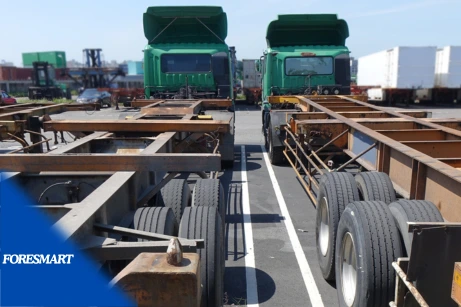
When you have container goods to ship across borders, you may find a “Chassis Fee” listed on your shipping price list sent from your freight forwarder. So, what does chassis mean in freight?
The article below will dive into the concept of chassis, related fees, and tips on how to manage expenses. Understanding these may help you in making informed decisions as well as reduce your freight shipping costs.
Define Chassis in Freight
A chassis is a specialized kind of trailer or undercarriage that is used for the transportation of shipping containers via road. It consists of a sturdy base that provides a secure hold and transport for containers. So containers don’t shift or fall while being transported. Moreover, it comes in different sizes to accommodate various kinds of containers, which makes it a significant asset when it comes to intermodal transportation.
Types of Chassis
In freight shipping, there are different kinds of chassis catering to various container sizes and their associated transportation requirements. The most common types are as follows:
Standard
This one is designed to transport general-purpose containers that are in the size range of 20ft, 40ft, and 45ft. They are commonly used in the freight industry because of their versatility.
Extendable
Another word for it is “stretch chassis”. They are very versatile and can easily be adjusted to accommodate various container lengths. In order to ship different container sizes, this one would be convenient.
Tri-Axle
It comes with three axles as opposed to the standard two axles in many chassis. This type is best suited when dealing with bulky cargo, because the additional third axle is helpful in providing better weight distribution, making it a more reliable solution for long-haul journeys.
Tank
This particular one is designed for the transportation of gas (also called ISO tanks) or liquid containers. It is built in a way that ensures stability as well as safety during transportation.
Flatbed
It is mainly used for out-of-gauge or oversized cargo that is not able to fit in the standard container dimensions. Its surface is flat to accommodate cargo, as well as machinery, and any kind of large equipment, such as construction materials.
What Is a Chassis Fee for Freight Shipping?
A chassis fee in freight shipping is charged for the use of a chassis for container transportation.
It is also called the chassis rental fee, where there is a flat rate (this is a fixed amount) for full container load (the FCL shipment), and it varies with the size of the container. The cost of renting one can range between $40 and $60 per day in the USA. It is normally charged based on 2-3 days.
When it comes to less than container load (the LCL shipment), the fee is determined based on the volume of the cargo.
This fee not only covers the charges of leasing or renting but also the maintenance and lastly the administrative expenses. The chassis type and the duration for which it will be used all affect the cost.
What Is a Chassis Split Fee?
After a container is unloaded from a sea freight ship at the port, it needs to be delivered by truck to its final destination. To do that, truckers use a chassis at the port to carry the container.
A chassis split fee is an extra charge when the chassis is not located at the same terminal as the container.
In this case, the trucker must:
-
Drive to a separate location to pick up the chassis,
-
Go back to the terminal to get the container,
-
Deliver the container to the final consignee,
-
Return the container to the port,
-
Return the rolling gear to its original location.
To cover the extra time and mileage involved, the trucker charges the split fee. There are two main types:
-
Split pick-up fee: Charged when the trucker has to pick up a chassis from another location because the port has none available.
-
Split return fee: Charged when the trucker must return the rolling gear to the rental provider instead of leaving it at the port.
What Factors Influence the Chassis Fee?
This fee, as mentioned above, is a flat fee; however, different factors might be responsible for any fluctuations in it. Below are some of those factors:
Fuel Price
Fuel cost no doubt affects freight systems. In the case when fuel cost is low, the overall shipment as well as trucking costs also decrease.
Peak Season
During peak seasons, it is a challenge to find an available chassis, so charges may turn higher than the average rate.
Customer Loyalty
Consistently doing business with the same trucking company every time may result in a lower shipping fee. If you are an infrequent shipper, you might be given either standard or slightly raised charges.
Government Policy
The fee is also affected by government policies. For example, it might be raised when regulations are imposed on transport and the operating hours are limited.
How to Avoid the Chassis Split Fee?
It is possible to avoid this fee if you plan ahead and consider some of the factors mentioned below:
-
Hire those truckers who already have a chassis of their own, preventing you from giving additional trailer pickups.
-
Request a carrier to arrange container transport instead of a trucker, but sometimes this may add a usage fee.
-
In the case the fee is unavoidable, you can negotiate with your truckers before contracting them for services.
-
Leave the shipping arrangement to professional personnel: work with your freight forwarder like Foresmart closely because we are devoted to providing the most cost-effective shipping solutions.
-
Utilize your own fleet and trailers.
Conclusion
Chassis are used to ship containers via road. The chassis fee and split fee indeed play a role in determining the total costs of the entire shipping journey.
By exploring different ways to reduce these fees, you will be able to reduce your logistics budget. It is best to properly plan in advance and have good coordination with your freight forwarders for a smoother shipping experience.
FAQs
What is the difference between chassis and frame?
The chassis supports the containers in freight shipping, whereas the frame is basically the vehicle’s structural base, and it provides the necessary support to all the other components of the vehicle.
Who charges chassis fee?
It is charged by the provider. Usually, chassis are supplied by the carrier or the port for cargo transportation. Sometimes, when ports or carriers do not offer one, it needs to be rented from a different provider who is outside the port location, adding an extra split fee.
How to do chassis maintenance and care?
It is necessary to regularly inspect the tires, brakes, the structure, as well as the other lubricating moving parts, to keep them in good condition.