International shipping can be complicated, with many rules and terms to understand. One area you may find confusing is shipping Incoterms or International Commercial Terms. Shipping Incoterms decide important things like:
-
Who pays for shipping
-
Who arranges transportation
-
Who handles customs clearance
-
When the risk transfers
This article will explain everything you should know about shipping Incoterms. Learning the meaning of Incoterms, you can manage your budgets and plan your international businesses better.
What are Incoterms?
Incoterms, short for International Commercial Terms, are standardized trade terms used in sales contracts for global shipping.
Developed by the International Chamber of Commerce (ICC) in 1936, these terms define the responsibilities of buyers and sellers in international transactions, outlining who is responsible for shipping, insurance, customs clearance, and other logistical tasks. They are written in 31 different languages and are used in over 140 countries.
Shipping Incoterms are periodically updated to reflect changes in global trade practices, with the latest Incoterms being Incoterms 2020.
This doesn’t mean you can only use Incoterms 2020 in 2025. If you and your supplier prefer to use an older version of the Incoterms, make sure to clearly specify this in your contract to avoid any misunderstandings.
Why are the Incoterms important?
Shipping Incoterms significantly impact international trade by ensuring all trading parties understand their legal obligations. They help to:
- Reduce Risk:
Incoterms minimize the potential for disputes by clearly defining the division of costs and risks between the buyer and seller.
- Simplify Communication:
By using a standard set of terms, buyers and sellers can communicate more effectively, reducing language barriers and misunderstandings.
- Improve Efficiency:
Streamlining the shipping process helps avoid delays and ensures that goods move smoothly through the supply chain.
- Legal Clarity:
Shipping Incoterms are recognized globally and provide a legal framework that supports international trade agreements.
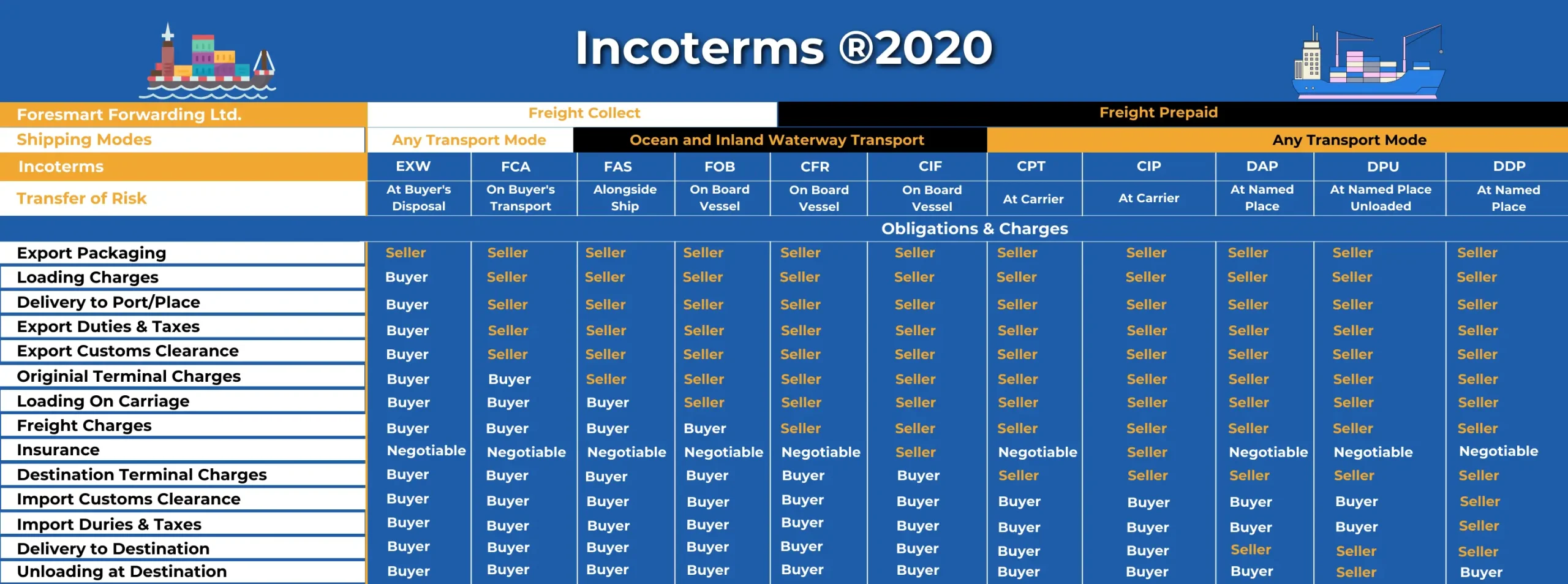
Incoterms 2020 Chart
The Incoterms 2020 consist of 11 terms that can be divided into two categories: those applicable to any mode of transport and those specifically for sea and inland waterway transport. Here’s a chart and list of the current Incoterms.

You can find the terms “freight collect” or “freight prepaid” on your shipping documents, like a Bill of Lading or an Air Waybill. Freight prepaid means that the freight charges are paid by the shipper at the port of origin. Freight collect means that the freight charges will be paid by the consignee at the destination.
Shipping Incoterms for any mode of transport
Shipping Incoterms like EXW, FCA, CPT, CIP, DAP, DPU, and DDP can be used for any mode of transport, including air, sea, road, or rail.
These terms provide flexibility for multimodal transport arrangements, which are increasingly common in today’s global supply chains.
- EXW (Ex Works)
EXW places the maximum responsibility on the buyer, who must handle all aspects of the shipment from the seller’s premises to the final destination. This term is often used for initial quotations or price lists, as it represents the minimal obligation for the seller.
- FCA (Free Carrier)
Under FCA, the seller must deliver the goods to a carrier or another entity specified by the buyer. The point of delivery can be the seller’s premises or another location. This versatile term is more commonly employed for containerized freight.
- CPT (Carriage Paid To)
CPT means the seller arranges carriage to the specified destination, thereby transferring the risk to the buyer upon handing over the goods to the initial carrier.
- CIP (Carriage and Insurance Paid To)
Similiar to CPT, however, the seller shouldcover insurance costs to protect against the buyer’s risk of loss or damage to the goods during transit.
- DAP (Delivered at Place)
The DAP seller completes delivery when the goods are available to the buyer at the specified destination and ready for unloading.
- DPU (Delivered at Place Unloaded)
The seller transports the goods to the specified destinationand is responsible for the unloading at the destination.
- DDP (Delivered Duty Paid)
The DDP seller assumes all risks and expenses, including duties, taxes, and other charges except unloading, for delivering the goods to the specified destination.
Shipping Incoterms for ocean and inland waterway transport
Freight Incoterms such as FAS, FOB, CFR, and CIF are designed explicitly for maritime transport. These shipping Incoterms are applicable when dealing with large shipments and cargo sent via sea.
- FAS (Free Alongside Ship)
The FAS seller fulfills their delivery obligation when the goods are positioned at the designated port of shipment. From that point onward, the buyer assumes all costs and risks.
- FOB (Free on Board)
FOB is one of the most commonly used maritime Incoterms. Under FOB, the seller is responsible for all associated costs and risks until the goods are loaded onto the shipping vessel. After this point, the buyer assumes all responsibility.
- CFR (Cost and Freight)
The seller covers the expenses for the cost and freight to deliver the goods to the destination port. Once the goods are on board, risk transfers to the buyer.
- CIF (Cost, Insurance, and Freight)
This is similar to CFR. In CIF, It is the seller who delivers the goods to the destination port, covering freight costs. Besides, the seller pays for insurance to protect the buyer if there’s a risk of loss or damage to the goods during transit.
What are the changes from Incoterms 2010 to Incoterms 2020?
The update from Incoterms 2010 to 2020 introduced several fundamental changes aimed at reflecting modern trade practices:
-
DAT Changed to DPU: The term Delivered at Terminal (DAT) was renamed Delivered at Place Unloaded (DPU) better to describe the broader range of destinations beyond terminals.
-
Increased Insurance Coverage: The insurance coverage required for CIP was increased to Institute Cargo Clauses (A), providing more comprehensive coverage.
-
FCA and Bills of Lading: Flexibility was introduced in FCA terms, allowing for the issuing of onboard Bills of Lading after the goods have been handed over to the carrier.
What are the most commonly used shipping Incoterms?
Certain shipping Incoterms are more frequently used due to their widespread acceptance and clarity:
-
FOB (Free on Board): Widely used in sea freight, especially for large bulk shipments.
-
CIF (Cost, Insurance, and Freight): Preferred by buyers for its inclusive insurance coverage. Common in commodity raw materials trade.
-
EXW (Ex Works): Common in scenarios where buyers want to handle the entire logistics chain. Used often in China exports.
-
DDP (Delivered Duty Paid): Favored for its all-inclusive nature. The seller coversall costs up to the final destination.
What does Incoterms 2020 not cover?
While shipping Incoterms provide a comprehensive framework for defining responsibilities, there are certain areas they do not cover:
-
Ownership Transfer: It is not up to the Incoterms to determine when the goods pass from the seller to the buyer as ownership.
-
Contractual Obligations: They do not address the broader terms of sale, such as payment types,timing, or penalties for breach of contract.
-
Detailed Logistics: Specific handling requirements, storage, or detailed transport arrangements are not covered.
-
Regulatory Compliance: Some countries modify Incoterms definitions/processes locally. As per their agreement, the buyer and seller remain responsible for complying with local laws and regulations.
How to use shipping Incoterms correctly?
Carefully selecting the shipping Incoterms and detailing the delivery location can avoid potential disputes later. Here are some key points to keep in mind when using Incoterms:
-
Specify Precise Location – The delivery point should be specified in the sales contract, whether it is a port, terminal, residential address, or another location.
-
Define Point of Sale – The sales contract should state where ownership moves from seller to buyer.
-
Assess Rules by Country – Incoterm interpretations can vary slightly by country or region, so it’s important to be aware of local differences.
Conclusion
Successfully leveraging shipping Incoterms like EXW or FOB in sales contracts requires all parties to know exactly what their transportation responsibilities entail.
As international trade continues to evolve, global traders should stay updated on the latest Incoterms to ensure successful and compliant trading practices.